
When a drug company holds a patent, it usually has exclusive rights to sell that medicine for years—often at high prices. But compulsory licensing, a legal tool that lets governments authorize generic manufacturers to produce patented drugs without the patent holder’s consent. Also known as government use authorization, it’s a critical safety valve in global health systems. This isn’t about breaking rules—it’s built into international trade law under the TRIPS Agreement, and it’s been used by over 80 countries to get affordable HIV drugs, cancer treatments, and vaccines when people can’t pay or supplies are scarce.
Compulsory licensing doesn’t erase patents. It just says: if a medicine is too expensive or unavailable, the public’s right to health comes first. Countries like India, Brazil, and Thailand have used it to bring down the cost of antiretroviral drugs by over 90%. In the U.S., it’s rare but possible—especially during public health emergencies. Think of it like this: if a life-saving drug costs $100,000 a year and no one can afford it, the government can step in and let a generic maker produce it for $1,000. That’s not theft. That’s fairness.
This tool connects directly to other key issues in healthcare. For example, generic drugs, lower-cost versions of brand-name medicines that meet the same safety and effectiveness standards are the end result of compulsory licensing. Without it, many generics would never reach the market because patent holders block them legally. And when patent rights, the legal monopoly granted to drug companies to protect their investment are too strong, they can delay access for years—especially in low-income countries. That’s why pharmaceutical access, the ability of patients to obtain necessary medicines regardless of income or location often depends on whether a country is willing to use compulsory licensing.
You’ll see how this plays out in real life in the posts below. Some cover how generic drugs cut costs by 80% in poor countries. Others show how patent challenges under the Hatch-Waxman Act speed up generic entry. There are pieces on drug shortages during COVID-19, how pharmacists handle generic substitutions, and why people still fear switching to generics—even when they’re just as safe. All of it ties back to one question: who gets to control access to medicine? The answer isn’t just in boardrooms or courtrooms. It’s in the laws that let a country choose life over profit.
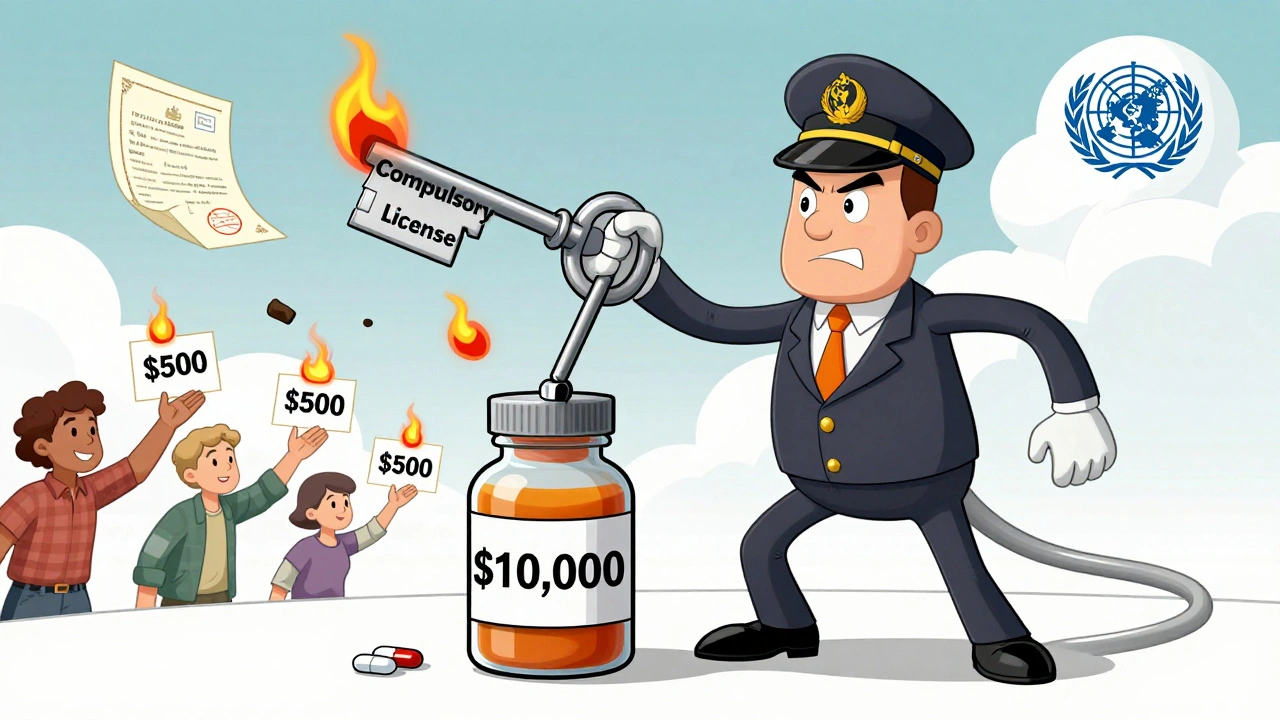
Compulsory licensing lets governments authorize generic production of patented drugs when public health is at risk. Used in India, Brazil, and during COVID-19, it balances patent rights with access to medicine - and it's fully legal under international law.
 Health and Wellness