
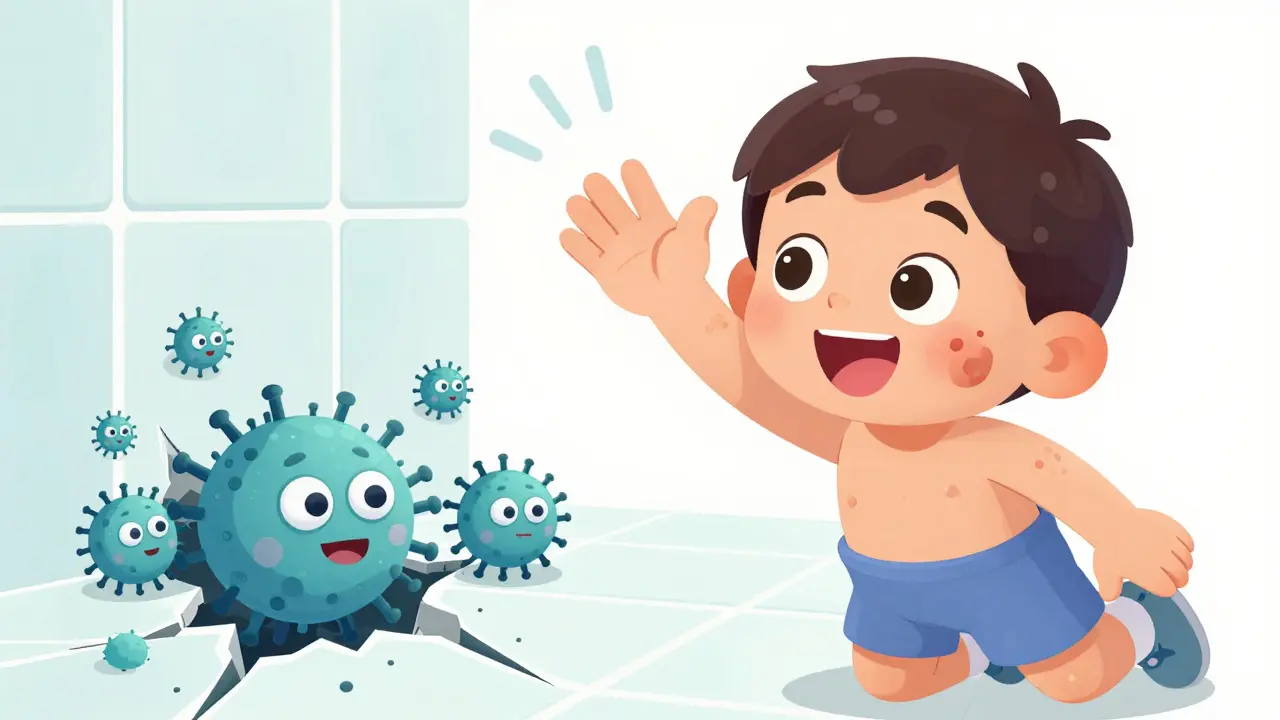
Warts aren’t just annoying-they can be painful, embarrassing, and stubborn. If you’ve ever looked at a rough bump on your hand or foot and wondered, “How did this even happen?”, you’re not alone. Viral warts are caused by the human papillomavirus (HPV), a group of more than 100 different strains. Not all HPV types are the same. Some cause genital warts, others cause warts on your fingers, and some just show up on your soles. The good news? Most go away on their own. The bad news? They can take years to disappear, and in the meantime, they spread.
What Causes Viral Warts?
HPV infects the top layer of your skin, usually through a tiny cut or scratch. You don’t need to be in a locker room or public shower to catch it-just touching a surface someone else with a wart touched can do it. Kids are more likely to get them because their immune systems haven’t learned to fight off these viruses yet. In Australia, up to 24% of children have warts. Adults? About 5% do. That’s millions of people, globally.
There are three main types you’re likely to see:
- Common warts (verruca vulgaris): Rough, raised bumps, often on fingers or hands. Caused by HPV types 1, 2, and 4.
- Plantar warts (verruca plantaris): Found on the soles of your feet. They grow inward because of pressure, so they look like a callus with black dots (tiny blood vessels). Caused by HPV types 1, 2, 4, 60, and 63.
- Flat warts (verruca plana): Smaller, smoother, and often show up in clusters on the face, arms, or legs. Linked to HPV types 3 and 10.
HPV doesn’t care about your age, hygiene, or how often you wash your hands. It just wants a foothold. And once it’s there, your skin starts growing abnormally-creating that bumpy, thickened patch you can’t ignore.
Do Warts Go Away on Their Own?
Yes. About 60 to 70% of viral warts disappear within two years without any treatment. That’s why some doctors suggest waiting it out, especially in kids. But waiting isn’t always practical. Warts hurt when they’re on your feet. They spread to other parts of your body-or to other people. And for many, the look of them is enough to make them want them gone.
Here’s the catch: even if a wart disappears, the virus might still be hiding under your skin. That’s why they come back. And if you keep scratching or picking at them, you can spread them to new spots. That’s called autoinoculation. It’s like planting seeds in your own skin.
Topical Treatments: What Actually Works?
Over-the-counter wart removers are everywhere. Salicylic acid is the most common-and the most studied. It’s in gels, pads, and liquids, with concentrations from 17% to 40%. The science is clear: if you use it right, it works. A 1976 study of over 1,800 patients found an 84% cure rate for plantar warts using daily salicylic acid.
How to use it properly:
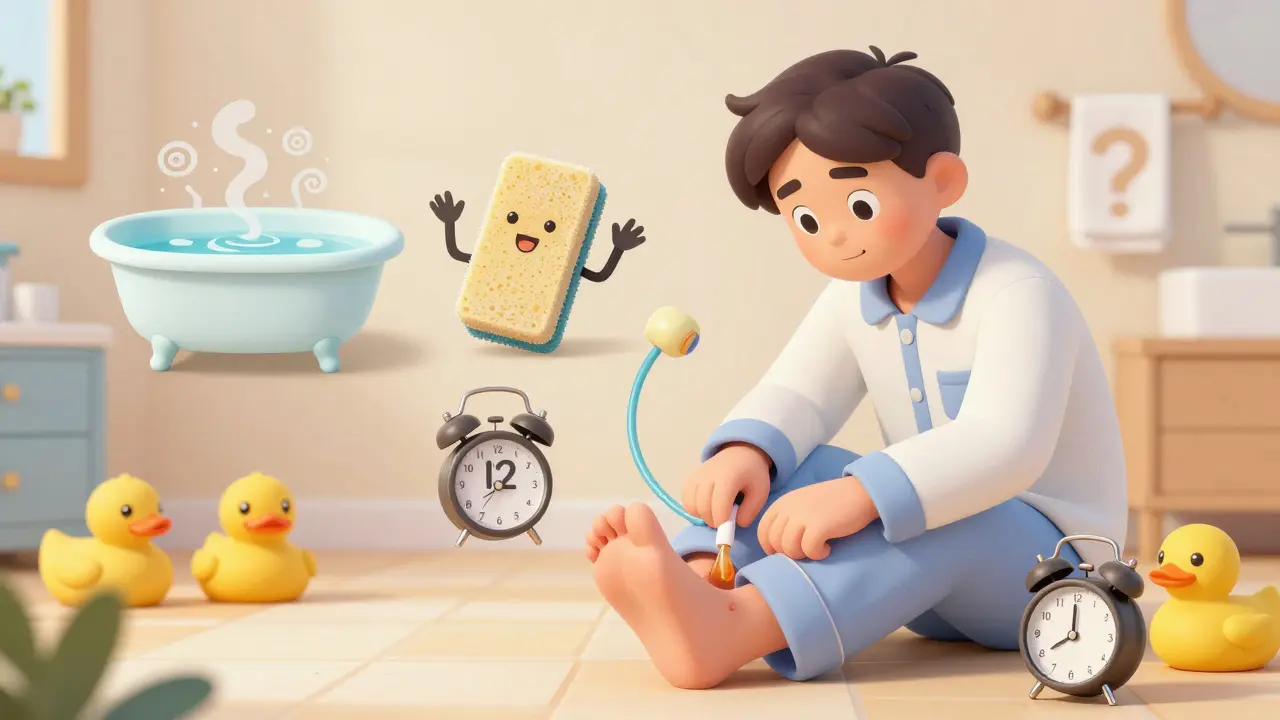
- Soak the wart in warm water for 10 minutes.
- Gently file away the dead skin with a pumice stone or emery board (use a new one each time-don’t reuse it).
- Apply the acid directly to the wart, avoiding healthy skin.
- Leave it on. Repeat daily.
It takes time. Six to twelve weeks. But if you stick with it, you’ll see results. No pain. No needles. Just patience.
Another option is trichloroacetic acid (TCA), sold as Tri-Chlor. This is stronger and usually applied by a dermatologist. It works by burning off the wart tissue. Before application, they’ll file the wart and sometimes prick it to let the acid sink in deeper. It stings. It can leave a scar. But it’s effective for stubborn warts on palms or soles.
Cryotherapy: Freezing Warts Off
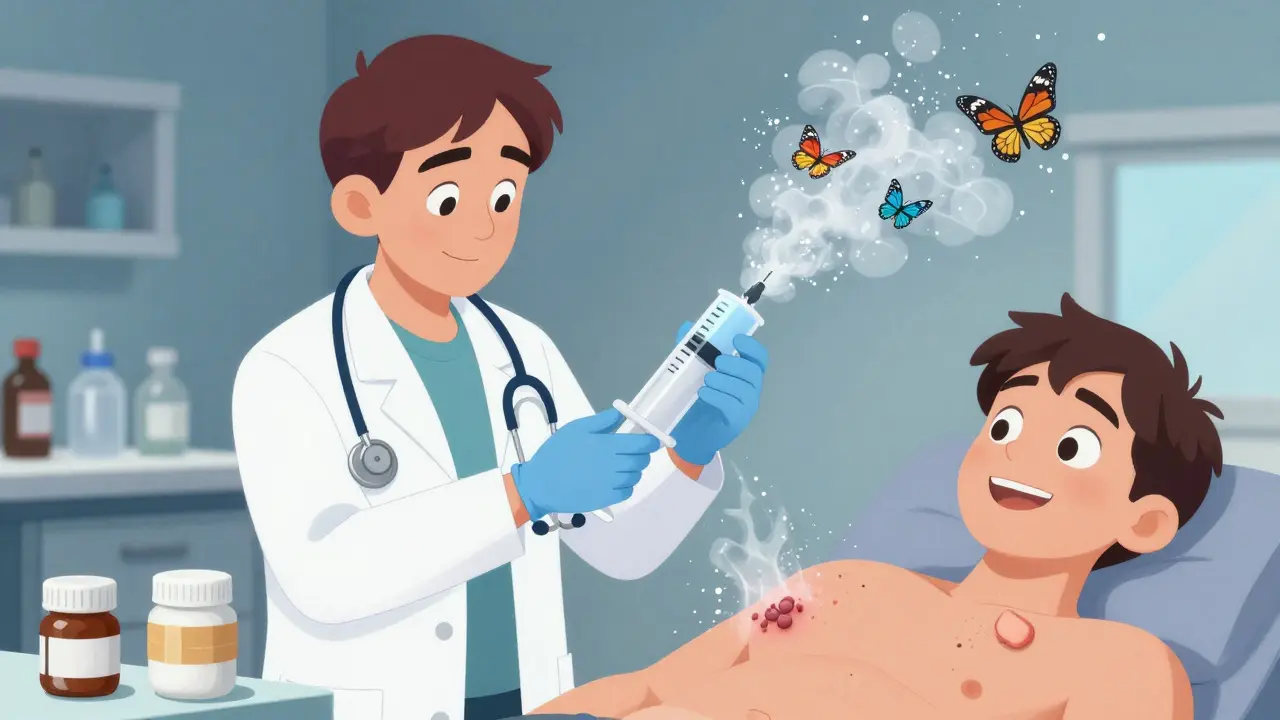
Cryotherapy-freezing with liquid nitrogen-is one of the most common in-office treatments. Dermatologists spray it directly onto the wart, freezing it to a depth of 2-3mm beyond the visible edge. The tissue dies, then falls off. It’s quick. It’s done in minutes.
A 2023 review of seven studies with nearly 1,000 patients found cryotherapy and salicylic acid had nearly identical success rates after 12 weeks. No big difference. But here’s the twist: timing matters.
The 1976 Bunney study showed something critical: if you wait too long between treatments, the cure rate drops. At 2-3 week intervals, 75% of hand warts cleared. At 4 weeks? Only 40%. Most people need 3-6 sessions. Each one hurts a little. You’ll feel a burning sensation, then numbness. A blister might form. It’s not fun-but it works.
Home cryotherapy kits exist. They’re weaker than what a doctor uses. Don’t expect miracles. If your wart hasn’t budged after a few tries, see a professional.
Immunotherapy and Other Advanced Options
When the usual methods fail, doctors turn to ways that wake up your immune system. Imiquimod cream (Aldara) is one. It’s not a wart killer-it’s a signal. It tells your body: “Hey, there’s a virus here. Go deal with it.”
It’s used for warts that won’t budge. Studies show it works even after cryotherapy and salicylic acid failed. But it takes weeks. And it causes redness, swelling, and itching. That’s not a side effect-it’s proof it’s working.
Other options include:
- Electrosurgery: A tiny electric needle burns the wart off. Usually done under local anesthetic. Leaves a small scar.
- Laser treatment: Pulse dye lasers (like VBeam) target the blood vessels feeding the wart. It turns purple or black, then sloughs off in 1-2 weeks. Used for stubborn cases, especially on the face.
- Antiviral creams: Cidofovir or acyclovir (Zovirax) are sometimes prescribed off-label. Not FDA-approved for warts, but used when other options run out.
Don’t expect surgery to be the answer. Cutting out a wart doesn’t remove the virus underneath. It often comes back, sometimes worse.
What Doesn’t Work (And Why)
There are dozens of treatments out there. Silver nitrate. Cantharidin. Zinc. Phenol. Formic acid. You’ll find them in alternative health blogs and YouTube videos. But here’s the truth: the Royal Australian College of General Practitioners reviewed 15 different therapies and found solid evidence for only two: salicylic acid and cryotherapy.
The rest? Anecdotes. Small studies. No randomised trials. That doesn’t mean they’re useless-but they’re not proven. And when you’re spending money and time, you want something that actually works.
Also, don’t believe the myth that duct tape suffocates warts. A few small studies suggested it might help, but later, larger reviews found no significant benefit over placebo.
Preventing Spread and Recurrence
Treating the wart is only half the battle. Stopping it from coming back-or spreading-is just as important.
- Don’t pick or scratch. Ever.
- Use separate towels, nail clippers, and pumice stones.
- Wear flip-flops in public showers and pools.
- Don’t share shoes or socks.
- Keep feet dry. Moisture helps HPV thrive.
- Wash hands after touching a wart.
Dr. William Warren Kwan, a dermatologist, says it plainly: “To attenuate transmission, hygienic practices need to be adopted in conjunction with any treatment.” That’s not a suggestion. It’s essential.
When to See a Doctor
You don’t need to rush to a dermatologist for every wart. But you should if:
- It’s painful or bleeding.
- It’s on your face or genitals.
- It’s growing quickly or changing color.
- You have diabetes or a weakened immune system.
- Home treatments haven’t worked after 12 weeks.
Also, if you’re not sure it’s a wart-see a doctor. Skin cancer can sometimes look like a wart. A dermatologist can tell the difference in seconds.
Final Thoughts
Viral warts are common. They’re annoying. And they’re not a sign of poor hygiene. They’re a sign that your skin got infected-and your immune system hasn’t kicked in yet.
Salicylic acid and cryotherapy are your best bets. Both have decades of evidence behind them. Both are affordable. Both require patience. No magic bullet. No overnight fix.
What works for one person might not work for another. That’s why treatment needs to be personal. Location matters. Skin type matters. Pain tolerance matters. And so does persistence.
Warts don’t define you. But how you handle them? That does. Stay consistent. Stay clean. And don’t give up.
 Health and Wellness
Chelsea Deflyss
February 7, 2026 AT 18:43so i got this wart on my thumb last year and i just kept ignoring it... until it started looking like a tiny cauliflower. gross. i tried salicylic acid for like 3 months and it did NOTHING. then i went to the dermatologist and they froze it. it hurt like hell but it’s GONE. why do people still try duct tape? lol. also, why is everyone so obsessed with ‘waiting it out’? my kid had 5 warts and they spread to his elbow. no thanks.
Andy Cortez
February 9, 2026 AT 18:38ok but let’s be real-doctors are just scared to admit they don’t know what the hell is going on with warts. they throw salicylic acid at you like it’s holy water. i tried it. i tried cryo. i tried putting apple cider vinegar on it with a bandaid like some internet guru said. nothing. then i read a study that said HPV can live on towels for WEEKS. so i burned all my towels. all of them. even my favorite one. worth it. now i use paper towels. and i don’t touch my face. ever. also, i think the real cure is just... letting your immune system win. which, for me, took 4 years. i’m 32. i’m not proud.
Jacob den Hollander
February 9, 2026 AT 19:28Hey, I just want to say how helpful this post is-seriously. I’ve been dealing with plantar warts since I was 12, and I’ve tried everything. I’m 41 now. I used salicylic acid for 14 weeks straight. Every night. Soaked. Filed. Applied. Didn’t miss a day. And yeah, it worked. No pain. No drama. Just consistency. I know it’s boring. But sometimes healing is just showing up. Also, I want to thank the person who mentioned autoinoculation-that was the lightbulb moment for me. I stopped picking. I stopped scratching. I started being gentle. And that’s when things changed. You’re not alone. It’s not your fault. It’s just a virus. And you’re doing better than you think.
Angie Datuin
February 11, 2026 AT 18:54My sister had a flat wart on her cheek for two years. She didn’t say anything. Just wore makeup. Finally went to a derm. Got it removed with laser. Now she’s got a tiny scar, but she smiles more. That’s the real win.
Camille Hall
February 13, 2026 AT 03:00For anyone reading this and feeling ashamed-please know that warts are one of the most common skin conditions out there. They’re not ugly. They’re not a reflection of your hygiene. They’re just viruses being stubborn. I’ve had them on my hands, my knees, even my eyelid (yes, really). I used to hide my hands in public. Now I just say, ‘Yep, HPV. It’s a thing.’ And people laugh. Then they say, ‘Oh, I had one too.’ We’re all in this weird little club. And we’re all doing fine.
Monica Warnick
February 14, 2026 AT 12:42So I tried cryotherapy and it didn’t work. So I tried imiquimod. It made my skin look like a sunburn from hell. I cried. I screamed. I Googled ‘is this normal?’ 17 times. Then I tried tea tree oil. And guess what? It vanished. Like, overnight. I’m not saying it works for everyone. But I’m saying: don’t let the ‘evidence’ silence your experience. Sometimes the internet knows better than the textbooks. Also, I think my cat licked it. Maybe cats have healing powers?
Ashlyn Ellison
February 15, 2026 AT 16:08Salicylic acid works. But only if you do it right. Soak. File. Apply. Repeat. No shortcuts. I did it for 11 weeks. My wart looked like a crater. Then it fell off. I cried. It was weirdly emotional. I didn’t realize how much I hated it.
Frank Baumann
February 17, 2026 AT 01:39Okay, I’m gonna go off here for a second. I had 17 warts on my foot. 17. I went to three different dermatologists. Two said ‘wait.’ One said ‘cut it out.’ I said no. I did the whole regimen: warm soak, pumice stone, salicylic acid, then TCA, then cryo. I did it all. I lost sleep. I stopped wearing sandals. I stopped going to the gym. I stopped dating. I thought I was the only one. Then I found a Reddit thread. And I realized: no. I’m not alone. And I’m not broken. I’m just infected. And now? I’m healed. And I’m telling you this so you don’t waste a year like I did. You can do this. You’re not weak. You’re just human.
Tricia O'Sullivan
February 18, 2026 AT 18:25Thank you for this meticulously detailed and clinically accurate overview. I have been a general practitioner in Dublin for over two decades, and I can confirm that the evidence-based approach you’ve outlined aligns precisely with current international guidelines. I particularly appreciate the emphasis on hygiene and the debunking of anecdotal remedies. I shall be sharing this with my patients. Well done.