
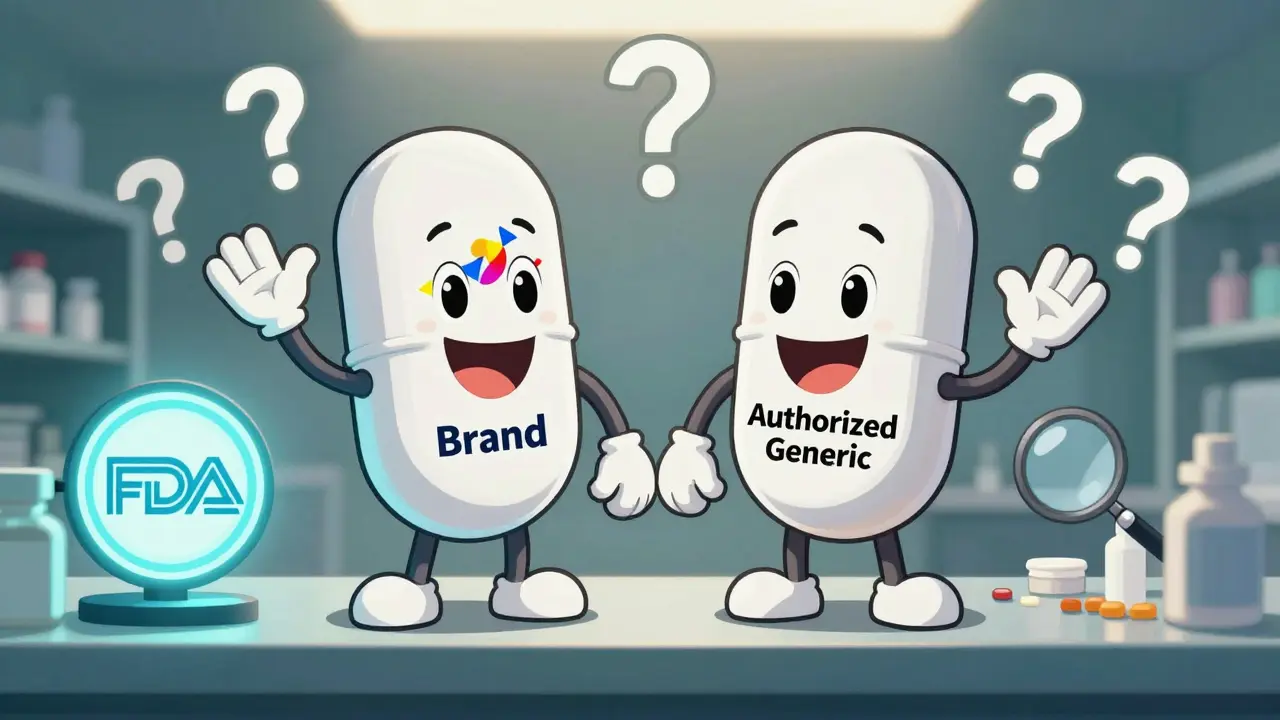
When you fill a prescription for a brand-name drug and get a pill that looks completely different-maybe a different color, shape, or even just a plain white tablet-you might wonder: is this really the same thing? Especially if you’ve been on the same medication for years and your doctor suddenly switches you to a generic. The answer isn’t always simple. But there’s one type of generic that’s often overlooked: the authorized generic.
What exactly is an authorized generic?
An authorized generic is the exact same drug as the brand-name version, just sold without the brand name on the label. It’s made by the same company that makes the original brand, in the same factory, using the same ingredients, the same process, and the same quality controls. The only difference? No logo. No fancy packaging. Sometimes, even the pill looks nearly identical to the brand version because it’s the same batch of medicine. The U.S. Food and Drug Administration (FDA) says it plainly: "It is the exact same drug product as the branded product." That’s not marketing speak. That’s regulatory language. Authorized generics aren’t copies. They’re the original product, rebranded under a different name to compete with other generics.How are they different from regular generics?
Regular generics-also called typical generics-must prove they’re bioequivalent to the brand drug. That means they deliver the same amount of active ingredient into your bloodstream at a similar rate. But they’re allowed to have different fillers, dyes, or binders. That’s why your generic pill might be blue instead of yellow, or oval instead of round. Authorized generics don’t need to prove bioequivalence. Why? Because they’re not a different product. They’re the brand drug with a different label. They use the exact same inactive ingredients. No changes. No substitutions. If your brand drug has cornstarch as a filler, so does the authorized generic. If the brand uses a specific dye, the authorized generic uses the same dye. This matters more than you might think. For some people-especially those with allergies, sensitivities, or conditions like epilepsy or thyroid disease-those tiny differences in inactive ingredients can cause problems. A study in 2018 followed over 5,000 patients who switched from brand drugs to generics. Those who got authorized generics had the same rates of hospital visits, emergency room trips, and medication discontinuation as those who stayed on the brand. The same wasn’t always true for typical generics, especially in narrow therapeutic index drugs where small changes can have big effects.Why aren’t they listed in the FDA’s Orange Book?
The FDA’s Orange Book is the go-to reference for pharmacists to know which generics are considered therapeutically equivalent to brand drugs. But here’s the twist: authorized generics aren’t in it. That’s not because they’re not equivalent. It’s because they’re not approved under the same process. Regular generics go through the Abbreviated New Drug Application (ANDA) pathway. Authorized generics are approved under the original brand’s New Drug Application (NDA). They’re not new products-they’re the same product under a different label. So they don’t get listed in the Orange Book. That can confuse pharmacists, patients, and even doctors. If you ask your pharmacist if your medication is a generic, they might say yes. But if you ask if it’s an authorized generic, they might not know unless they check the National Drug Code (NDC). That’s why clear communication matters. If you’re switching from a brand to a generic and you’re worried about changes, ask: "Is this an authorized generic?"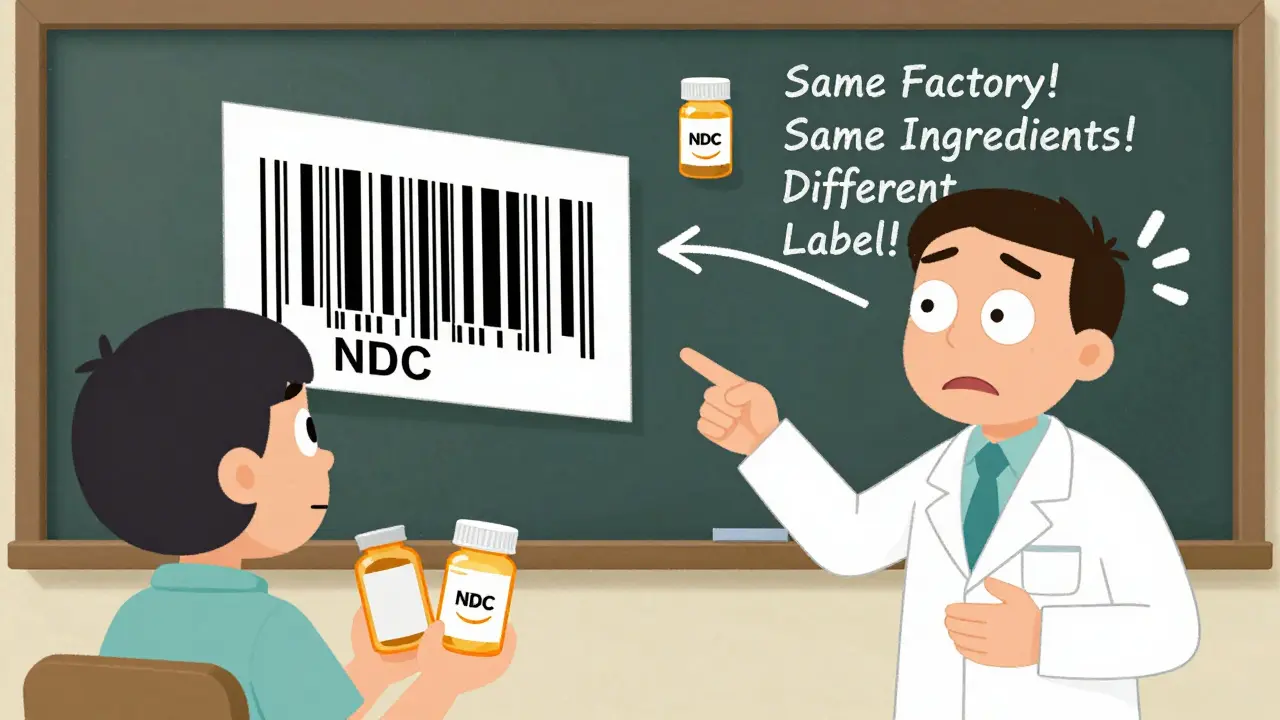
Are they cheaper than brand drugs?
Yes. Usually. But not always cheaper than regular generics. Authorized generics are typically priced lower than the brand-name version-often by 20% to 40%. But because they’re made by the same company, they’re sometimes priced higher than regular generics, which are made by separate manufacturers competing on price. You might see a regular generic for $5 and an authorized generic for $12, even though they’re chemically identical. Why? Because the brand company is still making money off the same drug. They’re not trying to undercut themselves-they’re trying to keep customers from switching to a competitor’s generic. It’s a business move, not a medical one. But for patients, it means the authorized generic might not always be the cheapest option.Do doctors and pharmacists recommend them?
Yes, especially when patients have had bad experiences with typical generics. Dr. Janet Woodcock, former director of the FDA’s drug center, said authorized generics give patients "the same therapeutic effect as the brand-name product." The American Managed Care Pharmacy (AMCP) backs this up, saying generic drugs-authorized or not-are expected to have the same clinical results and safety profile. In practice, many pharmacists will offer authorized generics when a patient says, "I’ve tried generics before and they didn’t work for me." It’s not that the generic failed. It’s that the inactive ingredients might have caused side effects-like nausea, dizziness, or even changes in mood. With an authorized generic, those risks drop dramatically because the formulation hasn’t changed.What about safety and quality?
The FDA inspects the same factories that make brand-name drugs for authorized generics. The same batch records. The same quality checks. The same standards. There’s no second-tier manufacturing. If a brand drug has to meet 99.9% purity, so does the authorized generic. The FDA also tracks side effects from both brand and generic drugs. If there’s a pattern of problems, they investigate. That applies to authorized generics too. In fact, because they’re made by the brand company, there’s often more consistency in quality control. One concern some experts raise is about batch variation in drugs with narrow therapeutic indexes-like warfarin, levothyroxine, or certain seizure medications. But the FDA requires all batches, whether branded or authorized generic, to stay within strict limits. The difference in absorption between brand and generic drugs, according to FDA studies, is usually less than 3.5%. That’s well within safe limits.
Who benefits most from authorized generics?
Three groups, mostly:- Patients with sensitivities: If you’ve had stomach upset, rashes, or headaches after switching to a regular generic, an authorized generic might be the fix.
- People on chronic medications: If you’ve been on the same drug for years and don’t want to risk any change-even a tiny one-an authorized generic gives you peace of mind.
- Those on expensive drugs: For drugs like asthma inhalers, insulin, or biologics, even a 30% discount can make a big difference in out-of-pocket costs.
What should you do if you’re switching?
Don’t assume all generics are the same. If your prescription changes and you’re unsure:- Ask your pharmacist: "Is this an authorized generic?"
- Check the label: Authorized generics won’t have the brand name, but they might list the manufacturer’s name-often the same as the brand.
- Look up the NDC code: You can search it on the FDA’s website or ask your pharmacist to explain the difference.
- Monitor how you feel: If you notice new side effects, call your doctor. It might not be the drug-it might be the filler.
Are authorized generics the future?
They’re growing. In 2023, about 5-7% of all generic prescriptions in the U.S. were authorized generics, mostly for high-cost, high-need medications. The FDA is pushing for more transparency, and some insurers are starting to prefer them in formularies because they reduce patient confusion and improve adherence. But they’re not a magic bullet. They’re still a business tool for brand companies. And they’re not always the cheapest option. But if you care about consistency, safety, and knowing you’re getting the exact same medicine you’ve always taken-they’re the closest thing to the brand without the brand price tag.Are authorized generics as safe as brand-name drugs?
Yes. Authorized generics are made by the same company, in the same facility, with the same ingredients and quality controls as the brand-name drug. The FDA holds them to the exact same standards. There’s no difference in safety, effectiveness, or manufacturing quality.
Why do authorized generics cost more than regular generics?
Because they’re made by the brand company, not a competing generic manufacturer. The brand company doesn’t need to undercut itself to win market share-they’re just offering the same product under a different label. Regular generics are often cheaper because multiple companies compete to produce them at the lowest price.
Can I trust an authorized generic if I’ve had bad reactions to other generics?
Yes. If your reaction was caused by inactive ingredients like dyes, fillers, or preservatives, an authorized generic is your best option. Since it uses the exact same formula as the brand, those ingredients won’t change. Many patients who had issues with regular generics report no problems after switching to authorized generics.
Are authorized generics listed in the FDA’s Orange Book?
No. Authorized generics are approved under the brand’s New Drug Application (NDA), not the Abbreviated New Drug Application (ANDA) used for regular generics. Because of this, they don’t appear in the Orange Book, which only lists ANDA-approved generics. This doesn’t mean they’re not equivalent-it’s just a regulatory quirk.
How do I know if I’m getting an authorized generic?
Ask your pharmacist. They can check the National Drug Code (NDC) on the bottle or box. Authorized generics won’t have the brand name on the label, but the manufacturer’s name may match the original brand. You can also look up the NDC on the FDA’s website to confirm the manufacturer.
 Health and Wellness
Juan Reibelo
January 23, 2026 AT 16:06So, authorized generics are literally the same pill, just without the brand logo? That’s wild. I’ve switched generics so many times, I’ve lost track of which one I’m on. But if it’s the same factory, same batch, same everything… why don’t more people know this? I’m telling my pharmacist next time I get a script.
Also, why is this not on the Orange Book? That’s just bureaucratic chaos. Someone’s getting paid to make this confusing.
Kat Peterson
January 24, 2026 AT 03:11OMG I KNEW IT 😭 I switched to a generic for my thyroid med and I felt like I was slowly turning into a zombie. Then I asked my pharmacist and they were like, ‘It’s just a regular generic.’ I was like, ‘BUT I NEED THE REAL ONE.’ Turns out, my doc didn’t even know about authorized generics. I’m switching back. My brain is worth $12 a month. 🙃
Himanshu Singh
January 24, 2026 AT 07:30This is one of those things that feels like a secret society of people who actually care about their health. We’re taught generics = cheaper = good. But what if ‘good’ isn’t the same as ‘identical’? The body doesn’t care about marketing. It cares about consistency. If you’ve been stable on a brand for years, why risk a change in fillers that might trigger a cascade? This isn’t about being picky-it’s about respecting how fragile some systems are.
Also, props to the FDA for being honest even when it doesn’t make the paperwork neat.
Jamie Hooper
January 25, 2026 AT 13:04so like… the brand company just makes the same drug and sells it as a generic to stop other generics from taking over?? that’s so sneaky lmao
like yeah it’s the same pill but now they’re charging more than the real generics?? what even is capitalism??
also why does no one talk about this?? i’ve been taking this med for 7 years and i had no idea
Husain Atther
January 26, 2026 AT 06:33This is a thoughtful and well-documented overview of a critical but under-discussed issue in pharmaceutical access. The distinction between authorized generics and standard generics is not merely regulatory-it is clinically significant for vulnerable populations. The FDA’s oversight mechanisms remain robust, and the lack of Orange Book listing is a documentation gap, not a safety gap. Patients deserve clarity, and pharmacists need better training on NDC verification. This should be standard curriculum in pharmacy schools.
Helen Leite
January 27, 2026 AT 15:59THEY’RE LYING TO US. I SWEAR. I read this and now I’m convinced the pharmaceutical companies are secretly controlling our brains through the fillers. That dye? It’s a tracking chip. The cornstarch? It’s laced with microchips to make us docile. Why else would they hide this?? They don’t want us to know we’re being manipulated. I’m switching to organic herbal tea now. 🌿👁️🗨️
Izzy Hadala
January 28, 2026 AT 15:24The regulatory distinction between NDA-approved authorized generics and ANDA-approved generics is functionally meaningful in terms of bioequivalence validation, yet clinically negligible in most cases. However, for drugs with narrow therapeutic indices, the absence of formulation variability in authorized generics may reduce inter-patient pharmacokinetic variance. This is supported by the 2018 cohort study referenced, which demonstrated statistically non-inferior outcomes in discontinuation and adverse event rates. The omission from the Orange Book is a consequence of approval pathway taxonomy, not therapeutic equivalence. A clarification in labeling protocols would mitigate pharmacist and patient confusion.
Marlon Mentolaroc
January 29, 2026 AT 12:49Let’s be real - this whole thing is just Big Pharma’s way of saying, ‘Hey, we’re not evil, we’re just… slightly less evil.’ They make the same drug, slap a new label on it, and charge $12 instead of $5. Meanwhile, the real generic makers are trying to survive. And we’re supposed to be grateful because ‘it’s the same pill’? Nah. It’s the same pill they’re monetizing twice. And don’t get me started on how pharmacists don’t even know the difference. This isn’t healthcare. It’s a puzzle designed by accountants.
Gina Beard
January 30, 2026 AT 21:01Consistency is comfort.
Comfort is safety.
And safety is rare in medicine.
Don Foster
February 1, 2026 AT 08:49Everyone’s overcomplicating this. It’s the same damn pill. The FDA says so. The manufacturer says so. The batch number matches. If you can’t tell the difference between cornstarch and tapioca starch then maybe you shouldn’t be taking pills at all. This isn’t wine. It’s medicine. Stop being dramatic. Also the Orange Book doesn’t list everything. You think they list every single generic? Please. You’re reading too much into this.
siva lingam
February 1, 2026 AT 20:34so you paid 40% more for the same pill because you wanted the brand logo gone but the same factory? wow. genius. next time just ask for the brand and get it over with. or better yet - just take the $5 generic and stop whining about fillers. your body is not a lab rat.
Shanta Blank
February 1, 2026 AT 21:35I had a full-blown panic attack after switching to a generic for my seizure med. Not because the drug didn’t work - because I felt like I was losing myself. Like my thoughts were foggy and my hands wouldn’t stop shaking. Then I found out it was the dye. The authorized generic? Back to normal. Like my brain came back online. I didn’t know this was a thing until I almost lost my job because I couldn’t focus. This isn’t just about pills. It’s about identity. If your medicine changes who you are - even a little - you deserve to know what’s in it.
Chloe Hadland
February 1, 2026 AT 22:36Thank you for writing this. I’ve been too scared to ask my pharmacist anything because I feel like they think I’m being difficult. But now I know to ask: ‘Is this an authorized generic?’ I’ve been on the same med for 12 years and I don’t want to risk anything. I’m printing this out and bringing it to my next appointment. You made me feel less alone.
Amelia Williams
February 3, 2026 AT 13:36This changed everything for me. I thought generics were all the same. I had no idea there was a version that was literally the exact same thing. I’m going to ask my doctor to write ‘authorized generic only’ on my prescription. No more guessing. No more side effects. Just peace of mind. And honestly? If it costs a few bucks more, I’ll pay it. My mental health is worth it. Thank you for sharing this knowledge - it’s not just information, it’s a lifeline.