
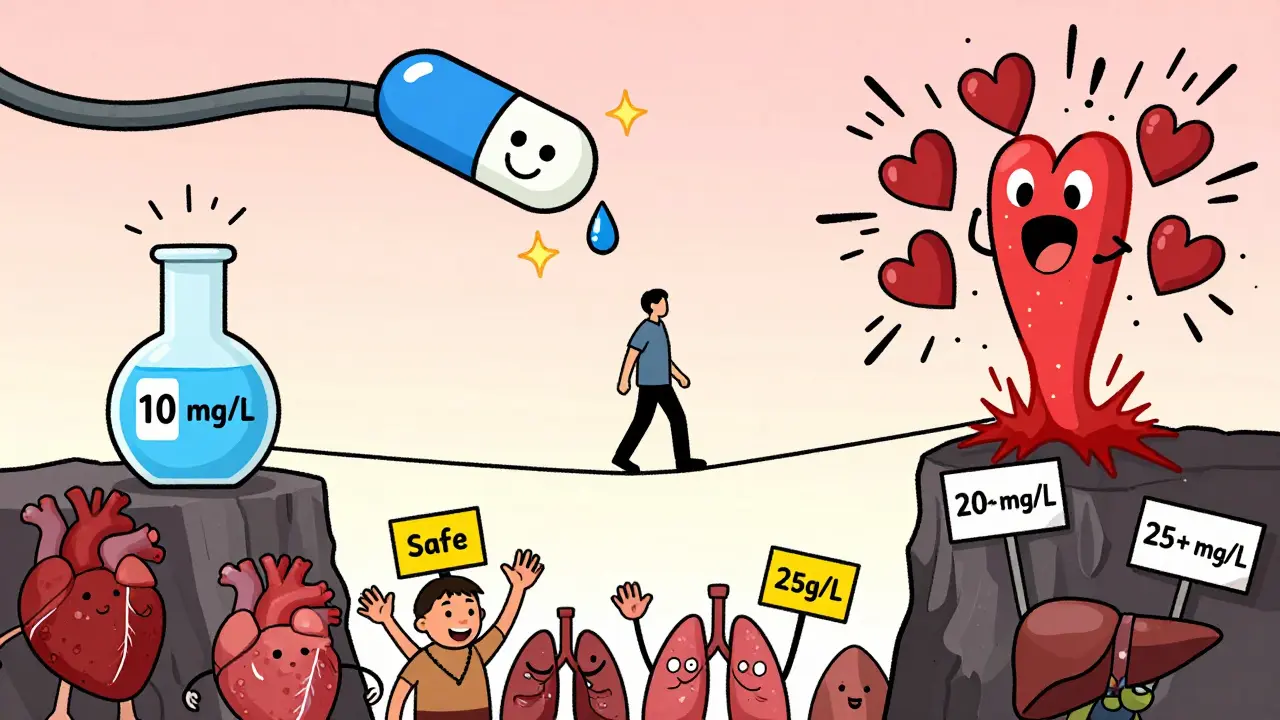
When you take theophylline for asthma or COPD, you’re not just swallowing a pill-you’re walking a tightrope. One milligram too much, and your heart could start racing. One milligram too little, and your lungs might not get the relief they need. That’s because theophylline has a narrow therapeutic index-a tiny window between working and causing harm. And if you’re not monitoring it closely, you’re gambling with your health.
What Makes Theophylline So Dangerous?
Theophylline has been used for over 80 years to open up airways in people with asthma and COPD. It works by relaxing the muscles around the lungs and reducing inflammation. But here’s the catch: the difference between a dose that helps and one that harms is razor-thin. The safe, effective range? Between 10 and 20 mg/L. Go below 10, and it barely works. Rise above 20, and you risk seizures, irregular heartbeats, vomiting, or worse. Above 25 mg/L? That’s a medical emergency.
Why does this happen? Because theophylline doesn’t follow simple rules. Your body doesn’t process it like most drugs. At higher doses, its metabolism slows down and becomes unpredictable. A small increase in your daily dose can cause your blood level to jump by 50% or more. This is called zero-order kinetics-essentially, your liver gets overwhelmed. And that’s just the start.
Your Body Isn’t Like Everyone Else’s
Two people taking the same dose of theophylline can have wildly different blood levels. Why? Because so many factors change how your body handles it.
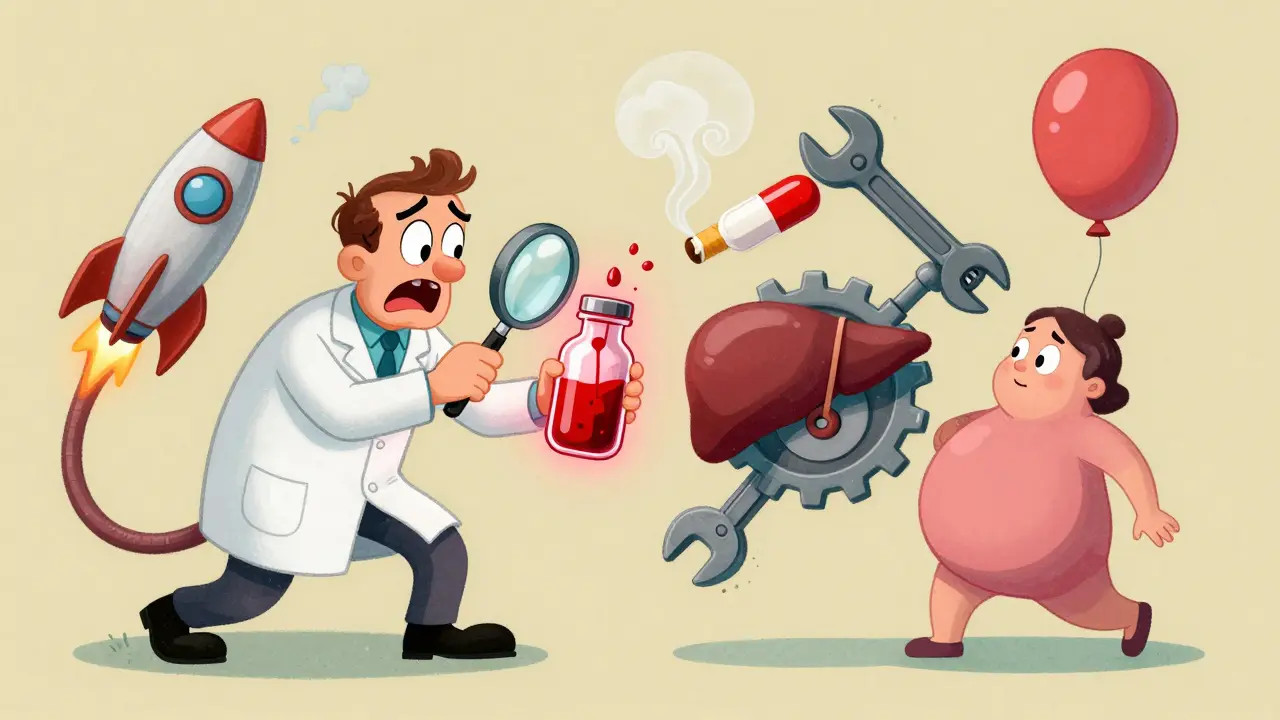
- Smoking? Your body clears theophylline 50-70% faster. You might need a higher dose-but if you quit, your levels can spike dangerously without warning.
- Drinking alcohol? It can drop your levels, making the drug less effective.
- Age over 60? Liver function slows. Clearance drops. Doses must be lowered.
- Heart failure or liver disease? Clearance can drop by half or more.
- Pregnancy? In the third trimester, your body clears the drug 30-50% faster. Levels can crash, putting both you and your baby at risk.
And then there are the drugs you take alongside it. Antibiotics like erythromycin or clarithromycin can boost theophylline levels by 50-100%. Cimetidine, a common heartburn pill, does the same. Meanwhile, drugs like carbamazepine or St. John’s Wort can slash levels by 30-60%. One new prescription-or a change in your supplements-can turn a stable patient into a patient in crisis.
When and How Often Should You Be Tested?
Monitoring isn’t optional. It’s mandatory. But timing matters.
For immediate-release tablets, blood should be drawn right before your next dose-this is called the trough level. For slow-release forms, samples are taken 4 to 6 hours after taking the pill. Why? Because levels peak and drop differently depending on the formulation.
Here’s the standard schedule:
- Start testing 5 days after beginning treatment-or 3 days after a dose change. That’s how long it takes for levels to stabilize.
- If you’re stable? Check every 6-12 months.
- Over 60? Monitor every 3-6 months.
- Heart failure or liver problems? Every 1-3 months.
- Pregnant? Monthly during the second and third trimesters.
And if you start a new medication, stop smoking, or feel symptoms like tremors, nausea, or a racing heart? Get tested right away. Don’t wait.
What Happens If You Skip Monitoring?
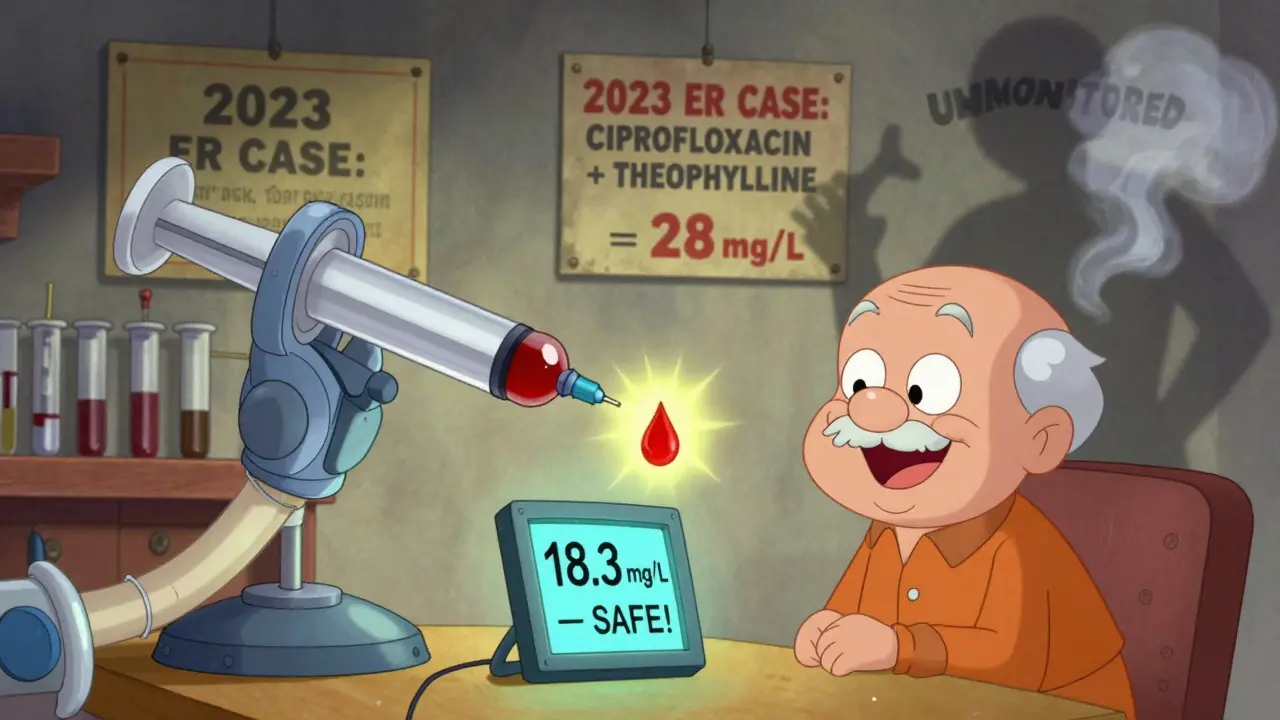
In 2023, a 68-year-old man in Brisbane was admitted to the ER with life-threatening ventricular tachycardia. His theophylline level? 28 mg/L. He’d been on the drug for years. Then his doctor prescribed ciprofloxacin for a sinus infection. Ciprofloxacin blocks the enzyme that breaks down theophylline. Within 72 hours, his levels jumped 65%. He didn’t know. No one tested him. He almost died.
This isn’t rare. Studies show that 15% of theophylline-related hospital visits happen because doctors didn’t adjust doses for liver problems. Another 22% are from unmonitored antibiotic interactions. In one U.S. study, a hospital that started routine theophylline monitoring cut adverse events by 78% and improved asthma control by 35% in just 18 months.
And the problem is getting worse. Between 2020 and 2023, theophylline toxicity cases reported to U.S. poison control centers rose 23% each year. Most victims were elderly, with undiagnosed liver or kidney issues. They weren’t being monitored. They didn’t know the risks.
Beyond Blood Levels: What Else Should Be Checked?
It’s not just about theophylline numbers. You need a full picture.
- Heart rate: Over 100 bpm? That’s a red flag.
- Electrolytes: Low potassium? Common if you’re also on steroids or diuretics. This can make arrhythmias worse.
- Respiratory rate: Is breathing getting harder? Or easier?
- Neurological signs: Headache, insomnia, irritability? These can precede seizures.
- Full blood count: Rare, but theophylline can suppress bone marrow over time.
If you’re getting IV theophylline, the line must be separate from dextrose solutions. Mixing them can cause clumping or even hemolysis. This isn’t a theoretical risk-it’s happened.
Why Do We Still Use Theophylline?
With all these risks, why not just stop using it? Because it still works-especially when other drugs fail.
For people with severe asthma who don’t respond to high-dose inhalers, theophylline adds a powerful anti-inflammatory effect. It helps restore HDAC2, a protein that calms lung inflammation. In low-income countries, it’s one of the few affordable options: a month’s supply costs $15-$30. Compare that to biologic therapies that run $200-$400 a month.
But here’s the truth: it’s not about whether the drug is outdated. It’s about whether you’re managing it right. The European Respiratory Society says it clearly: all theophylline therapy needs monitoring, no matter the dose. Even 200 mg a day isn’t safe without checks.
The Future: Faster Tests, But Still No Shortcuts
Three companies are now testing handheld devices that can measure theophylline levels in under five minutes using a finger-prick sample. If they work, they could change everything-especially for elderly patients who struggle with clinic visits.
But until those devices are approved and widely available, the gold standard remains the same: a lab test. The American College of Chest Physicians says so in their 2024 guidelines. No exceptions. No shortcuts.
There’s no magic here. No quick fix. Just one simple rule: if you’re on theophylline, you need regular blood tests. Not because you’re being difficult. Not because your doctor doesn’t trust you. But because the drug doesn’t care how you feel. It only cares about what’s in your blood.
Ignore the numbers, and you ignore the risk. Monitor them, and you unlock the drug’s real power-without the danger.
How often should theophylline levels be checked?
For most patients, check levels 5 days after starting treatment or 3 days after a dose change. Once stable, monitor every 6-12 months. Higher-risk patients-those over 60, with heart or liver disease, or pregnant-need checks every 1-6 months. Always test after starting or stopping other medications, changing smoking habits, or if symptoms of toxicity appear.
What happens if theophylline levels go too high?
Levels above 20 mg/L increase the risk of side effects. Between 20-25 mg/L, you may experience nausea, vomiting, tremors, or a fast heartbeat. Above 25 mg/L, serious risks kick in: seizures, irregular heart rhythms (like ventricular tachycardia), and even cardiac arrest. Levels over 30 mg/L are often fatal without emergency treatment.
Can I skip blood tests if I feel fine?
No. Theophylline toxicity doesn’t always cause obvious symptoms until it’s too late. Many patients feel fine even as their levels climb into the dangerous range. A 2022 study found that 40% of patients with toxic levels reported no symptoms before hospitalization. Blood tests are the only reliable way to know if your dose is safe.
Which medications interact with theophylline?
Many common drugs affect theophylline. Antibiotics like erythromycin, clarithromycin, and ciprofloxacin can raise levels by 50-100%. Heartburn meds like cimetidine and antifungals like fluconazole do the same. On the flip side, seizure drugs like carbamazepine, tuberculosis drugs like rifampicin, and herbal supplements like St. John’s Wort can lower levels by 30-60%. Always tell your doctor what you’re taking.
Is theophylline still used today?
Yes, but only in specific cases. It’s typically used as a third-line treatment for severe asthma or COPD when inhalers aren’t enough. It’s also common in low-resource settings because it’s cheap. Around 1.2 million people in the U.S. and 850,000 in Europe still use it. But it’s never used without monitoring-its risks demand it.
 Health and Wellness
Shalini Gautam
February 21, 2026 AT 12:55Theophylline is one of those old-school drugs that still packs a punch if you know how to handle it. I’ve seen patients in India go from gasping for air to breathing easy on this stuff-no fancy inhalers, no $400 biologics. Just a cheap pill and a blood test. Simple? Yes. Safe? Only if you’re paying attention.
Smokers? They need more. Elderly? Less. Add antibiotics? Watch out. It’s not rocket science-it’s basic pharmacology. But somehow, doctors forget. Maybe because it’s old, maybe because it’s cheap. But that doesn’t make it any less dangerous.
And yet, we still use it. Because when everything else fails, theophylline doesn’t quit. It’s the last soldier standing in the war for breath.
Erin Pinheiro
February 21, 2026 AT 21:31ok so i just read this whole thing and like?? i think we need to ban theophylline?? like i get it its cheap but like what if your liver is just kinda tired?? and your doc forgets to check?? and then you start having seizures?? like why is this still a thing??
also i think the fact that smoking changes everything is wild?? like if you quit smoking you might die?? that’s not a feature, that’s a bug!!
also why is no one talking about the fact that st john’s wort is basically a silent killer here??
Brandice Valentino
February 23, 2026 AT 12:04Look, I’m not a doctor, but I did stay at a Holiday Inn Express last night-and I’m pretty sure theophylline is just a glorified placebo with a side of cardiac arrest.
Modern medicine has biologics, inhalers, AI-driven dosing algorithms, and yet we’re still relying on a 1940s drug that requires a PhD in pharmacokinetics just to not die?
And don’t even get me started on cimetidine. Who even still takes that? It’s like prescribing a typewriter in 2024. If your doctor prescribed this without a full metabolic panel and a signed waiver, they’re not a physician-they’re a risk-taker with a medical license.
Larry Zerpa
February 24, 2026 AT 02:38Let’s be clear: theophylline isn’t dangerous because of its pharmacology. It’s dangerous because of systemic medical negligence. The fact that this drug requires monitoring isn’t a flaw in the drug-it’s a flaw in the entire healthcare infrastructure.
Doctors don’t monitor because they’re overworked. Labs don’t prioritize it because it’s low-revenue. Patients don’t know because they’re not educated. And yet, we keep prescribing it like it’s aspirin.
Also, the claim that ‘it’s still used because it’s cheap’ is a moral failure. We live in a world where $400/month biologics are normalized, but $15/month life-saving drugs are treated like relics. That’s not economics. That’s hypocrisy.
Gwen Vincent
February 24, 2026 AT 10:38I appreciate how thorough this post is. It’s rare to see something so well-researched on a drug that’s often dismissed.
I work in a rural clinic, and we still use theophylline for a few patients who can’t afford inhalers. We do monthly checks, and yes, it’s a hassle-but it’s worth it. One woman, 72, stopped having nighttime wheezing after we adjusted her dose based on a lab result. She said it felt like she could breathe again for the first time in years.
It’s not glamorous. But sometimes, medicine isn’t about the newest tech. It’s about doing the boring thing right.
Nandini Wagh
February 24, 2026 AT 17:39Wow. So we’re still using a drug that’s basically a Russian roulette pill? Congrats, medicine. You’ve outdone yourself.
Also, ‘theophylline doesn’t care how you feel’? Nah. It cares. It just doesn’t care enough to warn you before it murders you. That’s not science. That’s a horror movie plot.
Holley T
February 24, 2026 AT 22:33I’ve been on theophylline for 12 years. I’m 54, non-smoker, no liver issues. I take 300mg daily. My levels have been stable at 14.5 for years.
But here’s the thing: I’ve had three different doctors in that time. Two of them didn’t know what a trough level was. One thought ‘theophylline’ was a type of antidepressant.
So yes, monitoring is critical. But the real problem? The system doesn’t care. I had to beg for my last test. My insurance denied it. I paid $85 out of pocket. That’s not healthcare. That’s a scavenger hunt for survival.
And now? I have to remind my new doctor every time I see him. I’m tired. I shouldn’t have to be my own advocate just to not die from a $0.50 pill.
Ashley Johnson
February 25, 2026 AT 21:24Did you know the FDA knew about theophylline risks in 1982? They issued a black box warning. But the pharmaceutical companies? They didn’t want to admit it. Too many profits. Too many patients. So they buried it.
And now? They’re pushing handheld devices to ‘solve’ the problem. But what they really want is to sell you $200 finger-prick tests every month.
It’s not about safety. It’s about control. They don’t want you to know how dangerous it is. They want you to think it’s ‘just a pill’-so you’ll keep taking it.
And your doctor? They’re probably on a kickback from the lab. Just saying.
Check your blood. But also check your trust.
tia novialiswati
February 27, 2026 AT 13:47Yesss!! This is so important!! 💪❤️
I’m a nurse in a pulmonary clinic, and I’ve seen so many people panic because they felt ‘fine’ and skipped their test-only to end up in the ER with a heart rate of 160.
Just a little reminder: your body doesn’t lie. But it also doesn’t scream. It whispers. And if you’re not listening? It stops breathing.
Keep checking. Keep caring. You’re not being paranoid-you’re being smart. 💙
Valerie Letourneau
February 27, 2026 AT 20:38While the pharmacological rationale for theophylline monitoring is unequivocally sound, one cannot overlook the broader socioeconomic context in which its use persists. In nations with limited healthcare infrastructure, this agent remains a vital therapeutic option-not due to its safety profile, but due to its accessibility.
It is both a triumph and a tragedy: a life-saving intervention rendered perilous by the very systems meant to safeguard it. The imperative for structured, standardized, and universally accessible monitoring protocols is not merely clinical-it is ethical.
Khaya Street
March 1, 2026 AT 12:30Look, I’m not against theophylline. But why are we still talking about this like it’s 1995? We’ve got wearable monitors, AI dose calculators, even apps that track drug interactions. Why are we still relying on blood draws every six months?
It’s lazy. And frankly, it’s disrespectful to patients. If you’re going to prescribe a drug this finicky, at least give us a smart alert system. Not a piece of paper with a date scribbled on it.
Lou Suito
March 2, 2026 AT 20:44Let’s cut through the noise: theophylline isn’t dangerous. It’s misunderstood. The problem isn’t the drug. It’s the lack of standardization. No one agrees on when to test. No one agrees on what ‘stable’ means. No one agrees on how to interpret levels in comorbid patients.
And yet, we treat it like it’s common knowledge. It’s not. It’s a minefield wrapped in a textbook. The fact that we still use it without a national protocol is a scandal.
Also: ciprofloxacin? That’s not an interaction. That’s a death sentence with a prescription pad.
Joseph Cantu
March 2, 2026 AT 21:45They call it a ‘narrow therapeutic index.’ I call it a death warrant with a side of bureaucracy.
My cousin died from theophylline toxicity. He was 61. Had COPD. Took his pill. Got antibiotics for a sinus infection. His doctor never checked his levels. Never warned him. Never even asked if he smoked.
He was found in his chair. Heart stopped. No convulsions. No warning. Just gone.
And now? The same drug is being pushed as ‘affordable.’ Affordable? No. It’s a gamble with your life. And the system is betting you won’t notice until it’s too late.
They say ‘monitoring saves lives.’ But who monitors the monitors? Who holds the doctors accountable? Who pays for the tests when insurance says ‘no’?
This isn’t medicine. It’s a silent massacre dressed in white coats.