
When you switch health plans, your monthly premium might drop-but your prescription costs could skyrocket. It’s not just about the plan’s price tag. The real money saver-or money trap-is generic drug coverage. If you take even one regular medication, skipping this step could cost you hundreds or even thousands of dollars a year.
Why Generic Drugs Matter More Than You Think
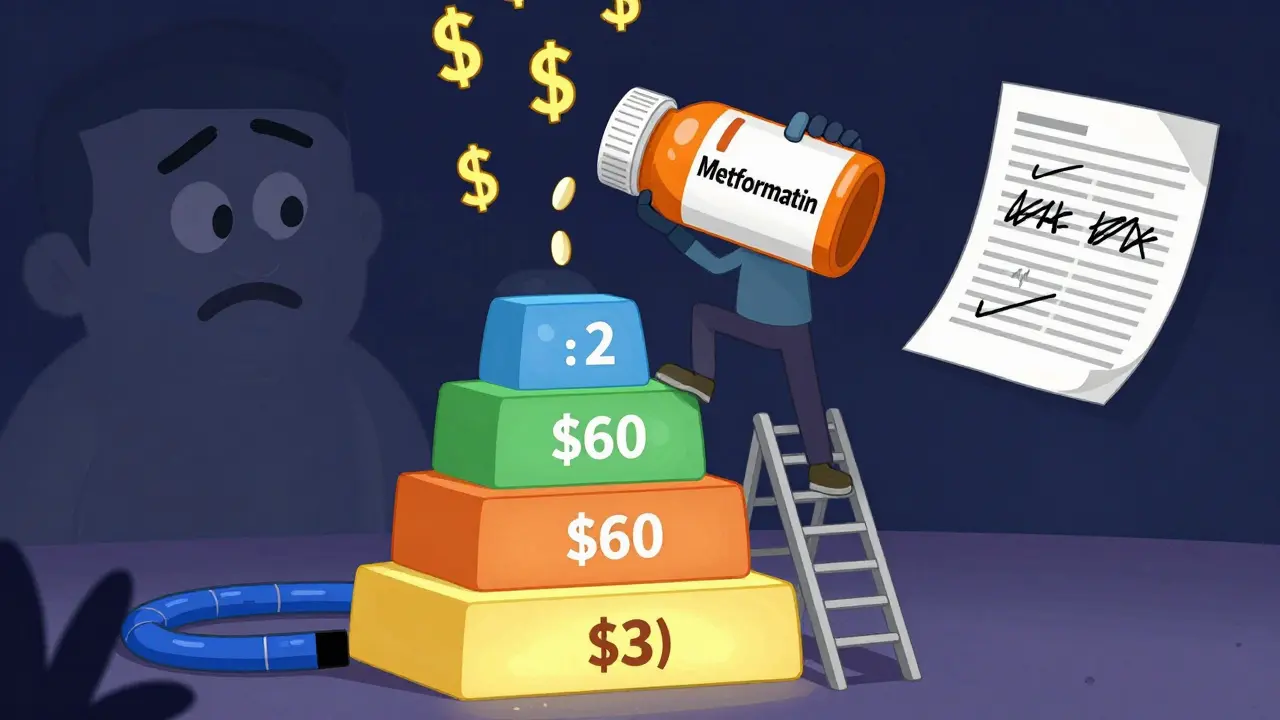
Generic drugs aren’t just cheaper versions of brand-name pills. They’re the exact same medicine, approved by health regulators, with the same active ingredients, same strength, and same effectiveness. But here’s the catch: not all health plans treat them the same. In 2022, generics made up 84% of all prescriptions filled in the U.S., yet they accounted for only 14% of total drug spending. That’s because insurers structure their plans to reward patients who use generics. But only if they’re covered properly. Most plans use a tiered formulary system. Think of it like a pricing ladder:- Tier 1: Preferred generics. Usually $3-$20 for a 30-day supply.
- Tier 2: Non-preferred generics or brand-name drugs. Often $30-$60.
- Tier 3 and 4: Higher-cost brand names or specialty drugs. Coinsurance kicks in-sometimes 30% or more.
The Hidden Trap: Integrated Deductibles
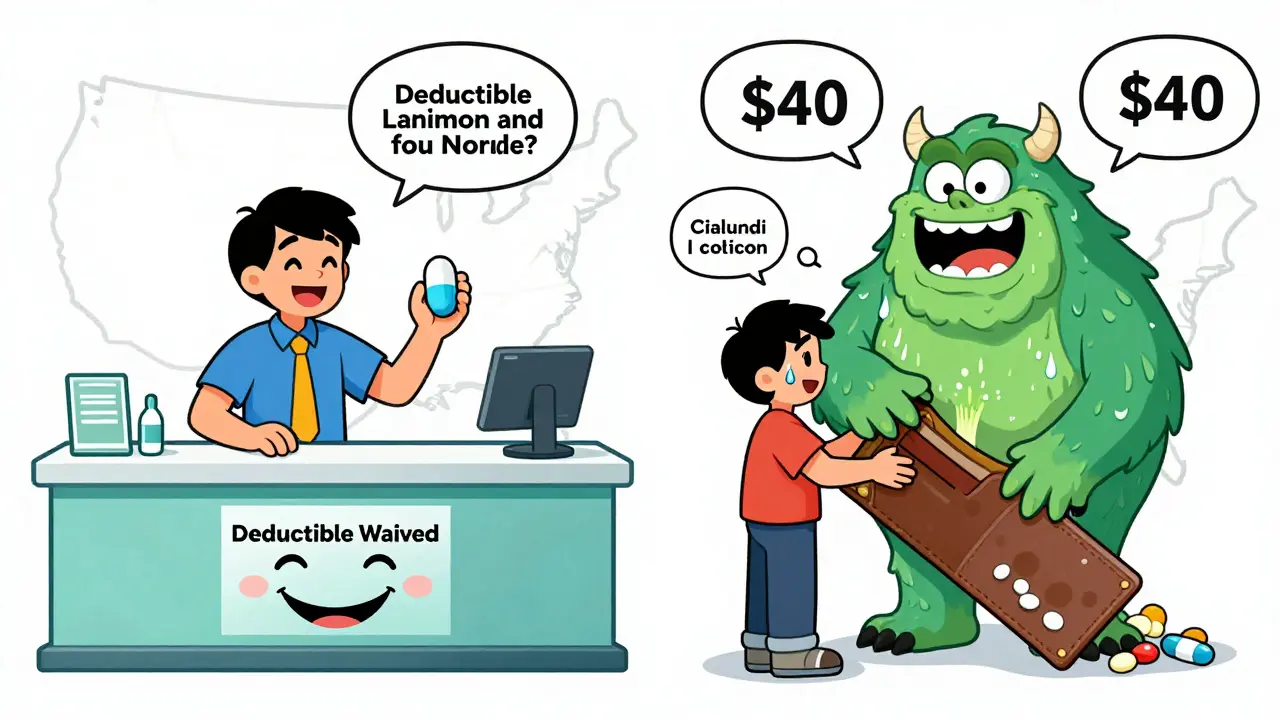
Many high-deductible health plans (HDHPs) combine your medical and prescription deductibles. That means you pay 100% of your generic drug costs until you’ve spent $1,500 or $3,000 out of pocket. That sounds fine-if you’re healthy. But if you’re on daily medication, you’re paying full retail price for your pills before the plan even kicks in. A $15 generic could cost you $50 before the deductible. Over a year, that’s $600 extra. Silver Standardized Plan Design (SPD) plans fix this. They waive the deductible for Tier 1 generics and charge a flat $20 copay-even before you meet your medical deductible. These plans are now available in 32 states as of 2024. If you take regular medications, this is the single biggest factor to look for.Medicare Part D and Medicare Advantage: A Different Game
If you’re on Medicare, things get more complicated. In 2023, the base Part D deductible was $505. Most plans still have it. But here’s the twist: many Medicare Advantage plans (MA-PDs) include drug coverage and often have lower out-of-pocket costs for generics than standalone Part D plans. For example:- Some Medicare Advantage plans charge $0-$10 for Tier 1 generics.
- Others split generics into two tiers: preferred (Tier 1, $0-$10) and non-preferred (Tier 2, $20-$40).
State Rules Change Everything
Your state can make or break your drug costs.- California: Has a separate $85 outpatient drug deductible. After that, you pay 20% coinsurance, capped at $250 per year.
- New York: Waives deductibles for generics entirely. Many generics cost $0-$7 copay.
- Washington, D.C.: Has a $350 separate drug deductible with a $150 cap on specialty drugs.
How to Check Your Medications Before You Switch
Don’t guess. Don’t rely on a sales rep’s word. Do this before you enroll:- Get your current prescription list. Include the exact name, strength, and manufacturer (e.g., metformin ER 500mg, Teva).
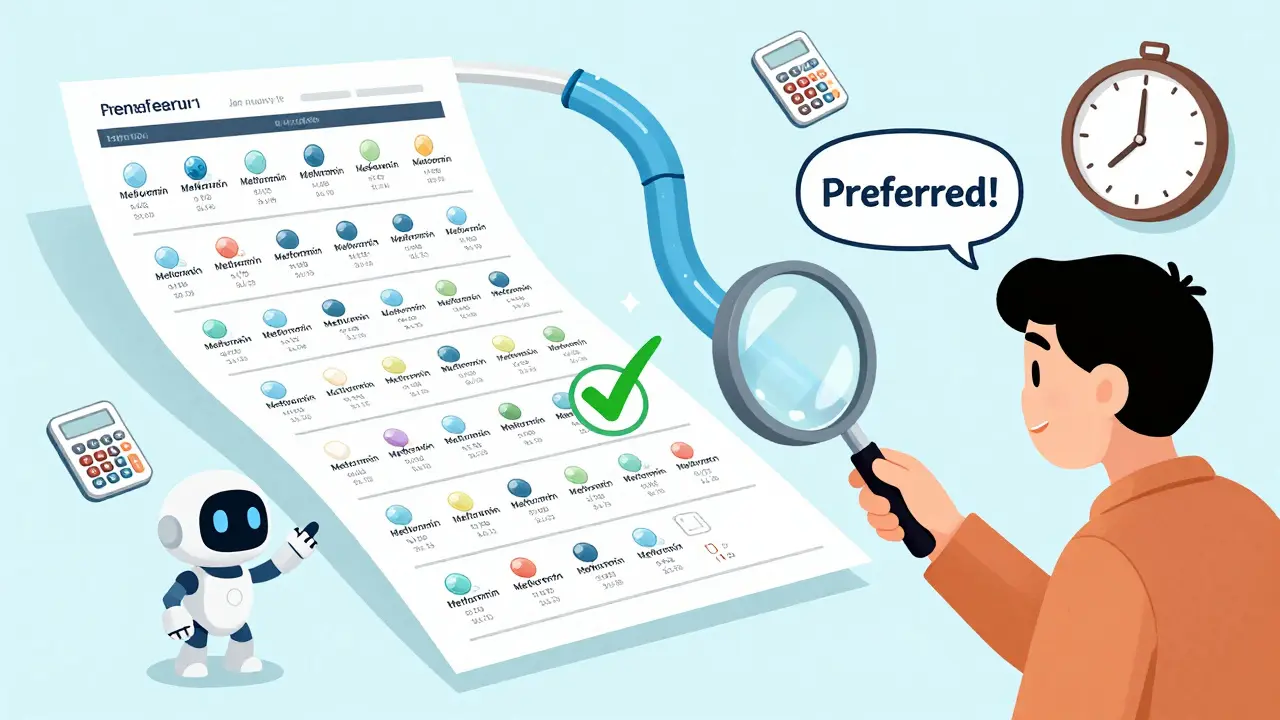
- Find the new plan’s full formulary. Don’t just look at the summary. Download the complete list. Most insurers have a searchable formulary tool on their website.
- Search each drug by name and manufacturer. Some plans list generics by brand name only. If your drug isn’t listed, it’s not covered.
- Check the tier and cost-sharing. Is it Tier 1? Tier 2? Is there a deductible? Is it covered at a preferred pharmacy?
- Use a cost calculator. Medicare.gov’s Plan Finder and Healthcare.gov’s plan selector let you enter your drugs and see estimated annual costs. Use them. They’re accurate.
Common Mistakes People Make
- Assuming all generics are equal. One metformin isn’t the same as another if the manufacturer isn’t preferred.
- Ignoring pharmacy networks. Your $3 generic might be $12 if your pharmacy isn’t in-network. OptumRx data shows non-preferred pharmacies can charge 300-400% more.
- Not checking mail-order options. Some plans offer 90-day supplies for the same price as 30-day retail. That’s a 20-30% savings.
- Missing formulary changes. Insurers change formularies every January. Your plan might cover your drug now-but not next year.
What’s Changing in 2025
New rules are coming. The Inflation Reduction Act caps insulin at $35/month starting in 2023-and by 2025, Medicare Part D will have a $2,000 annual out-of-pocket cap for all drugs. That’s huge for people on multiple medications. Also, Medicare is splitting generics into two tiers: preferred and non-preferred. That means even more complexity. If you take generics, you’ll need to be even more careful about which plan you pick. AI tools like CMS’s new “Medicare Plan Scout” are helping. In testing, it cut enrollment errors by 44%. But it’s not perfect. You still need to double-check.Bottom Line: Don’t Switch Without Checking
Switching health plans for a lower premium is smart. But if you don’t check your generic drug coverage, you could end up paying more for pills than you saved on premiums. The best plan isn’t the cheapest. It’s the one that covers your meds at the lowest cost. Take 30 minutes. Download the formulary. Search your drugs. Use the calculator. It’s the only way to know for sure.People who do this save $780 a year on average. Some save over $2,000. It’s not magic. It’s just doing the work before you sign up.
 Health and Wellness
Sophia Daniels
December 26, 2025 AT 14:46Okay but let’s be real - if you’re not checking your formulary like it’s your job, you’re just throwing money at Big Pharma and hoping for the best. I had a friend whose levothyroxine went from $0 to $87 overnight because the new plan ‘preferred’ a different manufacturer. Same pill. Same doctor. Same body. Just a different barcode. That’s not healthcare - that’s a rigged game.
And don’t even get me started on mail-order scams. ‘Save 30%!’ Yeah, right - unless your pharmacy is 200 miles away and your dog eats the package. Then you’re out $150 and three days without meds. Don’t trust the hype. Do the legwork. Or pay the price.
Also - why do insurers even have 4 tiers? Who decided that ‘non-preferred generic’ is a thing? It’s the same damn chemical. They’re just trying to confuse you into picking the expensive one. I call it pharmaceutical gaslighting.
And yes, I’ve filed complaints. Yes, I’ve called customer service until they transferred me to a robot that said ‘Your concern is important to us.’ No, it’s not. But I’m still here yelling into the void - because someone has to.
PS: If you’re on Medicare, don’t believe the ‘$0 copay’ ads. Read the fine print. It’s written in 5-point font and says ‘subject to formulary changes.’ Translation: they’ll screw you next January.
PPS: I saved $1,900 last year just by switching pharmacies. Not plans. Pharmacies. Who knew?
PPPS: This isn’t advice. It’s survival.
Nikki Brown
December 26, 2025 AT 22:11You're right to be alarmed. I've been managing chronic conditions for 12 years, and I can confirm: formularies are designed to exploit patient ignorance. The fact that two identical generics cost $5 vs. $40 based on manufacturer alone is not a market inefficiency - it's a deliberate strategy.
Insurers don't care about outcomes. They care about profit margins. And they know most people won't dig into the 47-page PDF called ‘Formulary and Drug List.’
I've personally documented 14 cases where a plan changed tiers mid-year without notice. No email. No letter. Just a declined prescription at the counter.
And yes - California’s $85 deductible is a joke. $250 cap? That’s still $165 you paid for 12 months of meds. Meanwhile, New York waives it entirely. Why? Because they have actual policy makers who understand that health isn’t a commodity.
Stop trusting sales reps. Stop trusting ‘estimated savings’ calculators. Download the full formulary. Print it. Highlight your meds. Compare. Repeat every January. This isn’t optional. It’s essential.
Amy Lesleighter (Wales)
December 27, 2025 AT 12:05just check your meds on the plan’s website. really. it takes 10 mins. i did it last year and saved like $800. no joke.
my levothyroxine was $3 before. new plan said $42. turned out they only liked the teva brand. my pharmacy had the sandoz one. switched to a different pharmacy. back to $3. boom.
people overthink this. it’s not rocket science. just look up your pills. don’t trust anyone. not the rep. not the ad. not your friend. look it up.
also - mail order is gold. 90-day supply for 30-day price? yes please. i’ve been doing it for 3 years. no issues. no delays. just cheaper.
do the thing. you’ll thank yourself.
Steven Destiny
December 27, 2025 AT 23:11Stop being passive. If you’re not auditing your drug coverage every year, you’re complicit in your own financial ruin. This isn’t ‘healthcare.’ It’s a predatory industry that profits from your laziness.
I used to pay $60/month for lisinopril. Switched plans, didn’t check - ended up paying $140. I called the insurer. They said, ‘It’s on Tier 2 now.’ I asked why. They said, ‘Because we can.’
So I switched again. Found a plan that waived deductibles for generics. Paid $5. Saved $1,200. Took 22 minutes.
If you’re still letting insurers decide your drug costs, you’re not a patient - you’re a revenue stream.
Wake up. Do the work. Or pay the price. No one’s coming to save you.
Fabio Raphael
December 28, 2025 AT 01:12I just want to say - thank you for writing this. I’ve been on metformin for 8 years and never realized how much the manufacturer mattered. I thought all generics were the same. Turns out, my pharmacy was giving me the ‘non-preferred’ version, and I didn’t even know.
I used the Medicare Plan Finder tool you mentioned - it showed me a plan I didn’t even know existed that covered my exact brand for $2. I switched. Saved $900. My blood sugar’s better too, honestly - less stress about money.
I’m not a policy expert. I’m just someone who takes pills. But this stuff matters. So much.
If you’re reading this and you’re scared to dig into formularies - I get it. I was too. But it’s not scary. It’s just… boring. And boring is better than broke.
You’re not alone in this. We’re all just trying to stay alive.
Becky Baker
December 29, 2025 AT 02:24Ugh I hate this system. I pay $38 for my thyroid med every month and I swear it’s the same pill my cousin gets for $5 in Ohio. Why? Because my plan is trash and my state is trash. And no one cares. They just want your premium.
Also - why do they even have ‘preferred’ and ‘non-preferred’? It’s literally the same chemical. I’m not paying extra because the pill has a different logo. That’s not healthcare. That’s corporate theater.
And don’t even get me started on the ‘mail order’ thing. I tried it. Took 10 days. I ran out. Had to go to ER. That’s not saving money. That’s gambling with your life.
Anyway. I’m switching next year. And I’m gonna check EVERYTHING. Even if I have to read the whole PDF in 12-point font. I’m done being played.
Rajni Jain
December 29, 2025 AT 13:53As someone from India who now lives in the U.S., I was shocked at how complicated this is. Back home, generics are cheap and everyone gets them - no tiers, no formularies, no drama.
Here, I spent weeks just trying to figure out if my metformin was covered. I thought I was being smart switching plans - ended up paying $70 more a month. I cried.
But I learned. Now I print the formulary. I call my pharmacy first. I use the calculator. I even ask the pharmacist: ‘Is this the preferred brand?’
It’s exhausting. But it’s worth it. You’re not just saving money. You’re saving your peace.
And if you’re on Medicare - please, please, please don’t trust the ads. They’re not your friends.
Brittany Fuhs
December 30, 2025 AT 09:28It’s deeply concerning that so many Americans are unaware that their healthcare system is engineered to extract maximum profit while minimizing accountability. The notion that two chemically identical pharmaceutical compounds can be priced differently based on arbitrary manufacturer preferences is not merely inefficient - it is morally indefensible.
The tiered formulary system is a deliberate mechanism of obfuscation, designed to exploit cognitive overload among patients who are already burdened by chronic illness. The fact that state-level regulations vary so wildly - New York waiving deductibles, California imposing separate caps - reveals a fractured, patchwork infrastructure that fails its most vulnerable populations.
Moreover, the reliance on algorithmic tools such as ‘Medicare Plan Scout’ is a dangerous abdication of personal responsibility, as these systems are trained on proprietary, non-transparent datasets that may prioritize insurer profitability over patient outcomes.
One must not merely ‘check’ the formulary - one must cross-reference it with pharmacy network data, manufacturer-specific listings, and historical changes. This is not consumer behavior. This is survival in a system designed to fail you.
And yet, the onus is placed entirely on the individual. No wonder 73% of people who follow the steps still report unexpected costs - because the system is rigged.
It’s not a flaw. It’s the feature.
Erwin Asilom
December 31, 2025 AT 08:15Just want to add something practical: if you’re on a high-deductible plan and take daily meds, ask if your insurer offers a ‘prior authorization exception’ for Tier 1 generics. Some will waive the deductible if you prove you’ve been on the same drug for over a year.
I did this with my lisinopril. Took two forms. One doctor’s note. Two weeks. But now I pay $5 instead of $50 until I hit my deductible.
It’s not easy. But it’s possible.
Also - call your pharmacy. Not your insurer. Pharmacists know the real scoop. They see what gets denied. They know which brands are preferred. They’ve seen the formularies. Ask them. They’ll help.
You’re not bothering them. You’re being smart.
Sumler Luu
December 31, 2025 AT 21:15My mom switched plans last year and didn’t check her meds. Ended up paying $200 for her blood pressure pill - the same one she got for $12 before.
She cried for three days. Then she called the insurer. They said, ‘We’re sorry, but it’s on Tier 2 now.’
She switched back. Paid $150 penalty. But now she’s back on her old plan. And she’s not switching again.
I told her: ‘If you’re not willing to spend 30 minutes a year checking your meds, don’t switch at all.’
She agreed.
Some things aren’t worth the hassle.
Peter sullen
January 2, 2026 AT 14:56It is imperative to underscore the criticality of formulary verification as a non-negotiable component of healthcare decision-making. The tiered structure of pharmaceutical coverage, while ostensibly designed to incentivize cost-effective utilization, is frequently misaligned with patient-centered outcomes due to opaque, non-transparent manufacturer preferences.
Furthermore, the integration of medical and pharmaceutical deductibles in HDHPs constitutes a structural disincentive for chronic disease management, effectively penalizing individuals who require consistent pharmacological intervention.
It is also noteworthy that state-level regulatory variance introduces significant geographic inequity in access to affordable therapeutics - a phenomenon that undermines the principle of equitable healthcare delivery.
Empirical evidence from the 2023 study cited in the original post (73% reduction in unexpected costs) supports a rigorous, evidence-based approach to plan selection. The utilization of official calculators (e.g., Medicare.gov, Healthcare.gov) is not merely advisable - it is a necessary, evidence-informed intervention.
Failure to execute this due diligence constitutes a systemic risk to both fiscal and physiological well-being.
Recommendation: Implement a standardized checklist, cross-validated with pharmacy network data, prior to any enrollment change.
Fabio Raphael
January 3, 2026 AT 19:14Actually, I just found something wild - my plan changed the preferred brand of my metformin last month. I didn’t know until I got a letter in the mail saying my old one was ‘no longer covered.’
I called the pharmacy. They said, ‘Yeah, we got the new batch. You can switch to the other one - it’s the same thing.’
So I did. But I had to pay $35 that month because it wasn’t on the preferred list yet. Took them 12 days to update the system.
So I wrote to the insurer. They said, ‘We’re sorry for the inconvenience.’
That’s it.
They don’t fix the system. They just say sorry.
So I started keeping a spreadsheet. Drug. Manufacturer. Tier. Cost. Date changed.
It’s a nightmare. But it’s my nightmare. And I’m not letting them win.