
SSRI-NSAID Risk Assessment Calculator
It’s not uncommon for someone to be taking an SSRI for depression or anxiety while also using an NSAID for arthritis, back pain, or headaches. But what most people don’t know is that combining these two medications can significantly increase their risk of a dangerous, even life-threatening, gastrointestinal (GI) bleed. This isn’t a rare side effect - it’s a well-documented, clinically significant interaction that affects millions of people worldwide. And yet, too many patients are never warned about it.
Why This Combination Is Riskier Than You Think
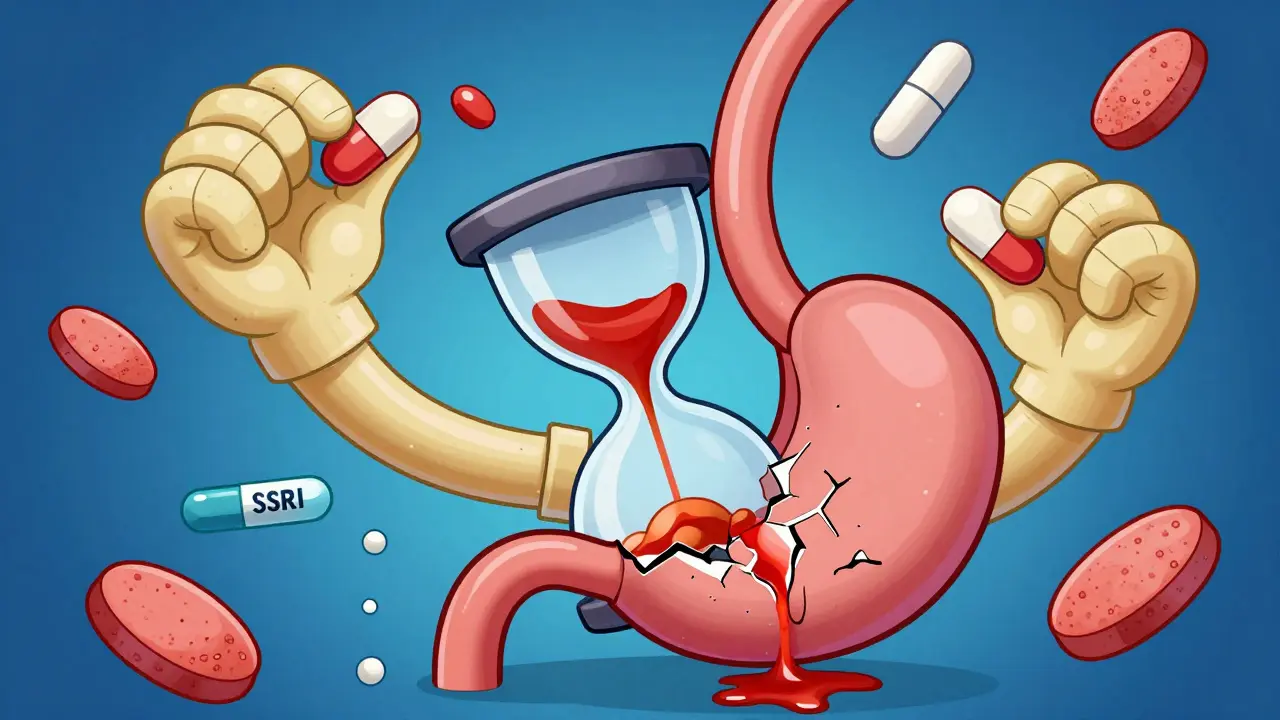
SSRIs - like sertraline, fluoxetine, and citalopram - work by increasing serotonin in the brain to improve mood. But serotonin isn’t just a brain chemical. It’s also stored in platelets, the blood cells that help stop bleeding. When SSRIs block serotonin reuptake into platelets, they deplete the serotonin those cells need to clump together and form a plug at the site of an injury. That means even a small cut or irritation in the stomach lining can bleed longer than it should. NSAIDs - such as ibuprofen, naproxen, and diclofenac - work by reducing inflammation and pain. But they do this by shutting down COX-1 enzymes, which are responsible for making protective prostaglandins in the stomach. These prostaglandins keep the stomach lining healthy by promoting mucus production, blood flow, and cell repair. Without them, the stomach becomes vulnerable to acid damage, ulcers, and bleeding. When you take both together, you’re hitting the body with a one-two punch: the stomach lining is weakened by the NSAID, and the blood can’t clot properly because of the SSRI. The result? A much higher chance of bleeding - and not just a minor one. This can mean vomiting blood, passing black, tarry stools, or sudden dizziness from internal blood loss.The Numbers Don’t Lie
Multiple large studies confirm the danger. A 2023 meta-analysis published in Digestive Diseases and Sciences reviewed dozens of studies and found that people taking both an SSRI and an NSAID had a 75% higher risk of upper GI bleeding compared to those taking either drug alone. That’s not a small increase. It’s a major jump. For context: taking an SSRI alone increases bleeding risk by about 40-50%. Taking an NSAID alone can double or even quadruple the risk, depending on the drug and dose. But together? The effect isn’t just added - it’s multiplied. The risk becomes so high that experts compare it to mixing blood thinners with NSAIDs. And it’s not just older adults. While people over 65 and those with a history of ulcers are at highest risk, younger people aren’t immune. A 2022 Reddit thread featured multiple users who ended up in the ER after taking sertraline and ibuprofen for weeks. One wrote: “I had black stools for three days. Thought it was just my diet. Ended up needing a blood transfusion.”Not All SSRIs or NSAIDs Are Equal
The risk isn’t the same across all medications in these classes. Among NSAIDs, celecoxib (a COX-2 inhibitor) carries the lowest GI bleeding risk. Studies show its risk is close to baseline - only about 16% higher than not taking any NSAID. That’s far better than naproxen or diclofenac, which can increase bleeding risk by 3-4 times. Ibuprofen is the safest among traditional NSAIDs, but it’s still risky when combined with an SSRI. For SSRIs, most have similar effects on platelets. But some data suggests escitalopram might have a slightly lower bleeding risk than fluvoxamine or paroxetine. Still, no SSRI is truly “safe” when paired with an NSAID. The class effect is real.
What Doctors Should Do - But Often Don’t
Despite clear guidelines from the American College of Gastroenterology and the FDA, many prescribers still overlook this interaction. A 2021 survey of 1,200 primary care doctors found that only 38.7% routinely check for SSRI-NSAID combinations when prescribing. Only 22.3% automatically add a protective medication. Patients are even less aware. A 2022 Medscape survey showed 68% of people prescribed both drugs were never told about the bleeding risk. That’s unacceptable. The standard of care now includes three steps:- Assess risk. Use tools like the ACG Upper GI Risk Calculator, which factors in age, prior ulcers, H. pylori infection, and other medications.
- Consider alternatives. Can pain be managed with acetaminophen instead of an NSAID? Could an antidepressant like bupropion be used instead of an SSRI? Bupropion doesn’t affect platelets and has no bleeding risk.
- If both are necessary, add a PPI. A proton pump inhibitor - like omeprazole 20mg daily - cuts the excess bleeding risk by about 70%. That brings the risk back down to near-safe levels.
Real-World Success Stories
One patient with rheumatoid arthritis and depression switched from naproxen to celecoxib and started taking omeprazole daily while staying on sertraline. She reported no GI issues for 18 months. Another patient, after a hospitalization for bleeding, was switched from fluoxetine to bupropion and stopped NSAIDs entirely. His symptoms resolved completely. These aren’t outliers. They’re examples of what happens when risks are recognized and managed.
What You Can Do Right Now
If you’re taking an SSRI and an NSAID - even if you’ve been on them for years - here’s what to do:- Check your medication list. Are you taking any NSAID? That includes over-the-counter ibuprofen, naproxen, or aspirin.
- Look for symptoms: black or tarry stools, vomiting blood, unexplained fatigue, dizziness, or abdominal pain.
- Ask your doctor: “Am I at risk for GI bleeding from these two drugs?”
- Ask: “Can I switch to acetaminophen for pain?”
- Ask: “Should I be on a proton pump inhibitor?”
The Bigger Picture
This isn’t just about individual prescriptions. It’s a public health issue. In the U.S. alone, an estimated 9.8 million people are taking both an SSRI and an NSAID. The annual cost of treating bleeding complications from this interaction is over $1.27 billion. Hospitals like Cleveland Clinic have reduced GI bleeding admissions by 42% after adding automated alerts to their electronic health records. That’s proof that systems can change - and save lives. New research is also emerging. Scientists are studying genetic markers (like CYP2C19 variants) that affect how people metabolize SSRIs and PPIs. Some are testing NSAIDs with built-in PPIs in pill form - a dual-release formula that could make protection automatic. But until those innovations become standard, the solution is simple: awareness, assessment, and prevention.Final Thought
Medications are powerful. But they’re not harmless. The fact that this interaction is so common - and so preventable - makes it even more troubling. You don’t need to stop your antidepressant. You don’t need to suffer through pain. You just need to know the risk and ask for the right protection. The tools are there. The guidelines exist. What’s missing is the conversation. Start it today.Can I take ibuprofen with an SSRI like sertraline?
Taking ibuprofen with sertraline increases your risk of upper GI bleeding by about 75% compared to using either drug alone. While ibuprofen is the safest NSAID option, it still poses a significant risk when combined with an SSRI. If you need pain relief, talk to your doctor about switching to acetaminophen or adding a proton pump inhibitor like omeprazole.
Are there antidepressants that don’t increase bleeding risk?
Yes. Bupropion (Wellbutrin) is an antidepressant that doesn’t affect platelet serotonin levels, so it doesn’t increase bleeding risk. If you’re taking an SSRI and need to use an NSAID long-term, switching to bupropion may be a safer option. Other non-SSRI antidepressants like mirtazapine or vilazodone also have lower bleeding risk profiles, but bupropion has the strongest evidence for safety in this context.
What’s the safest NSAID to take with an SSRI?
Celecoxib (Celebrex) is the safest NSAID option when used with an SSRI. It’s a COX-2 inhibitor that doesn’t significantly affect stomach-protecting prostaglandins, so its bleeding risk is much lower than traditional NSAIDs like naproxen or diclofenac. However, even celecoxib should be paired with a proton pump inhibitor if you’re on an SSRI, especially if you’re over 65 or have a history of ulcers.
Do proton pump inhibitors really help prevent bleeding with this combo?
Yes. Multiple studies show that taking a daily proton pump inhibitor (like omeprazole 20mg) reduces the excess bleeding risk from SSRI-NSAID combination therapy by about 70%. That brings the risk close to the level of taking an NSAID alone. PPIs are the most effective way to protect your stomach lining when both drugs are necessary. They’re generally safe for long-term use under medical supervision.
How do I know if I’ve had a GI bleed?
Signs include black, tarry stools (called melena), vomiting blood or material that looks like coffee grounds, sudden dizziness, weakness, or unexplained fatigue. Some people feel abdominal pain, but others have no symptoms until the bleed is severe. If you’re on an SSRI and NSAID and notice any of these signs, seek medical attention immediately - don’t wait.
Should I stop taking my SSRI or NSAID if I’m worried about bleeding?
Never stop either medication without talking to your doctor. Stopping an SSRI suddenly can cause withdrawal symptoms, and stopping an NSAID abruptly might worsen your pain or inflammation. Instead, schedule a review of your medications. Ask if alternatives exist, or if adding a proton pump inhibitor would make your current regimen safer. The goal is to manage risk - not eliminate necessary treatment.
 Health and Wellness
kelly tracy
December 29, 2025 AT 20:10Let me get this straight - you’re telling me millions of people are walking around with a ticking time bomb in their stomach because doctors are too lazy to connect two obvious dots? And we wonder why healthcare costs are insane. This isn’t medicine, it’s negligence dressed up as protocol.
Cheyenne Sims
December 30, 2025 AT 18:06It is imperative to note that the concomitant administration of selective serotonin reuptake inhibitors and nonsteroidal anti-inflammatory drugs constitutes a pharmacologically significant interaction, with documented increases in gastrointestinal hemorrhage risk exceeding seventy-five percent in peer-reviewed meta-analyses. Patient education and adherence to American College of Gastroenterology guidelines are not optional - they are non-negotiable standards of care.
Aayush Khandelwal
December 31, 2025 AT 04:48Yo, this is the kind of stuff that keeps me up at night - SSRIs and NSAIDs like two drunk guys in a chemistry lab, both thinking they’re helping but actually just setting the whole damn house on fire. The platelet depletion + prostaglandin suppression combo? That’s not a side effect, that’s a biological ambush. And celecoxib? Yeah, it’s the quiet one in the corner who doesn’t start fights. But even he needs a bodyguard - PPIs are the unsung heroes here. Someone’s gotta write a rap about this.
Sandeep Mishra
December 31, 2025 AT 10:02It’s easy to blame doctors, but let’s be real - we’re all just trying to survive. I get it. You’re in pain. You’re anxious. You just want to feel normal. But this interaction? It’s not just about pills. It’s about how we treat each other in healthcare. If someone takes your SSRI and NSAID combo seriously - if they ask you about black stools before you even mention them - that’s the kind of care that heals more than any drug. I’ve seen it. I’ve been it. Don’t wait for a crisis. Talk to your provider. You deserve better.
Joseph Corry
January 1, 2026 AT 06:02How quaint. We’ve reduced complex pharmacokinetic interactions to a checklist. PPIs? Bupropion? Celecoxib? How predictable. The real tragedy isn’t the bleeding - it’s the reduction of human suffering to algorithmic risk mitigation. You’re not preventing death. You’re optimizing for compliance metrics. And yet, the existential void remains untouched. The stomach bleeds. The mind still aches. And the system? Still just rearranging deck chairs.
Colin L
January 1, 2026 AT 12:34I remember last year, I was on sertraline for my anxiety - which, by the way, I didn’t even know I had until my therapist said I cried during a commercial for dog food - and I’d been popping ibuprofen like candy because my back felt like a rusty hinge. One morning, I woke up feeling like I’d swallowed a lead pipe, and my stool… oh god, my stool… it was like tar mixed with regret. I didn’t tell anyone for three days because I was too embarrassed. Then I Googled ‘black poop and antidepressants’ and nearly threw up. I didn’t just need a PPI - I needed a hug, a therapist, and someone to tell me it wasn’t my fault. Why is this so hard to talk about? Why do we treat medical risks like secrets?
Hayley Ash
January 2, 2026 AT 14:15So let me get this straight - you want me to stop taking Advil because I’m on Zoloft? But I’m fine. My stomach’s fine. My poop’s fine. My doctor’s fine. Why are you suddenly acting like I’m going to bleed out like a horror movie? Oh wait - because you read a study. And now you’re the expert. Cool. Next you’ll tell me my coffee is killing me too
srishti Jain
January 3, 2026 AT 16:15Same. Took sertraline + naproxen for 2 years. Black stools. ER. Blood transfusion. No one warned me. Now I’m on bupropion. No more drama.
Shae Chapman
January 4, 2026 AT 00:35THIS. IS. EVERYTHING. 🙌 I’m so glad someone finally said this out loud. My mom almost died from this combo and no one ever told her. I cried reading this. Please share this with everyone you know. Your body is not a lab experiment. 💔💊
Nadia Spira
January 5, 2026 AT 02:17Let’s be honest - most people taking SSRIs are already emotionally unstable. Adding NSAIDs? That’s not a drug interaction, that’s a public health liability. If you can’t manage your pain without risking GI bleeding, maybe you need to reevaluate your entire life strategy. This isn’t medicine - it’s a symptom of a broken culture that outsources coping to pills.
henry mateo
January 5, 2026 AT 23:08hey i just wanted to say thanks for this post. i was on citalopram and ibuprofen for like 3 years and never knew this was a thing. i started getting dizzy and my stomach hurt but i thought it was stress. i went to my doc and asked about ppi and now im on omeprazole. it changed everything. i wish i knew sooner. thanks again
Kunal Karakoti
January 7, 2026 AT 22:10There’s an irony here - we’ve mechanized the body into systems and pathways, yet we still treat the mind as something separate from the gut. The serotonin in your brain is the same serotonin in your platelets. The prostaglandins protecting your stomach are the same molecules that modulate inflammation across your entire system. We fracture care because we fracture understanding. Maybe the real solution isn’t just a PPI - it’s a return to seeing the body as one whole, not a collection of broken parts.
Kelly Gerrard
January 8, 2026 AT 14:52It is imperative that patients and practitioners alike recognize the grave risks associated with concomitant SSRI and NSAID administration. The evidence is unequivocal. Proton pump inhibitor prophylaxis is not merely advisable - it is mandatory in high-risk populations. Compliance with clinical guidelines saves lives. Do not delay. Act now.