
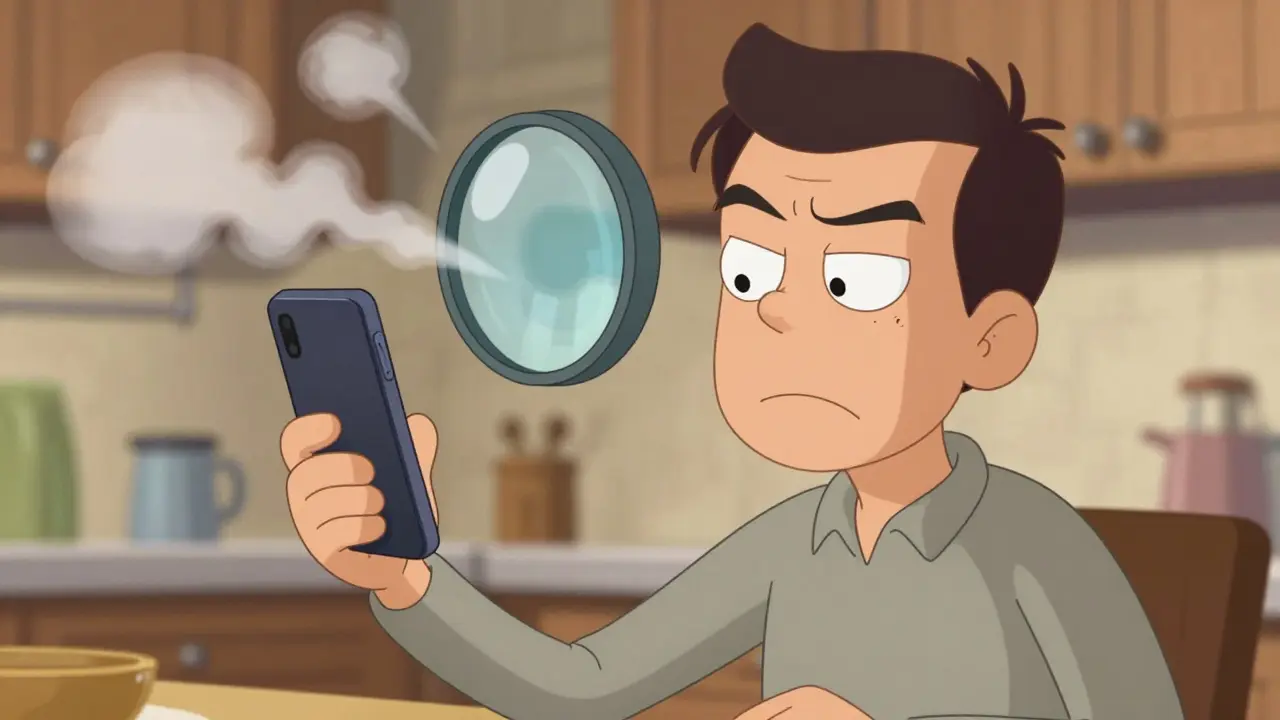
By your mid-40s, you might start holding your phone farther away to read text. Or you’re squinting at the menu at dinner. Suddenly, the small print on medicine bottles feels impossible. This isn’t bad eyesight-it’s presbyopia. And it’s happening to nearly everyone.
What Exactly Is Presbyopia?
Presbyopia isn’t a disease. It’s not caused by too much screen time or poor lighting. It’s a normal, unavoidable part of aging. Your eye’s natural lens, which used to bend easily to focus on close objects, slowly stiffens over time. Think of it like an old rubber band losing its stretch. By age 45, most people lose about half their ability to focus up close. By 60, that ability drops to almost nothing. This isn’t the same as farsightedness, which comes from the shape of your eyeball. Presbyopia is all about the lens. As you age, your lens keeps growing-adding layers like an onion-and loses flexibility. Light no longer focuses correctly on the retina when you look at something nearby. The result? Blurry text, tired eyes, headaches after reading. The National Eye Institute confirms: 100% of people develop presbyopia as they age. There’s no way around it. No eye exercises, no special diet, no supplements can stop it. Dr. Emily Chew from the NEI says it plainly: “It’s as inevitable as gray hair.”How Strong Do Your Reading Glasses Need to Be?
The strength of reading glasses you need isn’t random-it follows a clear pattern. At age 45, most people need +1.00 diopters. By 50, it’s usually +1.50 to +2.00. By 65, many need +2.50 to +3.00. Some even need +3.50 for fine print. Over-the-counter reading glasses come in 0.25-diopter steps, from +0.75 to +3.50. You can find them at Walmart, CVS, or Amazon for as little as $6. But here’s the catch: buying the wrong strength makes things worse. A 2023 study in Optometry Times found that 35% of people pick lenses that are too strong or too weak. That causes eye strain, headaches, and blurred vision-even though you thought you were helping. If you’re unsure, get a quick eye check. Many optical stores offer free screenings. A proper exam uses cycloplegic refraction, which relaxes the eye muscles to get an accurate reading. Without it, your prescription might be off by 0.25 to 0.50 diopters. That’s enough to make reading uncomfortable.Reading Glasses vs. Progressive Lenses: What’s Better?
If you only need help with reading, simple reading glasses work fine. Put them on when you’re reading, take them off when you look across the room. Easy. But if you’re constantly switching between your phone, computer, and face-to-face conversations, they become a hassle. That’s where progressive lenses come in. These are single lenses with three zones: distance at the top, intermediate (like computer screens) in the middle, and near vision at the bottom. No lines. No switching glasses. But they’re not perfect. About 25% of first-time wearers get dizzy or feel off-balance because the sides of the lens distort peripheral vision. It takes 2 to 4 weeks to adjust. You have to learn to move your head, not just your eyes, to see clearly. Bifocals are cheaper-$200 to $350-but they have a visible line and a small reading zone. Progressives cost $250 to $450, but they’re more natural. Newer models like Essilor’s Eyezen Progressive 2.0, launched in March 2023, have a 30% wider near zone based on data from 10,000 wearers. That means less head movement and more comfort.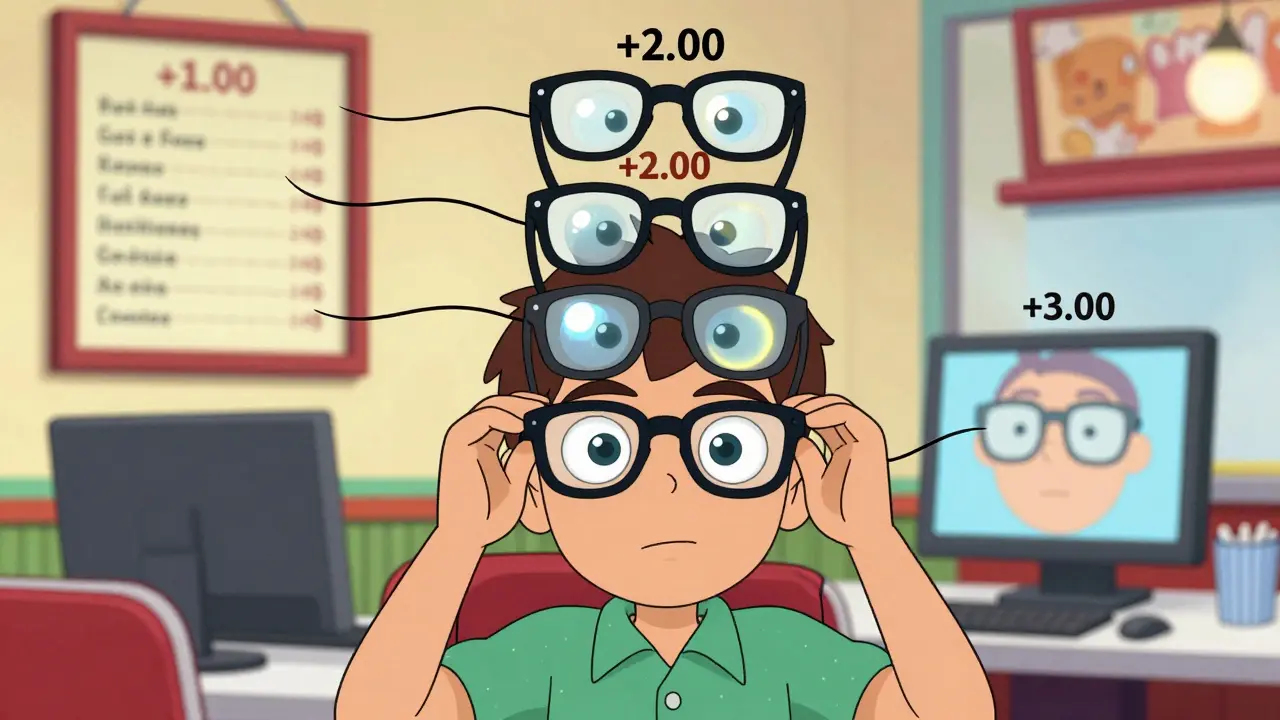
What About Contact Lenses or Surgery?
Some people prefer contacts. Monovision contacts correct one eye for distance and the other for near vision. It works for about 80% of users, according to Mount Sinai. But 15% lose depth perception, which can make driving or sports tricky. Surgical options exist, but they’re not for everyone. LASIK monovision costs $2,000 to $4,000 per eye. Satisfaction is high-85%-but 10-15% need a second procedure within five years. Dry eyes happen in 35% of cases. Refractive lens exchange replaces your natural lens with an artificial one, like a cataract surgery. It’s permanent and fixes presbyopia and future cataracts at once. But it costs $3,500 to $5,000 per eye. And while most people see better, 25% report halos at night, and 15% notice reduced contrast sensitivity. A newer option is the Presbia Flexivue Microlens-a tiny implant placed in the cornea. Approved in Europe in 2022, it helped 78% of patients reach 20/25 near vision after a year. It’s not yet FDA-approved in the U.S., but it’s a sign of where things are headed.Why Your Eye Exam at 40 Matters
The American Academy of Ophthalmology recommends a full eye exam starting at age 40. Why? Because presbyopia doesn’t happen alone. Glaucoma, macular degeneration, and diabetic retinopathy also start showing up around this age. A routine check can catch them early. During the exam, your doctor will measure your pupillary distance (the space between your pupils), frame fit, and how your eyes work together. These details matter-even for progressives. If your glasses are made with a pupillary distance off by just 0.5mm, you’ll get headaches. Don’t wait until you’re struggling. By the time you notice you’re holding your phone farther away, you’ve already lost significant focusing power. A simple exam can give you the right correction before frustration sets in.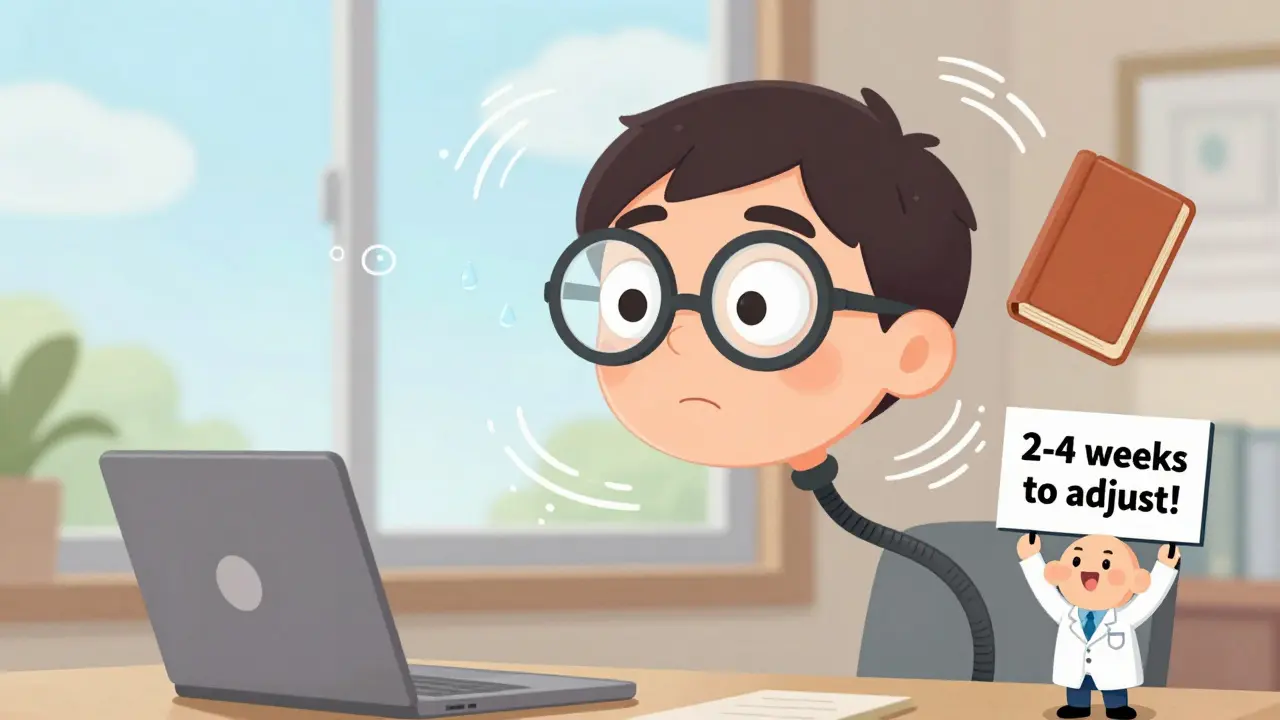
Real People, Real Experiences
On Reddit’s r/Eyeglasses forum, users share stories that sound familiar: “First noticed it reading the microwave display at 42.” “Had to buy three pairs of readers before finding the right strength.” “Took three weeks to get used to progressives-then I couldn’t go back.” One graphic designer, 52, switched to occupational progressives with a 14mm corridor. Now she can read code on her screen and see her coworkers without switching glasses. “It changed my workday,” she said. But not everyone has success. A 2022 report on EyeWorld described an 8% failure rate with monovision LASIK, where patients needed retreatment because their near vision wasn’t good enough. And Amazon reviews show that 22% of people who buy cheap readers get headaches-often because the lenses are poorly made or the strength is wrong.What’s Next for Presbyopia Correction?
The global market for presbyopia solutions is growing fast. It hit $14.2 billion in 2022 and is expected to reach $25 billion by 2030. Why? Because 1.8 billion people already have it-and that number will hit 2.1 billion as populations age. Innovations are coming. Johnson & Johnson’s Acuvue Oasys Multifocal, approved in early 2023, uses new tech to improve near vision with contact lenses. Researchers at the NEI are testing eye drops called VP-025 that temporarily restore focusing power for up to six hours. If it works, it could mean no glasses for a few hours at a time. But for now, the best solution is still the simplest: getting the right glasses at the right time. Whether it’s a $10 pair for reading the newspaper or custom progressives for daily life, the goal is the same-keep your world clear, close up.What to Do Next
If you’re over 40 and struggling with small print:- Try over-the-counter readers in +1.00 to +1.50 strength. See if it helps.
- If you need them often, schedule an eye exam. Don’t guess your prescription.
- If you wear distance glasses, ask about progressives. Ask for a trial pair if your optician offers one.
- Avoid cheap, no-name readers. Poor lens quality causes strain.
- Don’t wait for symptoms to get worse. Early correction means less frustration.
Is presbyopia the same as farsightedness?
No. Farsightedness (hyperopia) happens when the eyeball is too short or the cornea is too flat, making it hard to focus on close objects even when young. Presbyopia is caused by the lens stiffening with age. You can be farsighted and develop presbyopia, but they’re different problems with different causes.
Can eye exercises or diet prevent presbyopia?
No. Despite claims online, no eye exercises, vitamins, or supplements can stop or reverse presbyopia. The lens hardens due to natural aging, not lifestyle. The National Eye Institute confirms this is a universal biological process, like wrinkles or gray hair.
Why do my reading glasses give me headaches?
Headaches usually mean the lens strength is wrong-or the lenses are low quality. Cheap readers often have uneven optics, poor alignment, or incorrect power. If you’re getting headaches, try a different pair or get a professional prescription. Also, make sure you’re not holding the text too close-your eyes are trying to compensate.
How often do I need to change my reading glasses?
Every 2 to 3 years, on average. Your lens keeps stiffening as you age, so your needed correction increases. Most people go from +1.00 at 45 to +2.50 by 60. Don’t wait until you’re squinting-get checked every couple of years after 40.
Are progressive lenses worth the extra cost?
If you need clear vision at multiple distances-phone, computer, face-to-face-yes. They eliminate the need to switch glasses. But they take time to adjust to. If you only read occasionally, over-the-counter readers are fine. Progressives are an investment in convenience and comfort for daily life.
Can I wear reading glasses if I already wear contacts?
Yes. Many people who wear contacts for distance vision use reading glasses over them. Others switch to multifocal contacts or monovision. The choice depends on your lifestyle. Ask your eye doctor what fits your daily routine best.
Is surgery the best long-term solution?
It’s permanent, but not always the best. Surgery like refractive lens exchange fixes presbyopia and prevents future cataracts, but carries risks: halos, glare, dry eyes, and the need for retreatment. Most people do well, but optical solutions (glasses or contacts) remain safer and more adjustable. Surgery is best for those who want to be glasses-free and understand the trade-offs.
 Health and Wellness
Rob Webber
January 31, 2026 AT 18:38Let me guess-you’re one of those people who thinks reading glasses are for losers. Newsflash: everyone gets presbyopia. Even your precious iPhone screen doesn’t care if you’re 42 and still refuse to admit you need +1.50. You’re not special. You’re just old. And no, squinting harder won’t fix it.
calanha nevin
February 1, 2026 AT 21:57Presbyopia is not a flaw-it’s a natural part of aging, like graying hair or slower reflexes. The key is early correction. A simple $10 pair of readers can prevent headaches, eye strain, and unnecessary frustration. Don’t wait until you’re holding your phone at arm’s length to act. Schedule an eye exam. It’s one of the easiest ways to preserve your quality of life.
Lisa McCluskey
February 3, 2026 AT 01:15I started noticing this at 44. Thought it was just tired eyes. Bought a $6 pair from CVS, tried them while reading a recipe, and almost cried. It was like someone turned on a light I didn’t know was off. No drama. No surgery. Just glasses. I keep a pair in my purse, my car, and my desk. Life changed.
owori patrick
February 4, 2026 AT 05:04Back home in Nigeria, we don’t always have access to eye exams. But I’ve seen older folks use magnifying lenses from the market or even hold books under bright sunlight. It’s not ideal, but they make do. The real issue is awareness. If we could spread simple info like this, more people could avoid unnecessary strain. Education matters.
Jason Xin
February 4, 2026 AT 15:50So let me get this straight. You spent 2000 words explaining that your eyes are breaking down like a 2005 Honda Civic. And the solution is… buying $6 glasses from Walmart? Groundbreaking. Next you’ll tell me breathing is important.
Donna Fleetwood
February 5, 2026 AT 17:28Don’t let anyone make you feel bad about needing readers. I used to hide mine in my pocket like they were embarrassing. Then I realized: I’m not losing my vision-I’m gaining clarity. And that’s a win. If you’re reading this and you’re struggling? Get help. You deserve to see your grandkids’ faces clearly.
Blair Kelly
February 7, 2026 AT 05:30Correction: The National Eye Institute does NOT say presbyopia is ‘as inevitable as gray hair.’ That’s a metaphor. The NEI states it is a universal age-related change in the crystalline lens due to decreased elasticity and increased lens mass. Precision matters. Also, ‘reading glasses’ is a colloquialism-correct term is ‘plus-powered single-vision lenses.’
Lily Steele
February 9, 2026 AT 03:30My mom wore progressives for 10 years. She said the first week felt like walking on a boat. But after that? She could read her tablet, see the stove, and talk to me all in one glance. No more switching. Worth every penny. Don’t be scared of them. Give them a real shot.
Amy Insalaco
February 11, 2026 AT 00:01It’s fascinating how the biomechanical aging of the ocular lens-specifically the accumulation of insoluble crystallin proteins and the progressive loss of cytoskeletal integrity in lens fiber cells-renders accommodative amplitude nonfunctional. The commercialization of over-the-counter +1.00 to +3.50 spherical lenses represents a commodification of physiological inevitability, yet the lack of pupillary distance calibration in these mass-produced optics introduces significant aberrational distortion, particularly in the peripheral visual field, which may exacerbate asthenopia. The real solution lies in personalized wavefront-guided optical correction, not retail aisle pragmatism.
Marc Bains
February 12, 2026 AT 06:21In my culture, elders are respected for their wisdom-and their reading glasses. We don’t hide them. We celebrate them. When my uncle puts on his readers to read the Quran, we all pause. It’s not weakness. It’s a sign of life lived. Don’t shame your aging. Honor it.
kate jones
February 12, 2026 AT 23:52One thing the article doesn’t mention: lens material. Polycarbonate lenses reduce glare and are lighter than CR-39. If you’re using cheap readers, you’re likely getting CR-39 with inconsistent optical centers. That’s why you get headaches. Upgrade to polycarbonate, even if it’s $15. Your eyes will thank you.
Kelly Weinhold
February 14, 2026 AT 06:38I was skeptical about eye drops that restore focus. But when I heard about VP-025, I got excited. Imagine not needing glasses for your morning coffee or a quick text. I’m not saying ditch the readers yet-but if this works, it’s going to change everything. Keep pushing the science, researchers. We’re all rooting for you.
Kimberly Reker
February 14, 2026 AT 18:12Just bought my first pair of readers yesterday. +1.75. Read the whole damn label on my shampoo without squinting. Felt like a superhero. No drama. No surgery. Just glasses. You’re not broken. You’re upgraded.