
Opioid Dose Adjustment Calculator
How Liver Disease Affects Opioid Dosing
Liver disease impairs opioid metabolism, increasing toxicity risk. This calculator adjusts doses based on your liver function severity using guidelines from the article.
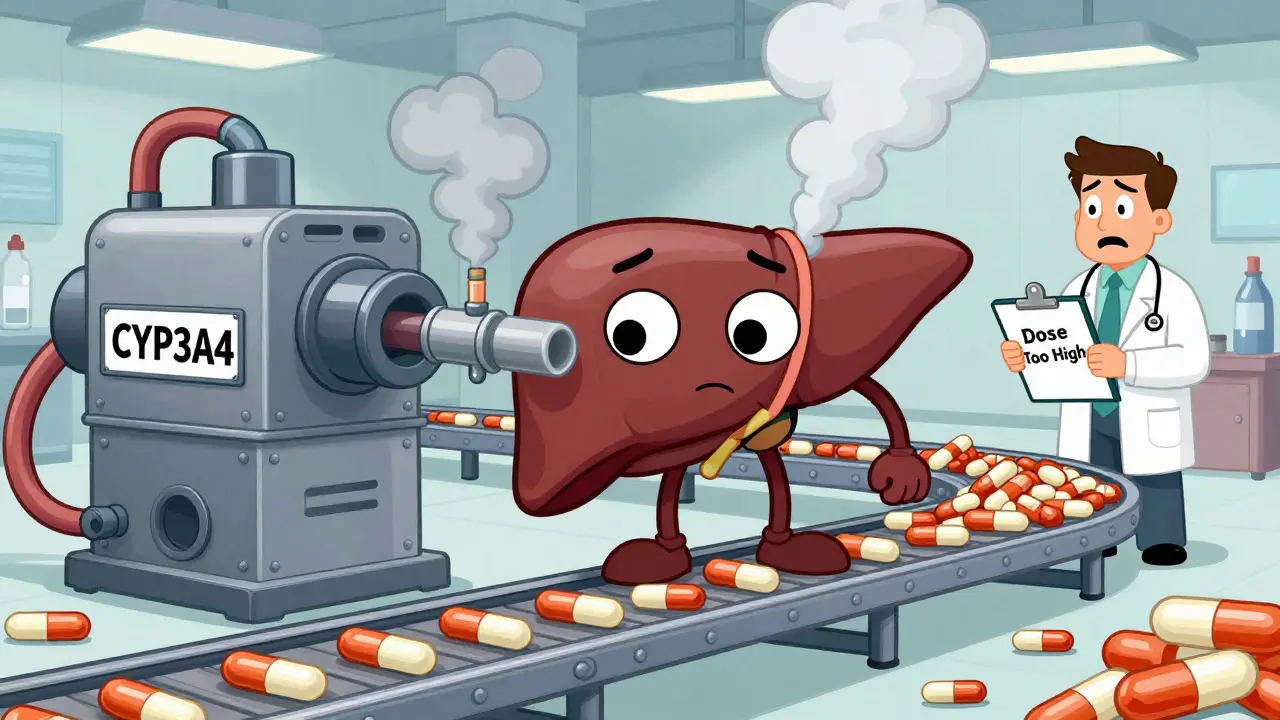
When someone has liver disease, taking opioids isn’t as simple as adjusting the dose. The liver doesn’t just break down drugs-it’s the main factory that processes them. When that factory is damaged, opioids don’t clear the way they should. Instead, they build up. And that buildup can turn a painkiller into a danger.
How the Liver Normally Handles Opioids
The liver uses two main systems to break down opioids: the cytochrome P450 enzymes and glucuronidation. These are like specialized machines that chop up drug molecules so they can be flushed out by the kidneys. Morphine, for example, gets turned into two metabolites: morphine-6-glucuronide (M6G), which helps with pain relief, and morphine-3-glucuronide (M3G), which can cause seizures and confusion. Oxycodone is split by CYP3A4 and CYP2D6 enzymes into active and inactive forms. If these enzymes work normally, the drug stays effective but safe.
But in a healthy liver, things change dramatically. In cirrhosis or advanced fatty liver disease, these enzymes slow down or stop working properly. CYP3A4 activity drops by up to 50% in severe cases. Glucuronidation gets sluggish too. The result? Opioids stick around much longer. What should be a 3.5-hour half-life for oxycodone can stretch to 14 hours-or even longer. That’s not just a delay. It’s a recipe for overdose.
What Happens When the Liver Fails
Patients with liver disease don’t just feel more pain-they feel more side effects. Drowsiness, confusion, slow breathing, and low blood pressure become far more common. Studies show opioid-related adverse events increase by 60-70% in people with moderate to severe liver impairment. Why? Because the liver can’t detoxify the drugs, and the kidneys can’t keep up either.
Morphine is especially risky. Its metabolite M3G builds up in liver failure and crosses the blood-brain barrier easily. That’s why patients with cirrhosis report more hallucinations and myoclonus (muscle twitching) on morphine than on other opioids. Even if the original dose was low, the toxic byproducts accumulate over days. One study found that patients with Child-Pugh Class C cirrhosis had M3G levels three times higher than healthy people after the same morphine dose.
Oxycodone behaves differently. In liver disease, its peak concentration jumps by 40%, and its half-life balloons from 3.5 hours to an average of 14 hours. That means if you give a standard 10 mg dose, the body is exposed to nearly twice as much drug over time. That’s why guidelines say to cut the starting dose by 30%-50% in severe liver impairment.
Why Some Opioids Are Riskier Than Others
Not all opioids are created equal when the liver is damaged. Morphine is one of the worst choices because it depends entirely on glucuronidation-a pathway that fails early in liver disease. Fentanyl and hydromorphone are also risky, but for different reasons. Fentanyl is heavily processed by CYP3A4, which drops in activity as liver function declines. Hydromorphone is cleared by the kidneys, so if the liver fails and kidneys start to struggle too, it’s a double hit.
Methadone is tricky. It’s metabolized by multiple CYP enzymes (CYP3A4, CYP2B6, CYP2D6), so it seems like it should be safer. But there’s no solid dosing guide for liver patients. One person might metabolize it normally; another might hold onto it for days. That unpredictability makes it dangerous without constant monitoring.
Buprenorphine and transdermal fentanyl have an advantage: they bypass the liver’s first-pass metabolism. When you use a patch, the drug enters the bloodstream directly through the skin. That means less strain on the liver. For patients with advanced cirrhosis, these options may be safer-though they still need careful titration.

Chronic Use and the Gut-Liver Connection
It’s not just about metabolism. Long-term opioid use changes the gut microbiome. Studies now show opioids reduce beneficial bacteria and increase harmful ones. This imbalance triggers inflammation in the gut lining, letting toxins leak into the portal vein-right into the liver. This is called the gut-liver axis.
In patients with existing liver disease, this leak worsens inflammation and fibrosis. It’s a cycle: liver damage slows opioid clearance → higher opioid doses are given → gut bacteria get disrupted → more toxins reach the liver → liver damage gets worse. This doesn’t show up on blood tests right away, but it accelerates progression from fatty liver to cirrhosis.
One 2024 study tracked 200 patients with NAFLD on long-term opioids. Those who used opioids for over a year had a 3.2 times higher risk of developing advanced fibrosis than those who didn’t-even after adjusting for alcohol, diabetes, and weight.
What Doctors Should Do
There’s no one-size-fits-all rule. But here’s what works in practice:
- Start low, go slow. For morphine, reduce initial dose by 50% in early liver disease. In advanced disease, reduce by 75% and extend dosing intervals to every 8-12 hours.
- Avoid morphine if possible. Use alternatives like transdermal fentanyl or buprenorphine patches when pain is chronic.
- For oxycodone, cut the starting dose to 30%-50% of normal and monitor for sedation for at least 72 hours after the first dose.
- Check liver function regularly. Even mild elevations in ALT or bilirubin can mean opioid clearance is dropping.
- Watch for signs of toxicity. Drowsiness, slurred speech, pinpoint pupils, or confusion aren’t just side effects-they’re warning signs of accumulation.
Also, avoid combining opioids with other drugs that stress the liver-like acetaminophen, benzodiazepines, or alcohol. These combinations are deadly in liver disease.

What’s Still Unknown
There are big gaps in the science. We don’t have clear dosing rules for tramadol, codeine, or tapentadol in liver disease. We don’t know how viral hepatitis (like hepatitis C) affects opioid metabolism differently than alcohol or fatty liver. And we still don’t have reliable biomarkers to tell when an opioid is starting to build up in someone’s system.
One promising area is pharmacogenomics. Some people naturally have slower CYP2D6 activity. In liver disease, that genetic trait becomes dangerous. But testing for these variants isn’t routine-and it should be.
The Bottom Line
Opioids aren’t banned in liver disease. But they’re not safe either-unless you treat them like high-risk medicine. That means starting with much lower doses, avoiding certain drugs, and watching closely for side effects. Many doctors still prescribe standard doses out of habit. But in liver failure, what’s normal for one person can be lethal for another.
If you or someone you know has liver disease and needs pain relief, talk to your doctor about alternatives. Sometimes, non-opioid options like gabapentin, physical therapy, or nerve blocks work better and carry far less risk. And if opioids are necessary, make sure the dose is tailored-not just copied from a chart for a healthy person.
 Health and Wellness
Dylan Patrick
March 15, 2026 AT 11:15Opioids in liver disease? Yeah, I’ve seen this play out firsthand. A friend on morphine for chronic pain went from functional to bedridden in three weeks. No one told her the dose needed to be slashed. The docs just kept saying, 'It’s standard.' Standard for a healthy liver, sure. Not for one that’s been through hell.
Now she’s on a buprenorphine patch. Barely any side effects. Life’s back. But it took a near-overdose to get here.
Serena Petrie
March 17, 2026 AT 00:54Stop prescribing morphine. That’s it.
Ali Hughey
March 18, 2026 AT 08:49Let me guess… Big Pharma’s been whispering in doctors’ ears again 😏
They don’t want you to know this: the liver isn’t 'slowing down'-it’s being *chemically sabotaged* by years of NSAIDs, acetaminophen, and yes… OPIOIDS. The real villain? The pharmaceutical-industrial complex that profits off your suffering. 🏥💸
And don’t get me started on 'transdermal fentanyl'-it’s just a Trojan horse for dependency. The patch? It’s a slow drip of control. 🤯
Wake up, people. This isn’t medicine. It’s a system designed to keep you hooked. And the liver? Just collateral damage.
Kathy Leslie
March 19, 2026 AT 06:13I’m a nurse in a liver clinic. We had a guy come in last month-62, cirrhosis, on 60mg oxycodone daily. He didn’t even know his liver was failing until he passed out in the pharmacy. Took us 48 hours to wean him off. He cried. Said he thought he was 'just taking pain meds.'
He’s on gabapentin now. Says he feels 'lighter.'
It’s not just about doses. It’s about how we talk about pain. We treat it like a number. It’s not. It’s a story.
Aaron Leib
March 21, 2026 AT 04:27Start low, go slow. It’s not just good advice-it’s basic human decency.
Doctors forget that patients aren’t lab rats. We’re people with bodies that break differently.
One size never fits all. Especially not when the liver’s involved.
Alex MC
March 22, 2026 AT 16:41Thank you for laying this out so clearly. I’ve been scared to ask my doctor about my pain meds since my fatty liver diagnosis. This gives me real language to use. I’m not alone in this. 💙
tynece roberts
March 24, 2026 AT 10:58so like… i had a cousin who was on methadone for 8 years after a car wreck. liver was toast by 45. she kept saying 'it’s fine, i feel fine' but her eyes? they’d glaze over mid-sentence. we thought it was just tiredness. turns out? her brain was slowly drowning in metabolites. they didn’t even test her levels until she started hallucinating cats. cats. 🐱
now she’s on a patch. and she says she finally remembers what silence feels like.
Amisha Patel
March 25, 2026 AT 08:00Is there any data on how viral hepatitis changes opioid metabolism compared to NAFLD? I’m curious because my hepatitis C is controlled but my liver enzymes are still elevated. Would buprenorphine be safer for me?
Elsa Rodriguez
March 25, 2026 AT 10:28Ugh. I HATE when people act like this is 'new information.'
My mom died from this. 78. Liver transplant candidate. Prescribed oxycodone for 'arthritis.' She was gone in 11 days. They said it was 'an accident.'
It wasn’t. It was negligence. And now they’re writing articles like it’s a revelation.
Wake up. People are dying. And the system doesn’t care.
rakesh sabharwal
March 27, 2026 AT 07:03One must acknowledge the pharmacokinetic anomalies arising from hepatic dysfunction, particularly in phase I and phase II metabolic pathways. The CYP450 isoform suppression and UGT1A1 downregulation create a non-linear pharmacodynamic landscape, rendering conventional dosing protocols not merely suboptimal, but statistically hazardous.
One wonders why clinical guidelines remain so rudimentary in the face of such complex biochemistry. The lack of pharmacogenomic integration is, frankly, an affront to evidence-based medicine.
mir yasir
March 28, 2026 AT 02:17It is an unfortunate reality that Western medicine persists in its reductionist approach to pain management. The liver is not merely a metabolic organ-it is a sentinel of homeostasis. To treat opioid clearance as a simple half-life calculation is to misunderstand the very nature of physiological adaptation.
One must consider the enterohepatic recirculation, the gut microbiome’s role in endotoxin translocation, and the systemic inflammatory cascade triggered by prolonged opioid exposure. These are not footnotes-they are the core of the matter.
Stephanie Paluch
March 28, 2026 AT 07:48I’ve been on buprenorphine for 4 years since my liver transplant. It’s the only thing that didn’t make me feel like I was drowning in fog.
My doctor said 'it’s the safest'-and she was right.
Also… thank you for mentioning the gut-liver axis. I didn’t know that. Now I’m eating more kimchi. Weird, but I feel better. 🥬❤️
Buddy Nataatmadja
March 30, 2026 AT 04:22Interesting how this mirrors what we see in traditional Javanese herbal medicine. They’ve known for centuries that certain pain herbs must be dosed lightly for those with 'weak liver.' No one in Western medicine talks about this. Maybe we’re not as advanced as we think.