
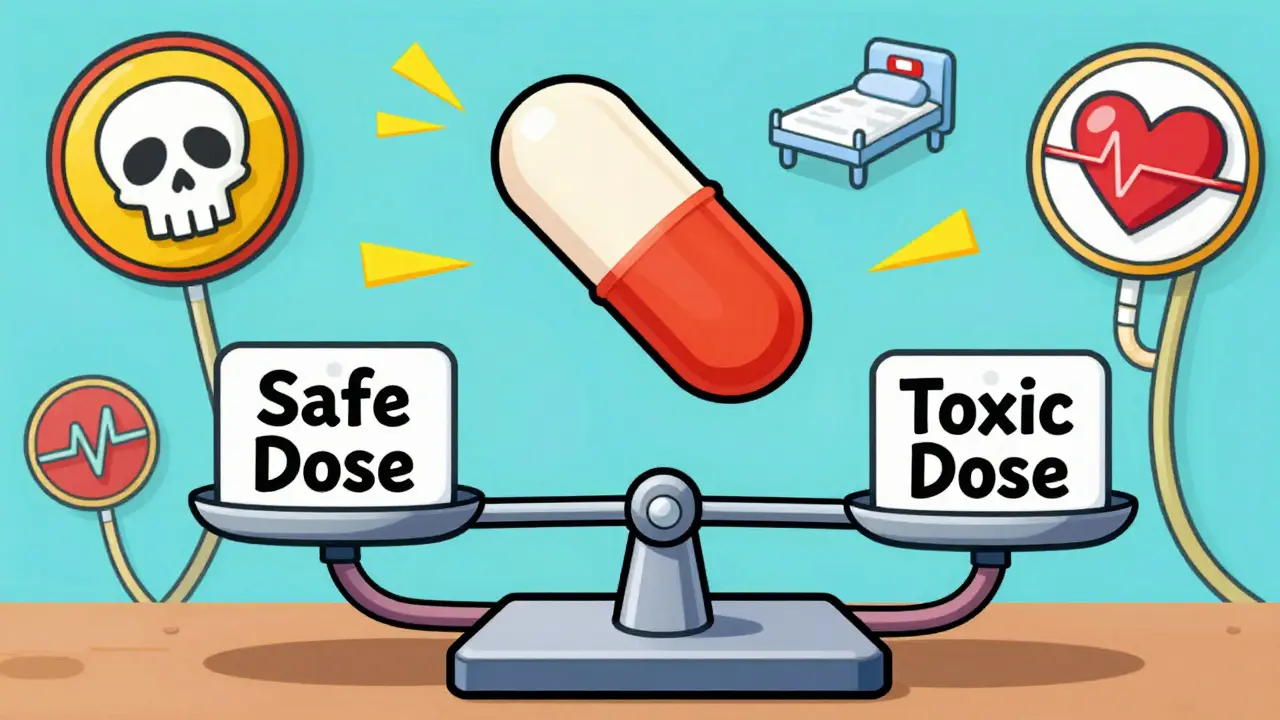
Some medications don’t just stop working after they expire-they can turn dangerous. This isn’t about old aspirin or leftover allergy pills. It’s about drugs where even a tiny change in dose can send you to the hospital-or worse. These are called narrow therapeutic index (NTI) medications, and if you’re taking one, expiration dates aren’t suggestions. They’re lifelines.
What Makes a Drug Have a Narrow Therapeutic Index?
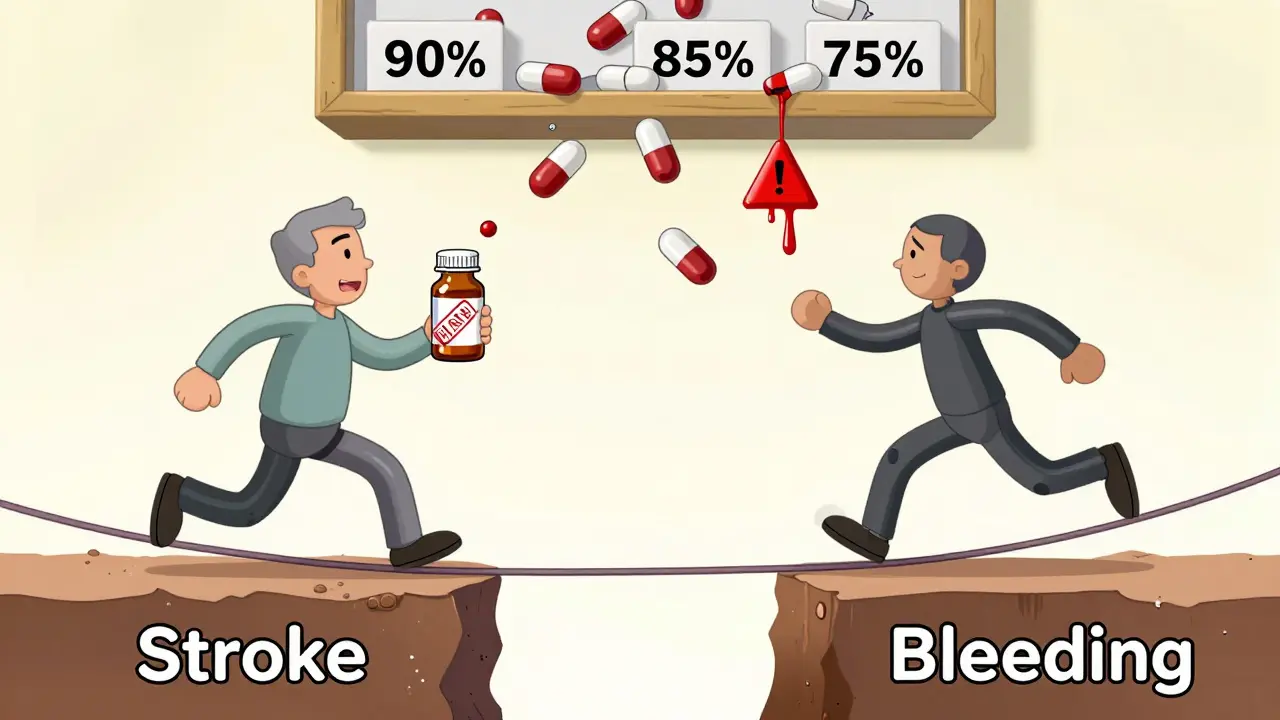
A narrow therapeutic index means the difference between a safe, effective dose and a toxic one is razor-thin. Think of it like walking a tightrope. One step too far, and you fall. For most drugs, your body can handle a little variation-you might take 10% more or less and still be fine. But for NTI drugs, that same 10% could mean the difference between controlling your seizures and having a seizure, or keeping your blood thin enough to prevent clots-and bleeding out.
The U.S. Food and Drug Administration defines NTI drugs as those where small changes in blood concentration can cause life-threatening side effects or treatment failure. Drugs like warfarin, lithium, digoxin, phenytoin, and levothyroxine all fall into this category. For example, digoxin’s safe range is between 0.5 and 0.9 nanograms per milliliter of blood. Toxicity starts above 1.2. That’s only a 33% increase from the top of the safe zone to the danger zone. One expired pill could push you past that line.
Why Expiration Dates Matter More for NTI Drugs
Every medication has an expiration date printed on the label. That’s not just a marketing tactic-it’s the last date the manufacturer guarantees the drug will work as intended, if stored correctly. For most drugs, even after expiration, potency may remain above 90% for years. But for NTI drugs, that 10% drop in potency isn’t just a number. It’s a medical emergency waiting to happen.
Take warfarin, used to prevent strokes in people with atrial fibrillation or artificial heart valves. If your INR (a blood test that measures clotting time) needs to stay between 2.0 and 3.0, a 10% loss in warfarin potency could drop your INR below 2.0. That means your blood starts clotting again. You could develop a stroke, a pulmonary embolism, or a heart attack-all because a pill sat on a shelf past its date.
And it’s not just about losing strength. Some drugs break down into harmful substances. While tetracycline is not an NTI drug, its degraded form can cause kidney damage. With NTI drugs, you don’t know what’s in that pill anymore. You can’t test it. You can’t see it. You just know your body needs a precise amount-and you can’t risk guessing.
How Regulators Handle NTI Drugs (And Why It’s Not Enough)
The FDA treats NTI drugs differently. For generic versions of these medications, they require stricter bioequivalence standards. Instead of allowing generic drugs to be 80-125% as potent as the brand name (the standard for most drugs), NTI drugs must fall within 90-111%. That’s a much tighter range. Why? Because even a 15% difference in potency between brands can cause problems.
But here’s the gap: no regulations specifically address what happens after the expiration date. The FDA has no official guidance saying, “Don’t use expired levothyroxine.” There’s no label warning, “This pill may cause heart rhythm problems if used past this date.” The system assumes that if the drug is stored properly, it’s safe. But for NTI drugs, that assumption is dangerously wrong.
Studies show that patients on NTI drugs often have low variability in how their bodies process the medication-meaning their response is predictable… until the drug changes. If your body normally responds to 75 mcg of levothyroxine, and the expired pill you took is now only 68 mcg, your thyroid levels will drop. You’ll feel tired, gain weight, and your cholesterol might spike. It’s subtle. It’s slow. And it’s easily mistaken for aging or stress.
Real-World Consequences: What Happens When People Use Expired NTI Drugs
In 2014, a study in the Journal of Clinical Pharmacy and Therapeutics found that drug-related problems involving NTI medications were far more likely to result in serious harm than those involving other drugs. One patient took expired phenytoin for epilepsy. The pill had lost potency. He had a seizure and ended up in the ICU. Another patient on lithium, thinking the bottle was fine because it looked normal, used a pill past its date. Her lithium level crept up. She developed tremors, confusion, and kidney damage. She didn’t know it was the pills-she thought she was getting sick.
Pharmacists know this. A 2018 survey found that 67% of pharmacists treat warfarin substitutions with extreme caution-even between different generic brands. If they’re that careful about swapping pills from different manufacturers, why would they trust a pill that’s been sitting in a bathroom cabinet for two years?
And it’s not just about potency. NTI drugs often have poor absorption. Their effectiveness depends on how your body takes them in. If the pill has degraded, it might not dissolve properly. That means you’re getting less than you think. Or worse-you’re getting an unpredictable dose every time you take it.
What You Should Do If You Take an NTI Drug
If you’re on one of these medications, here’s what you need to do:
- Never use expired NTI drugs. Even if they look fine. Even if they’re only a month past the date. Throw them away.
- Store them properly. Keep them in a cool, dry place. Not the bathroom. Not the car. Humidity and heat break down these drugs faster.
- Ask for small supplies. If your prescription is for 90 days, don’t refill early. You don’t need to stockpile. The less time the pills sit around, the less chance they have to degrade.
- Get blood tests when you should. For drugs like warfarin, lithium, or digoxin, regular blood tests aren’t optional. They’re your safety net. If your dose hasn’t changed but you feel different, get tested. Don’t wait.
- Ask your pharmacist for a new bottle. If you’re unsure about the expiration date, or if the bottle looks old, get a new one. Pharmacists can’t charge you extra for a replacement if the old one expired.
What Doctors and Pharmacists Should Be Doing
Healthcare providers need to treat NTI drugs as high-alert medications. That means double-checking prescriptions, verifying doses, and warning patients clearly about expiration. The Institute for Safe Medication Practices says these drugs should always be flagged in electronic systems and require independent verification before dispensing.
Pharmacists should refuse to dispense expired NTI drugs-even if the patient insists. No one should be handed a pill that might be 10% weaker and told, “It’s probably fine.” That’s not patient care. That’s negligence.
Some countries are starting to push for better labeling. The American Pharmacists Association has called for special warnings on NTI drug packaging: “Do not use after expiration. Small changes in dose can be life-threatening.” That kind of label could save lives.
Bottom Line: When It Comes to NTI Drugs, Expiration Isn’t a Suggestion
Most medications are forgiving. A little old? Still works. A little damp? Probably okay. But NTI drugs aren’t like that. They’re like a scalpel-precise, powerful, and unforgiving. A 5% drop in potency might not matter for your ibuprofen. But for your warfarin? It could mean the difference between going to work tomorrow and lying in a hospital bed.
If you’re taking one of these drugs, treat every expiration date like a deadline. Not a suggestion. Not a guideline. A hard stop. Your life depends on it.
Can I still take an NTI drug if it’s a few months past the expiration date?
No. Even a small loss in potency can push an NTI drug outside its therapeutic window. For drugs like warfarin, lithium, or digoxin, a 5-10% drop in strength can lead to dangerous underdosing or unpredictable effects. There’s no safe grace period. Always replace expired NTI medications.
Do all generic versions of NTI drugs work the same?
Not always. While the FDA requires stricter bioequivalence standards (90-111% potency) for generic NTI drugs compared to regular drugs, differences in fillers, coatings, and absorption can still cause variation between brands. If you switch generics and feel different-fatigue, dizziness, irregular heartbeat-get your blood tested. Don’t assume they’re identical.
Is it safe to store NTI drugs in the fridge?
Only if the label says so. Most NTI drugs should be stored at room temperature in a dry place. Refrigeration can cause moisture buildup, which may degrade the pill. Always follow the storage instructions on the bottle. If in doubt, ask your pharmacist.
What should I do with expired NTI medications?
Take them to a pharmacy that offers a drug take-back program. Never flush them down the toilet or throw them in the trash. Many pharmacies, especially in Australia and the U.S., have secure disposal bins. This prevents accidental ingestion and environmental contamination.
Can I tell if an NTI drug has gone bad by looking at it?
Not reliably. Some pills may discolor, crumble, or smell odd-but many degrade without any visible change. A warfarin tablet that’s lost potency looks exactly like a fresh one. You can’t judge safety by appearance. Always rely on the expiration date and your doctor’s advice.
Are there any NTI drugs that are safer to use after expiration?
No. All NTI drugs carry the same risk. Whether it’s carbamazepine, phenytoin, or cyclosporine, the margin for error is too small. The FDA’s own data shows that even drugs with longer shelf lives can degrade unpredictably. For NTI medications, there are no exceptions.
 Health and Wellness
Sarah Williams
December 20, 2025 AT 01:39This is the kind of post that makes you stop and actually think. I’ve got my mom on warfarin and I just threw out her last bottle last week-she was like ‘but it’s only two months past!’ I showed her this and she cried. Thanks for the wake-up call.
Theo Newbold
December 20, 2025 AT 17:23Let’s be real-the FDA doesn’t care about your lithium levels. They care about liability. Expiration dates are mostly about limiting the manufacturer’s legal risk, not your safety. The real problem? No one tests expired NTI drugs because it’s too expensive. So we’re all just guessing. And that’s terrifying.
Jay lawch
December 21, 2025 AT 11:17Western medicine is a scam. You think your little pill is safe? They don’t even know what’s in it anymore. Big Pharma owns the FDA, the labs, the doctors-everything. They want you dependent. They don’t want you to know that natural remedies have worked for centuries. Levothyroxine? Try seaweed. Warfarin? Garlic. But no, you’ll keep swallowing their poison because you’re too lazy to think for yourself. India knows this. We’ve been using herbs for 5000 years without a prescription. You’re all just lab rats.
Christina Weber
December 22, 2025 AT 03:23There is a critical error in your paragraph regarding bioequivalence standards. The FDA requires NTI generics to be within 90–111% of the reference product-not 80–125%. You correctly state this later, but the earlier sentence is misleading. Additionally, ‘lifelines’ is a metaphorical overreach; it’s not a medical term. Precision matters, especially when lives are at stake.
Cara C
December 22, 2025 AT 05:53I’ve been on lithium for 12 years. I used to stockpile because I didn’t want to run out. Then I had a bad month-fatigue, brain fog, hands shaking. Turned out my bottle was 8 months expired. My doctor said, ‘You got lucky.’ I don’t want to get lucky again. I throw mine out the second they expire. No excuses.
Erika Putri Aldana
December 24, 2025 AT 03:37why do people even take these pills? like... if you need something this precise to stay alive, maybe you shouldn't be trusting a drug made by some corporation in a factory that smells like wet socks. just sayin'. also, i'm pretty sure my cat could do a better job than the FDA.
Sandy Crux
December 24, 2025 AT 22:58While your argument is emotionally compelling, it lacks epistemological rigor. You conflate ‘potency loss’ with ‘toxicity,’ which is not synonymous. Furthermore, the notion that degradation is uniformly dangerous across all NTI drugs is empirically unfounded. The 2014 study cited? It had a sample size of 47. You’re weaponizing anecdotal fear under the guise of medical authority. And please-‘scalpel’? That’s not even a metaphor. It’s a cliché.
mukesh matav
December 25, 2025 AT 06:06I work in a pharmacy in Delhi. People bring expired NTI drugs every week. We tell them to throw them away. Most say, ‘But it’s just a little old.’ I don’t argue. I just hand them a new bottle and say, ‘Your life is worth more than this.’ They cry. We all do.
Peggy Adams
December 27, 2025 AT 01:44okay but what if you’re broke? i’m not joking. i skipped my digoxin refill last month because my insurance dropped it. i took the old ones. i’m fine. so far. so what? you gonna sue me for being poor?
Dan Adkins
December 27, 2025 AT 09:05It is imperative to underscore that the pharmacokinetic variability inherent in pharmaceutical formulations, particularly those classified under narrow therapeutic index, necessitates stringent adherence to regulatory guidelines. The absence of formalized post-expiration protocols represents a systemic oversight in public health policy, which, if unaddressed, may precipitate preventable iatrogenic morbidity and mortality. A multidisciplinary approach involving pharmacovigilance, patient education, and policy reform is not merely advisable-it is ethically obligatory.
Grace Rehman
December 27, 2025 AT 13:09so we’re all just scared of expiration dates now? cool. next you’ll tell me not to drink water after 2025 because it might’ve been in a plastic bottle too long. also i’m pretty sure my grandma took aspirin from 1987 and lived to 98. maybe we’re just overthinking this? or maybe the system wants us scared so we buy more pills?
Jerry Peterson
December 29, 2025 AT 02:24My dad’s from Nigeria. He used to say, ‘In our village, we don’t throw medicine. We pray over it.’ I used to laugh. Then he got on warfarin. I made him throw out the old bottle. He cried. Said he felt like he was betraying his ancestors. I told him, ‘They’d want you alive.’ He got a new one. He’s fine now.
Jackie Be
December 29, 2025 AT 06:17OMG I JUST THREW OUT MY LITHIUM AND I FEEL SO MUCH BETTER LIKE IM FREEEEEEE I WASN’T EVEN USING IT ANYMORE BUT I JUST HAD IT AND NOW I’M A NEW PERSON