
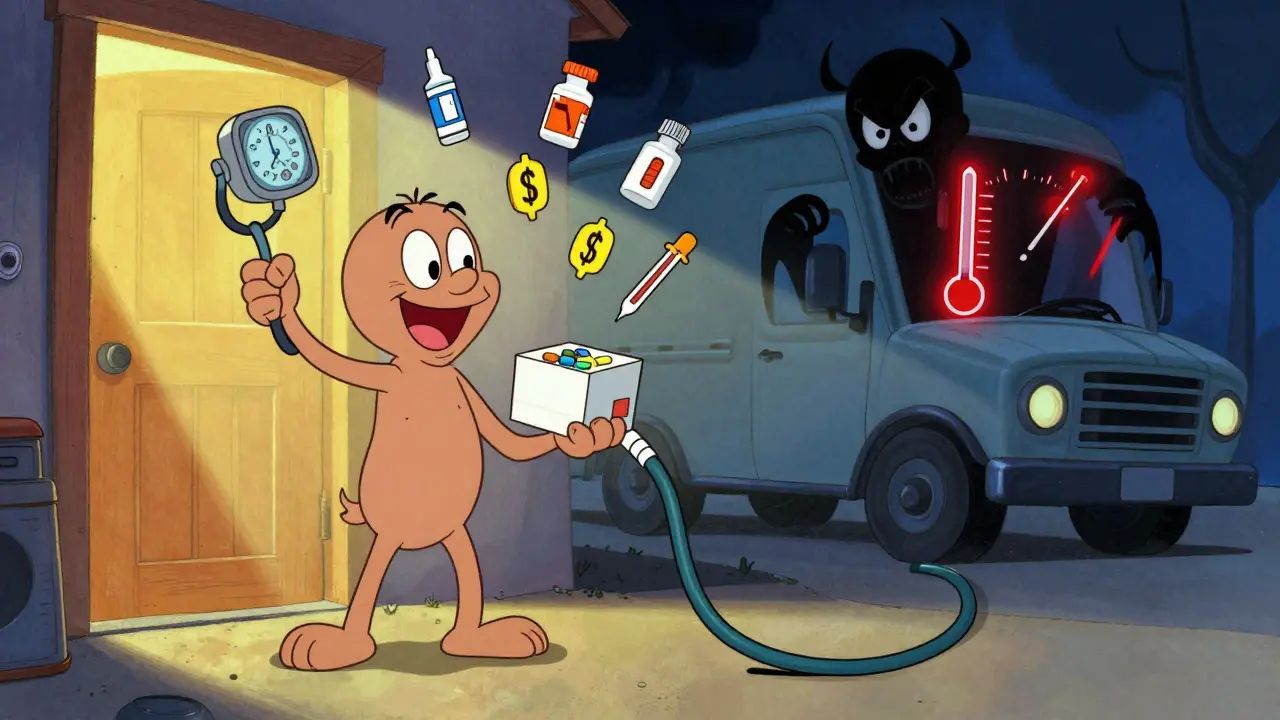
Buying your blood pressure pills, diabetes meds, or cholesterol drugs through the mail sounds simple: order online, get them delivered, save money. But behind that convenience lies a system full of hidden costs, temperature risks, and safety gaps most people never think about until something goes wrong.
Why Mail-Order Generics Are So Popular
Millions of Americans use mail-order pharmacies because they work - for some things. If you take the same medication every day for years, like metformin for diabetes or lisinopril for high blood pressure, getting a 90-day supply shipped to your door saves time and often money. Insurance companies push these services hard because they get bulk discounts from pharmacy benefit managers like Express Scripts, CVS Caremark, and OptumRx. These three companies handle nearly 80% of all mail-order prescriptions in the U.S.For Medicare Part D enrollees, it’s common to pay just $10 for a 90-day supply of a generic drug - compared to $40 or more at a local pharmacy for a 30-day dose. That’s why 63% of people with high blood pressure and 58% of those with diabetes use mail-order services, according to IQVIA. The system was designed to improve adherence. And it does. Studies from the National Institutes of Health show people who get their meds by mail are more likely to take them regularly, which lowers hospital visits and controls long-term health risks like heart disease.
The Cost Myth: Not Always Cheaper
But here’s the catch: the savings aren’t universal. For many generic drugs, the price you see online is wildly inflated. A pill that costs $12 at your local pharmacy might be billed at $100 through a mail-order service - an 800% markup. Brand-name drugs can be marked up 35 times higher than retail. How? Because insurance companies negotiate deals with pharmacy benefit managers, and those managers set the prices. You’re not always getting the lowest possible cost - you’re getting the price the system wants you to pay.Uninsured patients face the worst of this. A month’s supply of semaglutide (a weight-loss drug) can cost $500 through direct-to-consumer mail-order pharmacies. That’s not affordable for most people. And if you’re paying out-of-pocket, you might actually pay more than if you walked into a retail pharmacy with a GoodRx coupon.
Temperature Risks: Your Medication Could Be Dead on Arrival
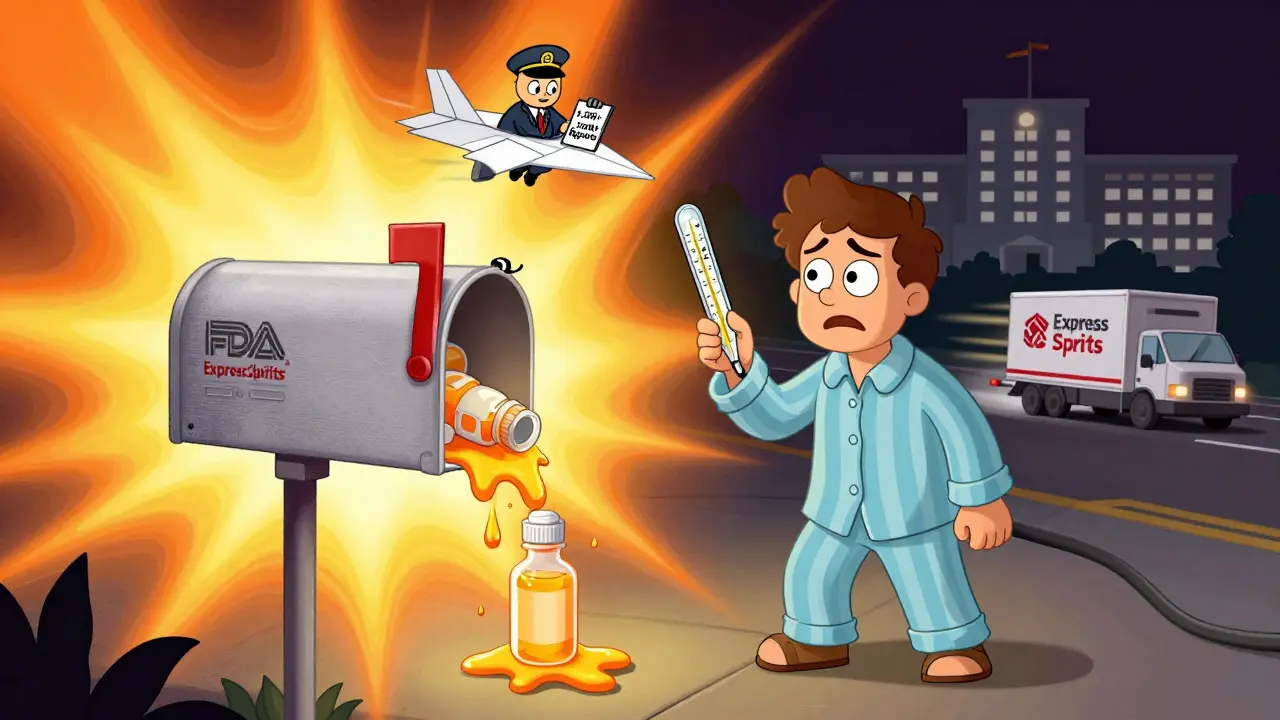
Medications aren’t books or clothes. They’re chemicals. And most need to stay between 68°F and 77°F during shipping. Insulin, for example, loses effectiveness if it gets too hot - even for a few hours. A study cited by The Happy PharmD found that only one-third of mail-order medications are shipped within safe temperature ranges. The FDA has logged over 1,200 reports of temperature-related failures between 2020 and 2023. That’s likely just the tip of the iceberg.Reddit users have shared stories of insulin arriving melted in summer heat. One woman in Texas said her diabetes meds were delivered after sitting in a hot mailbox for three days. She didn’t know until her blood sugar spiked. No one called to warn her. No one asked if she received it. That’s the reality: no one’s checking if your life-saving drug survived the trip.
Lost, Damaged, or Delayed: The Delivery Problem
Trustpilot reviews show 17% of negative experiences with mail-order pharmacies involve lost, damaged, or delayed packages. For someone on a strict schedule - like someone taking blood thinners or seizure meds - even a two-day delay can be dangerous. Unlike a local pharmacy where you can walk in and get a fill same-day, mail-order has no backup. If your package doesn’t arrive, you’re out of meds until the next one ships. That’s why experts recommend ordering at least two weeks before you run out. But most people don’t plan that far ahead.Pharmacists Aren’t There When You Need Them
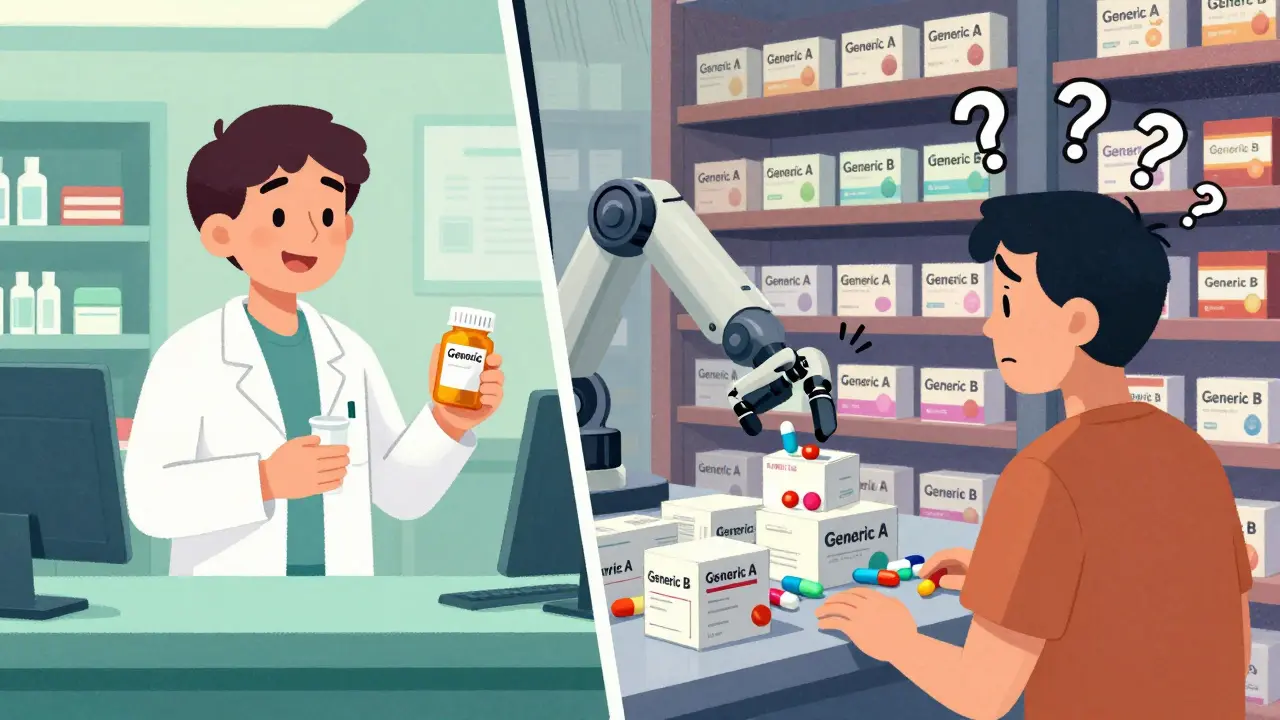
At a local pharmacy, you can ask the pharmacist, “Does this new pill interact with my blood pressure med?” They’ll check your full list. In mail-order, you’re talking to an automated system or a call center rep who doesn’t have your full history. A Consumer Reports survey found 68% of users worry about missing face-to-face consultations. That’s not just inconvenience - it’s a safety risk. Drug interactions can kill. And without a pharmacist reviewing your full regimen, you’re flying blind.Even worse, if you’re taking multiple medications from different pharmacies - say, one generic from mail-order, another from your local pharmacy - no one is seeing the full picture. JAMA Network Open warns this fragmentation increases the chance of dangerous interactions. Your local pharmacist can’t see what’s being mailed. Your mail-order pharmacy doesn’t know what you picked up last Tuesday.
Generic Switching Can Backfire
Generics are supposed to be identical to brand-name drugs. The FDA says so. But they’re not always the same. Different manufacturers make the same generic pill, and they can vary in shape, color, size, or even taste. One patient might get a white oval pill one month, then a blue capsule the next. For people with dementia, anxiety, or chronic illness, that change causes confusion. They think the medicine changed. They think it’s not working. Some stop taking it.A 2017 study found patients switched between multiple generic versions of topiramate (used for epilepsy and migraines) ended up with higher hospitalization rates and longer stays. The drug didn’t change - but their perception of it did. And perception affects adherence. If you’re scared your meds aren’t right, you might skip doses. That’s how a simple switch leads to real harm.
What You Should Do
Mail-order generics aren’t good or bad. They’re a tool. And like any tool, they work best in the right hands.- Use them for chronic meds only - blood pressure, diabetes, thyroid, antidepressants. Not antibiotics, inhalers, or emergency meds.
- Order at least two weeks before you run out. Don’t wait until you’re out.
- Check the shipping method. Ask if they use temperature-controlled packaging. If they don’t answer, find another service.
- If you take more than three meds, keep a printed list and share it with your local pharmacist. Ask them to review all your prescriptions - including mail-order ones.
- Compare prices. Use GoodRx or SingleCare. Sometimes your local pharmacy has a better deal, even without insurance.
- Never assume your mail-order pharmacy has your full medication history. Always tell your doctor and pharmacist about every source you use.
What’s Changing? And What’s Not
The mail-order market is growing fast. Sales jumped from $86 billion in 2013 to over $206 billion in 2023 - while the number of prescriptions only rose 11%. That means prices, not volume, are driving growth. That’s a red flag.There’s talk of new rules. The Pharmacy Delivery Safety Act, introduced in 2023, would require temperature monitoring and proof of delivery for all mailed prescriptions. But it’s still in committee. Until then, you’re on your own.
By 2027, McKinsey predicts nearly half of all chronic medication prescriptions in the U.S. will come through mail-order. That’s not a bad thing - if safety catches up. Right now, convenience is outpacing care. And that’s dangerous.
If you’re using mail-order generics, you’re not wrong. But you’re not fully protected either. Know the risks. Plan ahead. Ask questions. And never assume your meds are safe just because they arrived at your door.
 Health and Wellness
Jenna Allison
January 23, 2026 AT 23:29Got my insulin shipped last winter and it arrived frozen solid. Called the pharmacy, they said 'sorry, not our problem.' I had to go to the ER because my BG went sky-high. No one checks temps. No one cares. Just another profit-driven system.
Always order extra. Always ask about cold packs. Always keep a backup at home. You're the only one looking out for you.
blackbelt security
January 24, 2026 AT 21:49Just started using mail-order for my metformin. Saved $120 a month. No complaints yet. But I do keep a 14-day buffer and check the box when it arrives. If it looks melted or dented, I snap a pic and call immediately. Small effort, big safety net.
Patrick Gornik
January 25, 2026 AT 05:10Let’s be real - this whole system is a neoliberal farce wrapped in a Medicaid blanket. The PBM oligarchs don’t give a shit about your adherence, they care about the spread between the wholesale acquisition cost and the inflated formulary price. You’re not a patient - you’re a revenue stream with a prescription number.
And don’t get me started on generic switching. It’s not just perception - it’s bioequivalence theater. The FDA allows up to 20% variance in active ingredient absorption between generics. That’s not a pill swap - that’s pharmaceutical Russian roulette. And they wonder why people stop taking their meds?
Meanwhile, the same corporations that profit from your dependency are lobbying against temperature regulations because 'it increases operational complexity.' Translation: profit > life. Welcome to American healthcare.
Tommy Sandri
January 26, 2026 AT 09:48The structural inefficiencies in the U.S. pharmaceutical supply chain are well-documented. The fragmentation between retail, mail-order, and PBMs creates dangerous information asymmetries. While convenience is a legitimate benefit, the absence of integrated clinical oversight undermines the very purpose of medication therapy management.
It is imperative that patients maintain a comprehensive, updated medication list and proactively coordinate care across all dispensing entities. This is not merely a best practice - it is a clinical imperative.
venkatesh karumanchi
January 27, 2026 AT 02:53India has the same problem but worse. We get fake meds shipped from unknown labs. I once got pills that looked like candy. Took one. Felt like I swallowed a brick. Never again. Always check the manufacturer. Always. Even if it costs more.
Stay safe, friends.
Marlon Mentolaroc
January 27, 2026 AT 14:57Bro, you’re overthinking it. I’ve been on mail-order for 7 years. My blood pressure is stable. My wallet’s happy. If your insulin melts, maybe you shouldn’t live in Texas? Just saying.
Also, GoodRx is a scam. I paid $3 for lisinopril last week. That’s it. No drama. No fear. Just buy cheap and move on.
Gina Beard
January 28, 2026 AT 18:24Convenience is just another word for surrender.
They want you passive. Quiet. Dependent.
Don’t be.
Don Foster
January 30, 2026 AT 14:22Anyone who uses mail-order without a pharmacy degree is asking for trouble. You think the FDA cares? They’re busy regulating glitter in lip gloss. The real issue is the lack of accountability. No pharmacist. No audit trail. No consequences. Just a box with your life in it. And you’re okay with that?
Also stop using GoodRx. It’s a middleman tax trap. Go to Walmart. $4 for everything. Done.
siva lingam
February 1, 2026 AT 12:55So you’re telling me I need to become a logistics expert just to get my blood pressure pills?
Wow. America. You really did it.
Phil Maxwell
February 3, 2026 AT 04:03I use mail-order for my thyroid med. Never had an issue. But I always call before ordering to ask about shipping temps. They usually say yes. If they don’t answer? I go local.
Simple. No drama. Just… check.
Shelby Marcel
February 3, 2026 AT 19:54my doc switched me to mail order and i didnt even notice the pill changed color till i was like… wait this isnt the one i had last month?? then i got scared and stopped taking it for a week. my anxiety went nuts. now i take a pic of every pill when it arrives. its dumb but i feel safer.
also why does every generic look like a different candy?
Viola Li
February 5, 2026 AT 15:34You’re all missing the point. The real problem is that we’ve outsourced our health to corporations who don’t care if you live or die - only if you keep paying. This isn’t about temperature control or generics. It’s about capitalism turning your medicine into a commodity.
And you’re still surprised when it breaks?
Dolores Rider
February 7, 2026 AT 14:55THEY’RE TRACKING YOU THROUGH YOUR MEDS. I SWEAR TO GOD I GOT A TEXT FROM MY PHARMACY SAYING 'HOPE YOU’RE DOING OK TODAY' THE DAY AFTER I TALKED TO MY THERAPIST ABOUT DEPRESSION. THEY’RE CONNECTING THE DOTS. THEY KNOW EVERYTHING.
THEY’RE SELLING YOUR HEALTH DATA TO INSURERS. I’M NOT TAKING ANYTHING BY MAIL AGAIN. I’M GOING TO THE PHARMACY IN PERSON AND I’M HOLDING THE PILL UP TO THE CAMERA BEFORE I SWALLOW IT.
WE’RE BEING WATCHED.
PS: I SAW A MAN IN A BLACK VAN PARKED OUTSIDE MY HOUSE YESTERDAY. I THINK IT WAS A PBM SPY.