
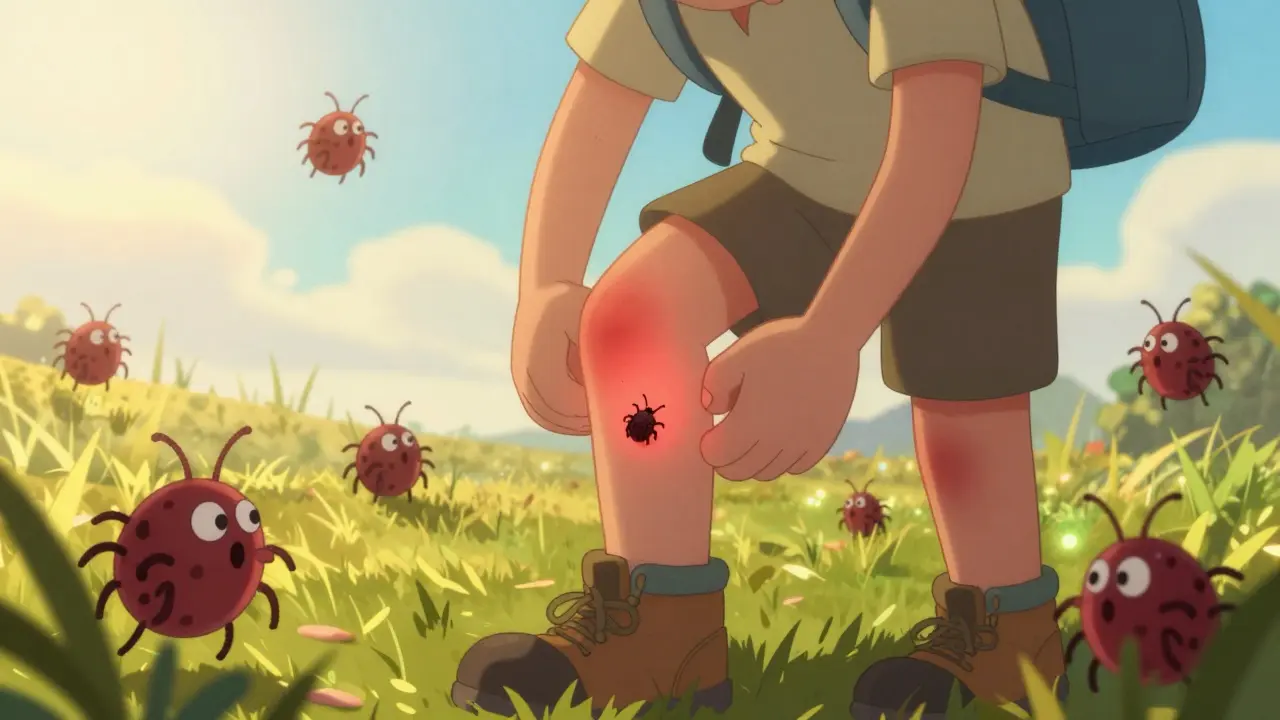
When you get a tick bite, most people assume it’s no big deal. But if that tick is infected, it could start a chain reaction in your body that leads to months - or even years - of pain, fatigue, and confusion. Lyme disease isn’t just a summer nuisance. It’s a stealthy infection that can hide in plain sight, and if you don’t catch it early, it can change your life.
How Lyme Disease Starts
Lyme disease is caused by a spiral-shaped bacteria called Borrelia burgdorferi a bacterium transmitted by infected blacklegged ticks. It doesn’t jump into your system the moment a tick latches on. The tick has to be attached and feeding for at least 24 hours - sometimes longer - before the bacteria travel from its gut to your skin. That’s why checking yourself after being outdoors isn’t just a good habit; it’s your best defense.
The real danger comes from tiny nymph ticks, barely the size of a poppy seed. They’re hard to spot, and they’re most active in spring and early summer. That’s when people are hiking, gardening, or playing in tall grass - exactly where these ticks live. In the U.S., two types of ticks spread Lyme disease: Ixodes scapularis the blacklegged tick found in the Northeast and Midwest, and Ixodes pacificus the Western blacklegged tick along the Pacific coast. If you live in or visit states like Connecticut, Pennsylvania, or Wisconsin, you’re in one of the highest-risk zones. Climate change is pushing these ticks further north, even into Canada.
The Three Stages of Lyme Disease
Lyme doesn’t hit all at once. It unfolds in stages - and each stage has its own warning signs.
Stage 1: Early Localized - This starts 1 to 28 days after the bite. About 70 to 80% of people get a distinctive rash called erythema migrans a circular, expanding red rash often called a "bull’s-eye". It usually appears around 7 to 14 days after the bite. The rash isn’t always painful or itchy. Sometimes, it just looks like a red ring that keeps growing. Other symptoms? Fever, headache, fatigue, muscle aches. These are easy to mistake for the flu.
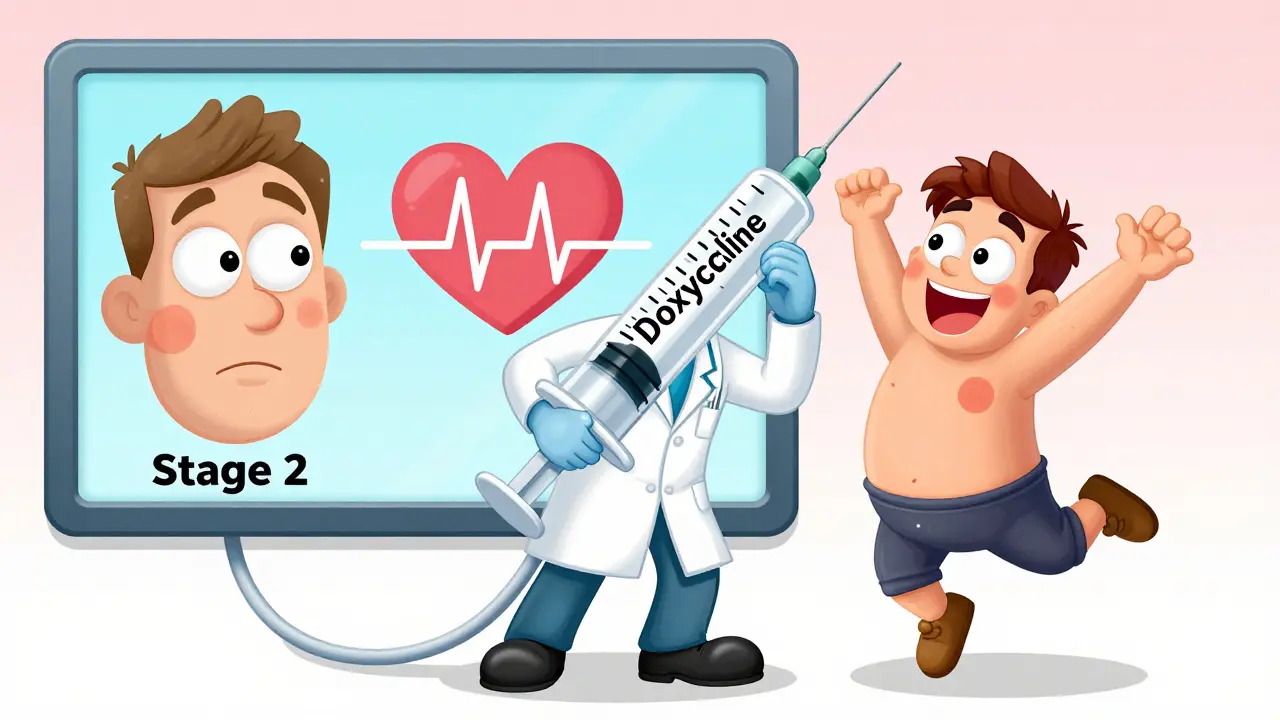
Stage 2: Early Disseminated - If untreated, the bacteria spread through your bloodstream over weeks or months. Now you might see multiple rashes. Or you could develop facial paralysis - one side of your face droops. That’s called Bell’s palsy, and it happens in 5 to 10% of untreated cases. Some people get heart problems, like an irregular heartbeat (Lyme carditis), which affects 4 to 10%. Joint pain and swelling can begin, too, especially in the knees.
Stage 3: Late Disseminated - This stage can show up months or even years later. About 60% of people who go untreated develop severe joint inflammation, often in the knees. Nerve damage can cause numbness, tingling, or shooting pains. Some people struggle with memory lapses, trouble focusing, or brain fog. These symptoms don’t just fade. They linger.
Treatment: What Works and When
The good news? Lyme disease is treatable - if you catch it early.
For early-stage Lyme, doctors prescribe doxycycline an oral antibiotic effective against Borrelia burgdorferi for adults. Kids and pregnant women usually get amoxicillin a safer antibiotic for children and expectant mothers. The course lasts 10 to 21 days. Most people feel better within days. A 2022 CDC review found that 87% of patients treated within 30 days of symptoms fully recovered within three months.
If the infection has spread - say, to your nerves or heart - you’ll need intravenous antibiotics like ceftriaxone, delivered through an IV for 14 to 28 days. This isn’t a hospital stay forever. It’s often done at home with outpatient IV therapy. The goal? Stop the bacteria before it causes permanent damage.
There’s one exception: if you’re in a high-risk area, find an engorged tick stuck to you for more than 36 hours, and you get to the doctor within 72 hours, you might get a single dose of doxycycline - even without symptoms. That’s called prophylaxis. It cuts your risk of infection by over 90%.
The Diagnosis Problem
Here’s the ugly truth: many doctors miss Lyme disease. A 2022 study showed only 52% of primary care doctors could correctly identify all three stages of Lyme in a clinical case. That’s why patients often see three or more doctors before getting diagnosed. The average delay? 1.8 years.
Why? Blood tests aren’t perfect. The standard two-tiered test (ELISA followed by Western blot) only catches about 30% of early cases. That’s because your body hasn’t made enough antibodies yet. The test can be wrong when you need it most. That’s why experts like Dr. Allen Steere say: if you have the bull’s-eye rash, don’t wait for a lab result. Start treatment immediately. The rash alone is proof enough.
There’s hope on the horizon. In March 2023, the FDA approved a new test called MiQLick a urine-based diagnostic that detects Borrelia burgdorferi DNA. It’s 92% sensitive in early Lyme - a huge leap forward. A vaccine trial (VLA15) is also in phase 3, with early results showing 70-96% effectiveness. And researchers are working on an mRNA vaccine, similar to the ones for COVID-19, expected to enter human trials in 2024.
What About "Chronic Lyme"?
This is where things get messy. Some patients - about 10 to 20% - still feel tired, achy, or foggy months after finishing antibiotics. This isn’t an ongoing infection. It’s called Post-Treatment Lyme Disease Syndrome a condition where symptoms persist despite successful antibiotic treatment. The cause isn’t clear. Maybe it’s lingering inflammation. Maybe it’s nerve damage. But it’s not the bacteria hiding.
Some clinics still offer long-term antibiotics for this. But the Infectious Diseases Society of America says there’s no proof it helps. In fact, it can be dangerous. Antibiotics can cause serious side effects - from gut infections to antibiotic-resistant superbugs.
Meanwhile, 28 U.S. states have passed laws protecting doctors who prescribe long-term antibiotics for "chronic Lyme." The debate isn’t just medical. It’s political. And it leaves patients caught in the middle.

Prevention: Your Best Shield
You can’t eliminate all risk. But you can slash it.
- Check your whole body for ticks within 2 hours of coming indoors - especially your scalp, armpits, and groin.
- Shower within 2 hours of being outside. Water helps wash off unattached ticks.
- Use permethrin-treated clothing. It kills ticks on contact.
- Stick to trails. Avoid tall grass and leaf piles.
- Use DEET-based repellents on skin. They’re effective against ticks.
- If you find a tick, remove it with fine-tipped tweezers. Pull straight up. Don’t twist. Save it in a sealed bag - you might need it for testing.
And if you live in a high-risk area? Keep a tick removal kit in your backpack. A quick check could save you months of pain.
The Bigger Picture
Lyme disease isn’t going away. Cases are rising. The CDC estimates 476,000 Americans get it each year - ten times more than official reports. Climate change is expanding tick habitats. More people are moving into wooded suburbs. Outdoor recreation is booming.
But here’s the key: most people who get diagnosed early and treated properly get better. No long-term disability. No lifelong medication. Just a few weeks of antibiotics and a return to normal life.
The problem isn’t the disease itself. It’s the delay. The confusion. The missed diagnosis.
If you’ve had a tick bite and feel off - even a little - don’t wait. Don’t assume it’s just a bug. Get checked. The clock starts ticking the moment the tick attaches.
Can you get Lyme disease more than once?
Yes. Getting Lyme disease once doesn’t make you immune. You can be bitten again by another infected tick. That’s why prevention doesn’t stop after one infection.
Do all ticks carry Lyme disease?
No. Only certain species - mainly blacklegged ticks - carry the bacteria. And even among those, not every tick is infected. In high-risk areas, about 20 to 50% of ticks may carry Borrelia burgdorferi. But you can’t tell by looking. Always treat any tick bite seriously.
Can pets get Lyme disease and pass it to humans?
Dogs and cats can get Lyme disease, but they don’t directly transmit it to humans. However, ticks that feed on infected pets can later bite people. So, using tick prevention on pets reduces your risk too.
Is the Lyme disease rash always a bull’s-eye?
No. Only about 20% of rashes have the classic ringed appearance. Most look like a solid red patch that expands over time. Don’t wait for the bull’s-eye. If you see any unusual red rash after a tick bite, get it checked.
Can Lyme disease be cured?
Yes, when caught early. Most people fully recover after a short course of antibiotics. The challenge is catching it before it spreads. Delayed treatment increases the chance of lingering symptoms, but even then, many improve over time with proper care.
Are there natural remedies for Lyme disease?
There’s no scientific evidence that herbal supplements, essential oils, or special diets cure Lyme disease. Antibiotics are the only proven treatment. Relying on unproven methods can delay proper care and lead to serious complications.
 Health and Wellness
Ray Foret Jr.
March 10, 2026 AT 05:31Samantha Fierro
March 10, 2026 AT 20:04Peter Kovac
March 11, 2026 AT 22:06APRIL HARRINGTON
March 12, 2026 AT 22:29Leon Hallal
March 14, 2026 AT 00:03Judith Manzano
March 15, 2026 AT 03:43rafeq khlo
March 16, 2026 AT 21:58Morgan Dodgen
March 17, 2026 AT 14:43Philip Mattawashish
March 17, 2026 AT 16:09Tom Sanders
March 18, 2026 AT 04:52Jazminn Jones
March 18, 2026 AT 21:32Mary Beth Brook
March 19, 2026 AT 21:41Neeti Rustagi
March 21, 2026 AT 02:45