
Levothyroxine and PPI Interaction Calculator
If you're taking levothyroxine for hypothyroidism and also use a proton pump inhibitor (PPI) like omeprazole or pantoprazole for heartburn, you might be unaware that these two medications are working against each other. This isn't just a theoretical concern-it’s a real, documented interaction that can leave you feeling tired, gaining weight, or wondering why your thyroid levels won’t stabilize, even when you take your pills exactly as prescribed.
Why Levothyroxine Needs Acid
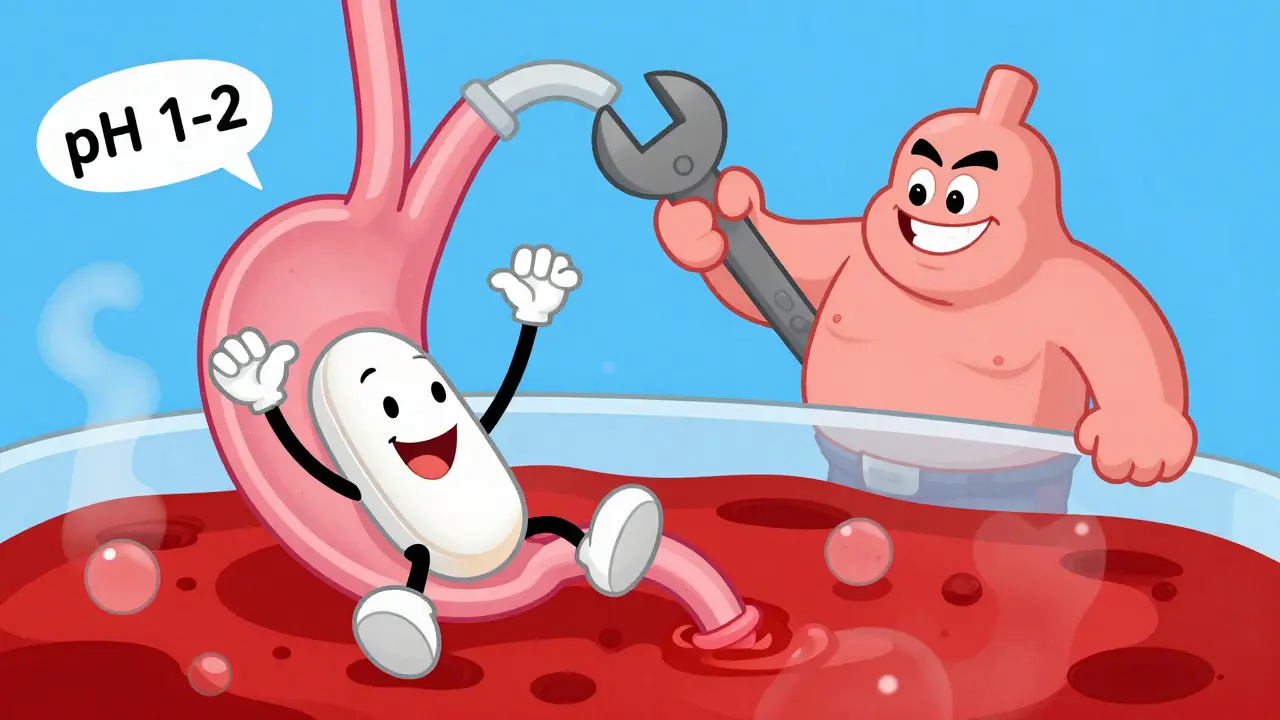
Levothyroxine isn’t like most pills. It doesn’t just dissolve in your stomach and get absorbed. It needs an acidic environment-specifically, a pH between 1 and 2-to break down properly and enter your bloodstream. That’s why doctors tell you to take it on an empty stomach, first thing in the morning, at least 30 to 60 minutes before eating. But if you’re also taking a PPI, you’re basically turning your stomach into a neutral pond instead of a strong acid bath.
Proton pump inhibitors block the acid-producing pumps in your stomach lining. That’s great if you have chronic GERD or ulcers. But for levothyroxine, it’s a problem. Without enough acid, the tablet doesn’t dissolve correctly. The hormone stays locked inside the pill, passes through your gut mostly unchanged, and gets flushed out. Your body doesn’t get the dose it needs.
What the Science Shows
A 2021 systematic review in the Journal of General Internal Medicine looked at seven studies involving over 1,200 patients taking both levothyroxine and PPIs. The results were clear: TSH levels rose in nearly every group. Higher TSH means your thyroid isn’t getting enough hormone signal from your brain, which is your body’s way of saying, “We’re still hypothyroid.”
One 2023 study published in PubMed (PMID: 37259094) gave patients 40 mg of pantoprazole daily for six weeks-just a standard dose-and saw TSH jump significantly, even in people who had been stable on levothyroxine for years. And here’s the kicker: it didn’t matter whether they took the PPI in the morning with levothyroxine or at night. The acid suppression lasted too long for timing to fix it.
That’s the key point most people miss. You can’t just space them out by a few hours. PPIs don’t wear off after 4 or 6 hours. They shut down acid production for up to 72 hours in some cases. So even if you take levothyroxine at 6 a.m. and the PPI at 8 p.m., your stomach is still too neutral for proper absorption.
Who’s Affected and How Much
About 15 million Americans take levothyroxine regularly. Around 18% of them-roughly 2.7 million people-are also on a PPI. That’s a huge number of people potentially underdosed on their thyroid medication. The Mayo Clinic Proceedings found that 15 to 20% of these patients need their levothyroxine dose increased, usually by 12.5 to 25 micrograms per day.
But it’s not just about the numbers. Real people feel it. On Reddit’s r/Hashimotos subreddit, a review of 147 posts from late 2023 showed that 68% of users taking long-term PPIs reported needing higher levothyroxine doses. The most common complaints? Fatigue (72%) and unexplained weight gain (58%). These aren’t just side effects-they’re signs your thyroid isn’t getting what it needs.
What You Can Do
There are three real options if you’re taking both medications.
- Adjust your levothyroxine dose. If you’re on a PPI and your TSH is high, your doctor should increase your levothyroxine by 12.5-25 mcg. Retest your TSH in 6 to 8 weeks. Most patients stabilize within 12 weeks, according to Cleveland Clinic data.
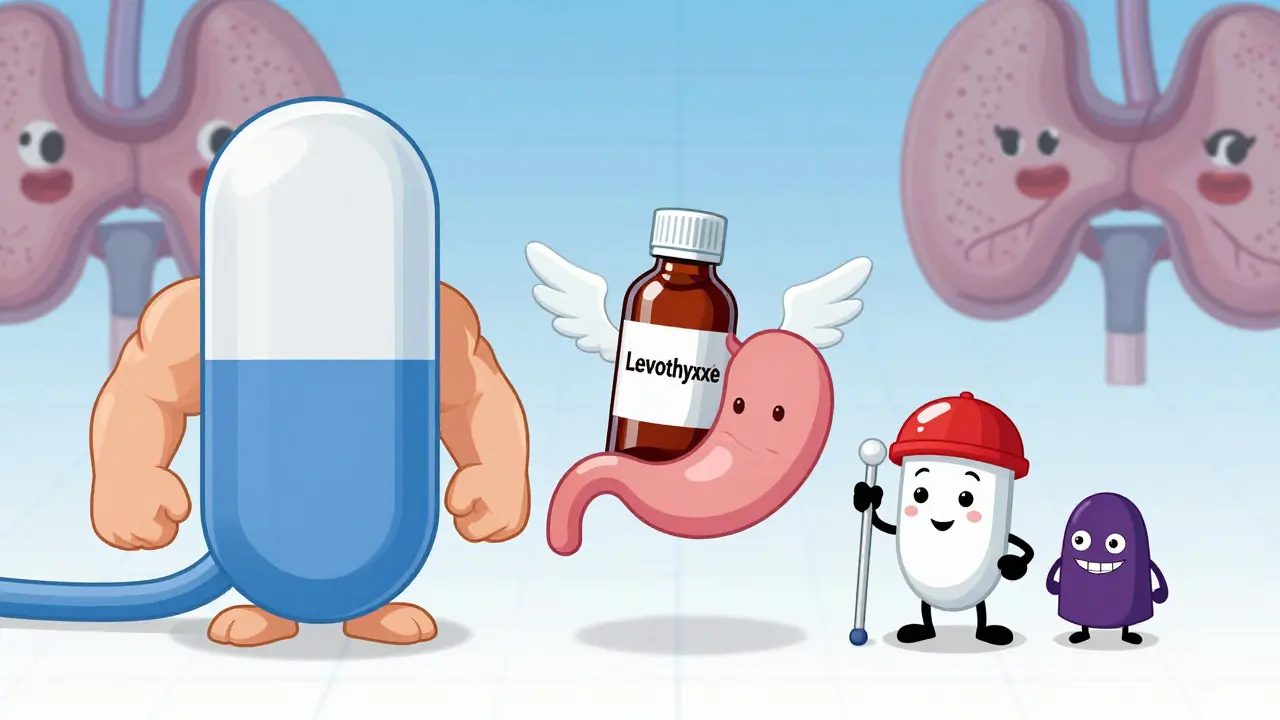
- Switch to liquid levothyroxine. Tirosint-SOL is a liquid formulation that doesn’t rely on stomach acid. A 2019 study in the Journal of Clinical Endocrinology & Metabolism confirmed it’s absorbed just fine even with PPIs. The catch? It costs about $350 a month-15 to 20 times more than generic tablets. Insurance doesn’t always cover it, and generic liquid versions aren’t widely available yet.
- Try an H2 blocker instead. Famotidine (Pepcid) reduces acid too, but not as strongly or as long as PPIs. A 2018 study in Pharmacotherapy showed no significant change in TSH levels when famotidine was taken with levothyroxine. If you don’t need full PPI-level acid suppression, this might be a safer alternative.
What Doesn’t Work
Many people try to fix this by taking levothyroxine and the PPI hours apart. You’ll hear advice like “take your thyroid pill at 6 a.m., and the PPI at 10 p.m.” But the science says it won’t help. PPIs don’t just reduce acid for a few hours-they shut down the pumps for days. Even if you space them out, your stomach remains too neutral for levothyroxine to absorb properly.
And short-term PPI use? If you’re only on it for two or three weeks-say, after a bad bout of gastritis-you probably won’t see any effect. But if you’ve been on it for three months or longer, you need to assume the interaction is happening and act on it.
What’s Coming Next
The FDA is working on new labeling rules for thyroid medications that will explicitly warn about PPI interactions. That’s a big step forward. Meanwhile, researchers are testing new enteric-coated levothyroxine tablets designed to dissolve in the small intestine, bypassing the stomach entirely. Early trials are promising, but they’re still in phase 3.
Also watch for the 2025 patent expiration of Tirosint-SOL. Once that happens, generic manufacturers may finally be able to make affordable liquid levothyroxine. Right now, formulation challenges have slowed things down. But if they crack it, this interaction could become much easier to manage.
What to Do Now
If you’re on levothyroxine and a PPI:
- Don’t stop either medication without talking to your doctor.
- Ask for a TSH test if you haven’t had one in the last 3 months.
- If your TSH is high and you’ve been on a PPI for more than 3 months, discuss dose adjustment or alternatives.
- Consider switching to famotidine if your acid reflux isn’t severe.
- If cost isn’t an issue and your symptoms persist, ask about Tirosint-SOL.
This isn’t a rare edge case. It’s a common, well-studied problem that affects millions. If your thyroid levels keep being off, and you’re on a PPI, this is probably why. Don’t assume it’s just your body being stubborn. The science is clear. Your medication is fighting itself. Time to fix it.
 Health and Wellness
Kathryn Featherstone
December 20, 2025 AT 07:29I’ve been on levothyroxine for 8 years and started omeprazole last winter for silent reflux. My TSH went from 2.1 to 7.8 in 4 months. I thought I was just getting older or stressed. Turns out, my stomach was too chill for my thyroid med. Switched to famotidine and my dose got bumped up by 12.5 mcg. Energy’s back. No more 3 p.m. naps. Thank you for this post.
Dorine Anthony
December 21, 2025 AT 03:39My endo never mentioned this. I’ve been on pantoprazole for 5 years and just found out my TSH is high because my pills aren’t dissolving. I feel like a fool for thinking it was ‘just my metabolism.’
Henry Marcus
December 21, 2025 AT 09:30Big Pharma doesn’t want you to know this! PPIs are designed to keep you dependent-why? Because they make billions off people who then need higher levothyroxine doses, then more labs, then more visits! It’s a profit loop disguised as medicine! And don’t get me started on Tirosint-SOL-$350/month? That’s a scam wrapped in a pill bottle with a FDA sticker! The real solution? Apple cider vinegar and cold showers. I’ve been off both meds for 14 months. My TSH is 1.9. The system hates free thinkers.
Carolyn Benson
December 22, 2025 AT 05:02What’s interesting here is the ontological rupture between pharmaceutical intent and biological reality. The PPI doesn’t merely inhibit acid-it imposes a metaphysical negation upon the very process of bioavailability. Levothyroxine, as a synthetic analog of a natural hormone, demands the primordial chaos of gastric acidity to assert its identity in the bloodstream. To suppress that is to deny the body’s epistemological contract with its own chemistry. We’ve turned physiology into a corporate algorithm. And we wonder why people feel empty.
Aadil Munshi
December 22, 2025 AT 12:17Wow, this post is actually useful. Most people on Reddit just scream about keto or intermittent fasting. But this? This is real. I’m from India and we’re seeing this more and more here-people on PPIs for years, never tested TSH. My cousin’s mom took 100mcg levothyroxine and still felt awful. Switched to famotidine, dose adjusted, now she’s hiking in the Himalayas. The science is solid. Also, Tirosint-SOL is a joke unless you’re rich. Famotidine is the MVP here. 10/10 post.
Sajith Shams
December 23, 2025 AT 20:12Everyone’s missing the point. Even if you switch to famotidine, you’re still taking a drug that alters your stomach pH. The real solution is not more pills. It’s gut healing. Low FODMAP diet, probiotics, stop eating processed crap. I was on PPIs for 7 years. Got off. Lost 30 lbs. My TSH normalized without any dose change. You don’t need to swap one drug for another. You need to stop poisoning your system. This post is good but it’s still playing the game.
Adrienne Dagg
December 25, 2025 AT 17:35OMG I’ve been taking omeprazole since 2020 and my thyroid’s been a mess 😭 I just thought I was ‘thyroid weird’ 🤦♀️ I’m calling my doctor tomorrow. Also, Tirosint-SOL sounds like a luxury spa treatment 💸 but I’m willing to try if it means I can stop feeling like a zombie. THANK YOU for this. 🙏❤️
Erica Vest
December 26, 2025 AT 06:50Important clarification: The 2023 study (PMID: 37259094) used 40 mg pantoprazole daily. Most patients are on 20 mg. The effect is dose-dependent. Also, liquid levothyroxine (Tirosint-SOL) is absorbed regardless of gastric pH, but it’s not bioequivalent to tablets at a 1:1 ratio-dose adjustments are still needed. And famotidine’s effect is transient; it’s not a long-term replacement for PPIs in severe GERD. Always consult your provider before changing meds. This is excellent information, but context matters.
Chris Davidson
December 28, 2025 AT 02:05This is why medicine is broken. People take pills like candy. They don’t think about mechanisms. They don’t read the small print. They don’t ask questions. You take levothyroxine. You take PPI. You wonder why you’re tired. The answer is in the pharmacology. It’s not complicated. But you need to care. Most people don’t. That’s the real problem.
Kinnaird Lynsey
December 29, 2025 AT 18:45Thanks for laying this out so clearly. I’ve been on both meds for 4 years and thought I was just ‘bad at thyroid management.’ My TSH was 8.2. We switched me to famotidine and bumped my levothyroxine by 12.5 mcg. Six weeks later: 2.8. I feel human again. I’m not mad at the system-I’m just glad someone finally explained it without jargon. Also, I’m now telling all my friends on PPIs. This deserves more attention.