
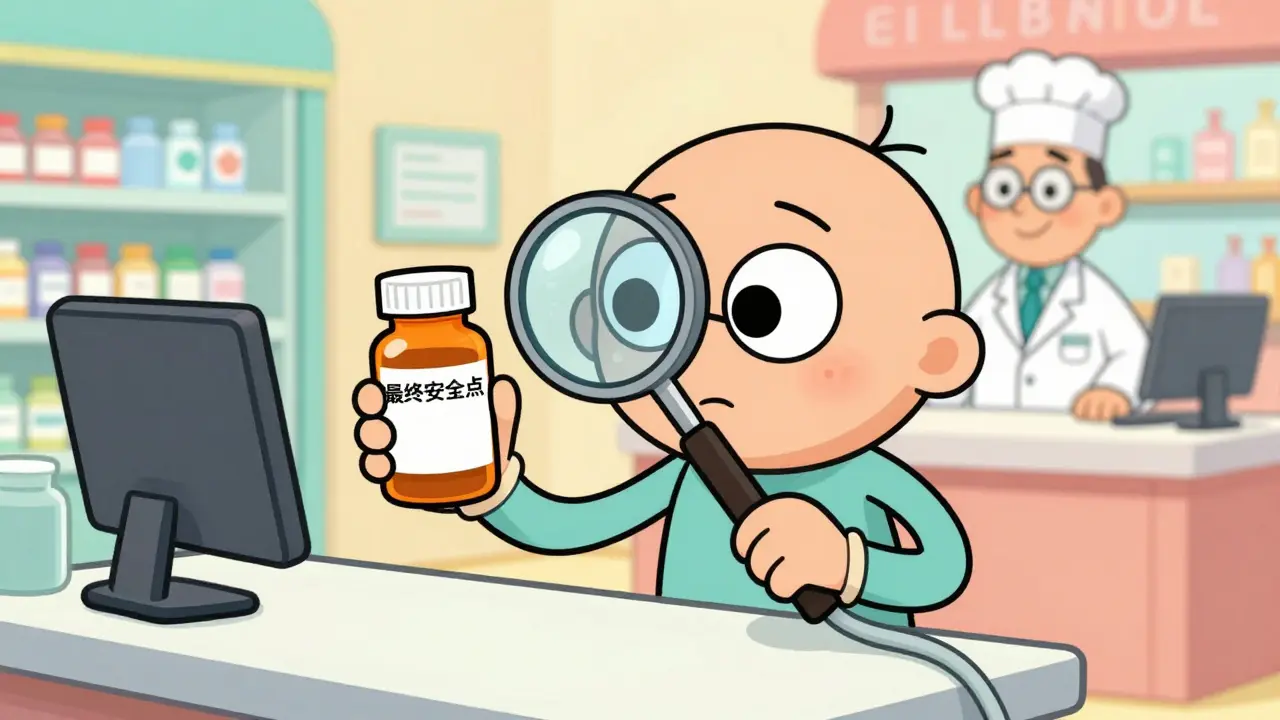
You trust your pharmacist, and you probably should. But even the best professionals make mistakes. In the US alone, about 1.5 million people are affected by medication errors every year. While pharmacists have their own double-check systems, those checks aren't perfect-studies show they still miss about 3.4% of selection mistakes. That means you, the patient, are actually the final safety checkpoint. If a wrong dose or the wrong drug slips through the pharmacy's system, you're the only one left to catch it before it enters your body.
The Red Flags: Common Labeling Mistakes
Not all errors look like a totally different drug. Some are subtle and far more dangerous. Knowing what to look for turns a quick glance into a real safety check. The most common culprits fall into a few specific categories:
- Look-Alike/Sound-Alike (LASA) Drugs: This is a huge issue, accounting for roughly 30% of dispensing errors. These are drugs with names that look or sound almost identical. For example, Cycloserine and Cyclosporine are dangerously similar. If you're expecting one and see the other, stop immediately.
- Strength and Decimal Errors: A misplaced dot can be catastrophic. A label that says "5 mg" instead of "0.5 mg" is a 10-fold overdose. This is especially critical for high-alert medications like Warfarin or Levothyroxine.
- Dosage Form Mix-ups: Sometimes the drug is right, but the form is wrong-like receiving capsules when your doctor prescribed tablets. This happens in about 25% of labeling mistakes.
- Missing Indications: A good label should tell you what the drug is for (e.g., "for high blood pressure"). If the indication is missing, it's harder to realize you've been given the wrong medication entirely.
The 4-Step Verification Protocol
Checking your meds shouldn't feel like a chore; it should be a habit, like checking your mirror before you drive. The Agency for Healthcare Research and Quality (AHRQ) suggests a simple method that takes about 60 to 90 seconds. To truly prevent a pharmacy labeling error, follow these steps every single time you pick up a new script:
- Compare to the source: Look at the pharmacy label and compare it directly to the prescription written by your doctor or your digital health record.
- Check for "Tall-Man" lettering: Look for capitalized parts of a drug name used to differentiate similar drugs. For example, GLIpiZIDE versus glyBURide. If the lettering looks weird, it's usually there to warn you.
- Read the numbers aloud: Don't just look at the strength (e.g., 10mg); say it out loud. This engages a different part of your brain and makes it much easier to spot a misplaced decimal point.
- Confirm the instructions: Does the label say "take once daily" when your doctor specifically told you to take it twice? If the directions don't match the conversation you had with your provider, don't take the pill.
| Error Type | Frequency | Example Risk | Detection Tip |
|---|---|---|---|
| LASA (Sound-Alike) | ~30% | Wrong medication entirely | Use Tall-Man lettering checks |
| Dosage Form | ~25% | Capsule vs. Tablet | Visually inspect the pill |
| Strength/Decimal | ~20% | 10-fold overdose | Read numbers aloud |

Why Your Previous Bottle is Your Best Tool
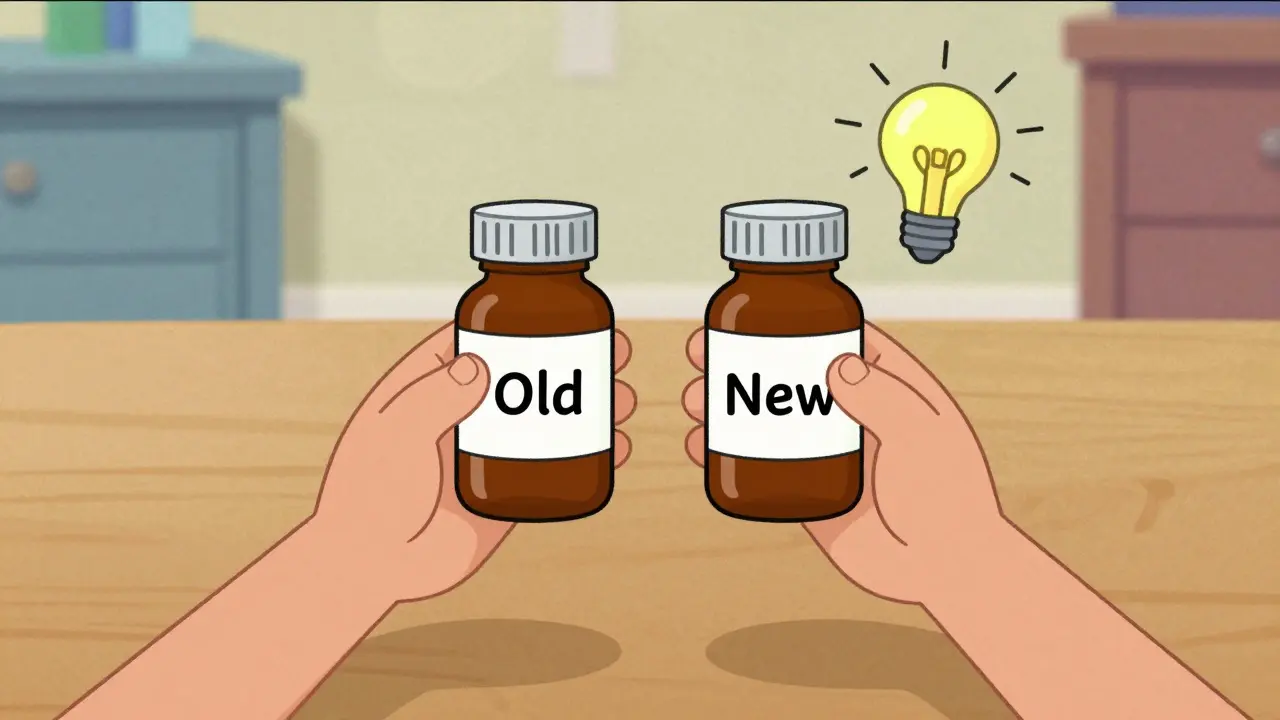
One of the most effective ways to spot a mistake is to use your old medication container as a baseline. Structured verification-comparing the new bottle to the previous one-is significantly more effective than just glancing at the new label. Research shows that patients using this comparison method detect 89% of errors, compared to only 42% for those who don't.
Check the color of the pill, the shape, and the imprint code on the tablet. If your blood pressure medication was always a small white round pill and suddenly it's a large yellow oval, something is wrong, even if the label looks correct. This physical check acts as a second layer of defense against dispensing errors.
Dealing with the "Bother" Factor
A surprising number of people-around 68% in some studies-notice something is off but take the medication anyway because they don't want to "bother" the pharmacy staff. Let's be clear: questioning your medication is not a nuisance; it's a safety requirement. Pharmacists would much rather spend five minutes correcting a label than spend five hours dealing with a patient in the emergency room due to an overdose.
If you spot an error, ask the pharmacist to walk you through the change. Sometimes, your doctor actually *did* change the dose, and the pharmacy is correct while your old bottle is outdated. The goal isn't to accuse the pharmacist of a mistake, but to confirm the current clinical plan. A simple, "This looks different than my last refill; can we double-check the dose?" is all it takes.
Tech Tools for Extra Peace of Mind
If you're managing multiple medications or have vision impairment, technology can help bridge the gap. New tools are emerging to reduce the cognitive load of verification. Some pharmacies now use QR codes on bags that provide audio descriptions of the medication, which has been shown to increase verification rates by nearly 50%.
Additionally, there are apps that use optical character recognition (OCR) to compare a photo of your label against your expected medication profile. While no app replaces a manual check, these tools provide an extra set of digital eyes. Just remember that the gold standard remains the "Teach-Back" method: if you can't clearly state what the drug is for and exactly how to take it, you haven't finished the verification process.
What are LASA medications?
LASA stands for "Look-Alike/Sound-Alike." These are medications that either have very similar names or look similar in their packaging. Because they are so easily confused, they are a primary cause of dispensing errors. Pharmacists use "Tall-Man" lettering (e.g., predNISOone vs. predNIZOlone) to help differentiate them.
How do I know if the strength is wrong?
Compare the dosage on the label to your previous refill or the instructions your doctor gave you. Be especially wary of decimal points. Read the number out loud (e.g., "zero point five milligrams") to ensure you aren't misreading it as "five milligrams." If the dose has changed, verify with your doctor that the change was intentional.
What should I do if the pill looks different than last time?
Do not take the medication. Even if the label says the drug is correct, a change in color, shape, or size could mean the wrong medication was put in the bottle. Take the bottle back to the pharmacy and ask them to verify the physical pill against the prescription.
Is it normal for pharmacies to make these mistakes?
While not "normal" in terms of desired outcome, errors do happen. Community pharmacies process billions of prescriptions, and a small percentage of dispensing errors occur despite safety protocols. This is why patient verification is considered the final, critical safety layer.
What is the "indication for use" on a label?
The indication is the reason you are taking the medication (e.g., "for cholesterol" or "for infection"). Having this on the label makes it much easier to spot an error-if you're taking a pill for blood pressure but the label says "for anxiety," you'll know immediately that something is wrong.
Next Steps for Your Medication Routine
To make this a permanent part of your health routine, try these a few simple adjustments:
- The Refill Ritual: Whenever you pick up a new medication, spend 90 seconds in the pharmacy parking lot performing the 4-step check before you head home.
- Maintain a List: Keep a digital or paper list of all your current medications, including the exact strength and dosage. Compare the new label to this list.
- Ask for Indication: Request that your pharmacy include the purpose of the medication on every label. It is a simple request that significantly increases your ability to catch errors.
- Use a Pill Organizer: When transferring meds to a weekly organizer, use that moment to perform one last visual check of the pill's appearance.
 Health and Wellness
Danielle Kelley
April 6, 2026 AT 11:09You're telling me we're the "final checkpoint" because the system is just "accidentally" failing? Give me a break. This isn't about mistakes, it's about control and seeing who's actually paying attention to what's being pumped into their veins. They want us to just trust the label while they experiment with doses. Wake up, people!
Toby Sirois
April 6, 2026 AT 11:25Honestly, if you can't handle a simple pill bottle, that's on you. It's basic common sense. Just look at the pill. If it's the wrong color, don't eat it. Not that hard.
charles mcbride
April 8, 2026 AT 02:29This is such a helpful guide for everyone to keep their health on track!
Alexander Idle
April 9, 2026 AT 21:50Oh my god, the sheer audacity of the pharmaceutical industry to leave the safety check to the patient is absolutely scandalous! I am literally shaking just thinking about the 10-fold overdose risk. It is simply an outrage of the highest order that we are forced to perform these "rituals" in a parking lot just to ensure we don't accidentally poison ourselves because some overworked pharmacist can't read a decimal point. This is a complete catastrophe of public health management and quite frankly, I find the entire situation utterly exhausting to even contemplate. Imagine the drama of a hospital visit just because someone forgot how to type 0.5! It's just too much for one person to bear.
Sarabjeet Singh
April 11, 2026 AT 15:25Stay safe and keep checking your meds.
Christopher Cooper
April 13, 2026 AT 01:31The mention of Tall-Man lettering is really interesting. I wonder if there are specific international standards for which parts of the drug names get capitalized, or if it varies by pharmacy chain. It seems like a great way to reduce cognitive load, but I'd love to see more data on how it actually performs in real-world high-stress environments.
Daniel Trezub
April 14, 2026 AT 07:59Actually, the 89% detection rate mentioned is probably inflated because people who are diligent enough to compare bottles are already more likely to spot errors anyway. It's a selection bias. But hey, keep believing the numbers if it makes you feel safe!
Rupert McKelvie
April 15, 2026 AT 20:42It's great to see a practical approach to patient safety. These small habits can truly save lives.
Vivek Hattangadi
April 16, 2026 AT 11:48I totally agree with the point about the "bother" factor. I've seen so many people just shrug it off. We should definitely support each other in speaking up at the pharmacy counter to ensure everyone gets the right dose!
Rauf Ronald
April 17, 2026 AT 15:24As someone who's worked in healthcare, I can tell you that the "Teach-Back" method is gold. If you can't explain it, you don't know it. Also, don't forget to check the expiration date-it's not a labeling error per se, but it's just as important for the drug's efficacy!
Del Bourne
April 19, 2026 AT 12:06I highly recommend keeping a physical log of your medications, as mentioned in the guide. It's especially useful when you're in an emergency situation and need to provide an accurate list to a doctor quickly. Using a pill organizer also helps you spot a physical change in the tablet's appearance much more easily than when you're just glancing at the bottle.
Michael Flückiger
April 20, 2026 AT 15:58This is just so vital!!! Everyone needs to do this!!!! Please, please don't be afraid to double-check your meds!!!! It's your life on the line!!!!