
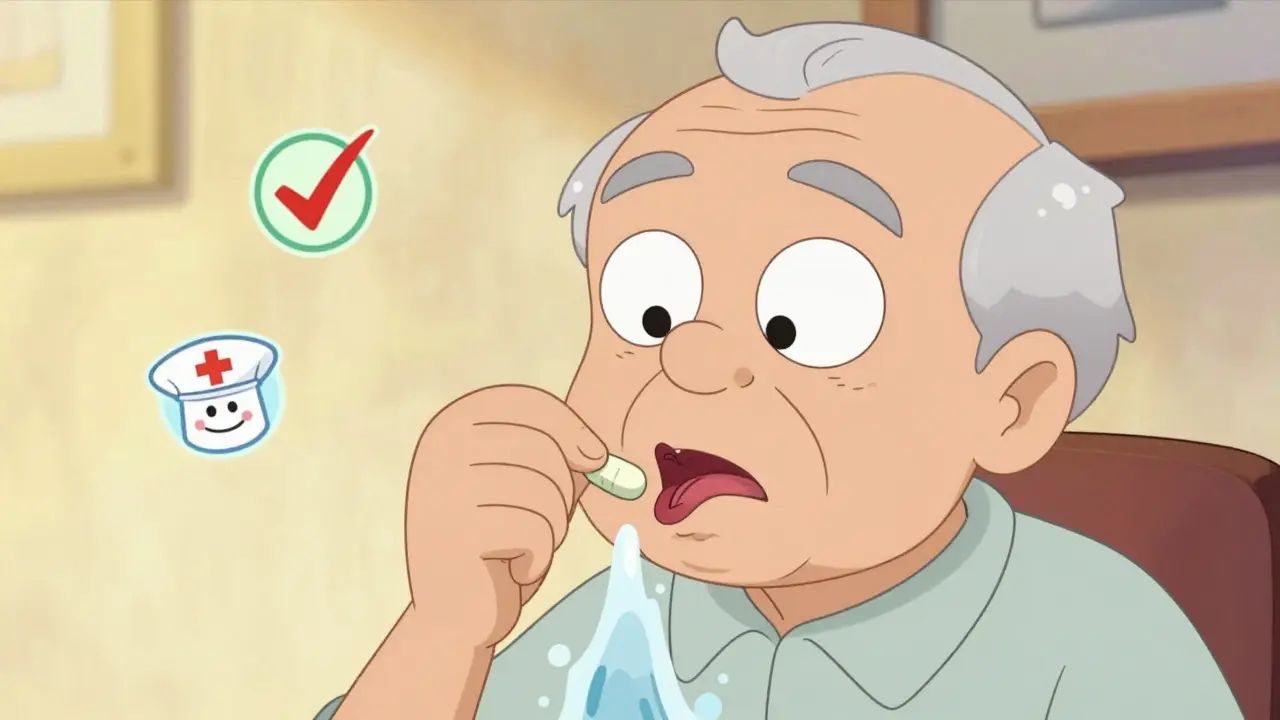
Swallowing a pill shouldn’t feel like a battle. But for millions of people-especially older adults, stroke survivors, or those with Parkinson’s or dementia-it is. Swallowing difficulties don’t just make taking medicine uncomfortable; they make it dangerous. Skipping doses because you can’t swallow a tablet can lead to worsening health, hospital visits, or even death. The good news? There are real, safe, and practical ways to keep taking your meds without risking choking, aspiration, or ineffective treatment.
Why Swallowing Pills Is Harder Than You Think
Dysphagia-the medical term for swallowing trouble-affects up to 15% of older adults living at home and nearly 7 out of 10 nursing home residents. It’s not just about dry mouth or fear of choking. Swallowing involves a complex chain of muscle movements: the tongue pushes the pill back, the throat closes off the airway, and the esophagus contracts to move it down. If any part of that system is damaged-by stroke, nerve degeneration, or even just aging-it breaks down. Many people assume crushing pills or mixing them with applesauce is harmless. But research shows nearly half of these modifications are unsafe. A 2023 study found that 48% of crushed or opened medications were changed in ways that could reduce effectiveness or cause harm. Some pills have special coatings to release slowly over hours. Crush them, and you get a dangerous spike in drug levels. Others are designed to dissolve in the gut, not the stomach. Crush those, and the drug never works right.What You Should Never Do
Before trying any trick, know what to avoid:- Don’t crush extended-release or enteric-coated pills (like omeprazole, metformin XR, or aspirin EC). These are labeled for a reason.
- Don’t open capsules unless the pharmacist confirms it’s safe. Many contain tiny beads that can’t be evenly divided.
- Don’t mix medications with thick foods like peanut butter or yogurt without checking. Some drugs bind to fat or protein and become inactive.
- Don’t assume all liquids work the same. Thin fluids like water can slip into the lungs, especially if your swallow reflex is weak. Thickened liquids are safer for some, but not all.
Safe Alternatives to Swallowing Tablets
The best solution isn’t forcing pills down-it’s changing the pill itself. Ask your pharmacist for alternatives:- Liquids: Many common meds-like blood pressure pills, antidepressants, or pain relievers-come in liquid form. Even if it’s not listed on the label, pharmacists can often order or compound them.
- Orodispersible tablets: These dissolve on the tongue in seconds. No water needed. Brands like Zofran and Risperdal offer these for patients with swallowing issues.
- Effervescent tablets: Dissolve in water to make a drinkable solution. Great for painkillers like paracetamol or vitamin C.
- Topical patches: For pain, hormones, or nicotine, patches avoid the digestive system entirely.
- Rectal suppositories: Used for nausea, fever, or certain seizure meds when oral intake isn’t possible.
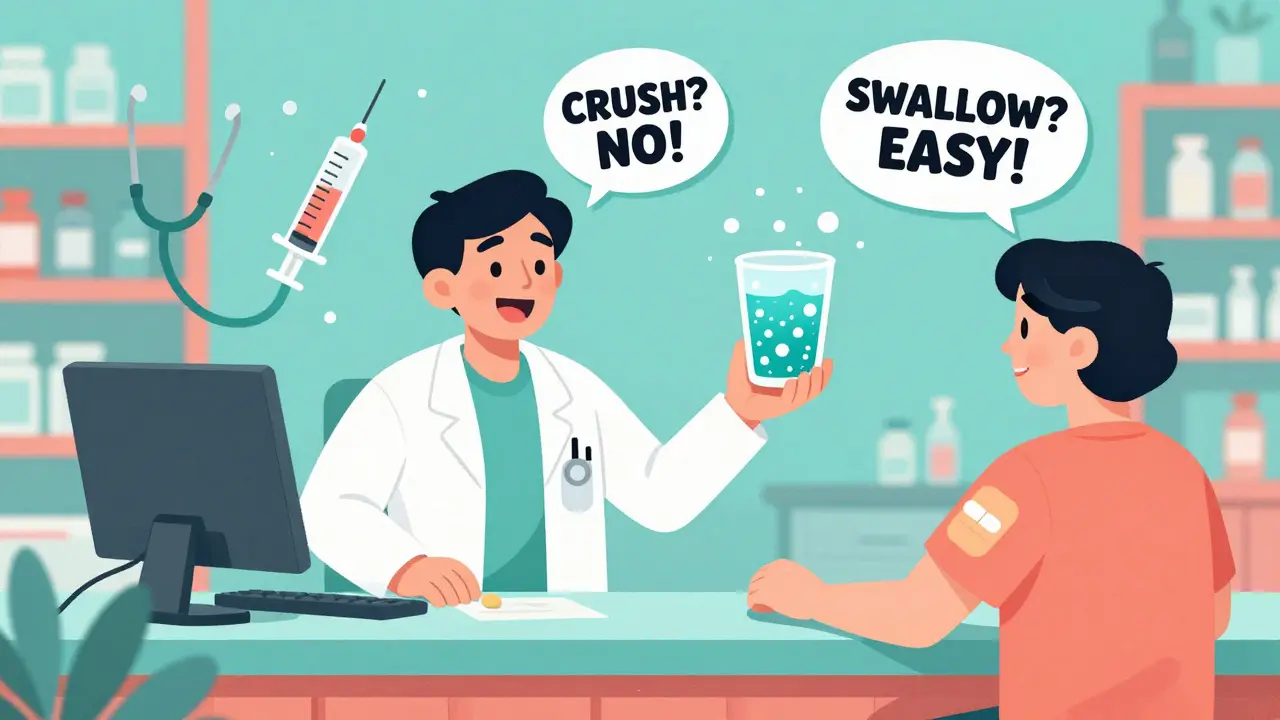
Techniques That Actually Work
If you must swallow a pill, these methods have helped thousands:- The Lean Forward Method: Place the capsule on your tongue. Take a sip of water-not too much, not too little. Then, bend your head forward toward your chest and swallow. This tilts the throat open, helping the pill slide down. Clinical reports show up to 75% success rate with this technique.
- The Pop Bottle Method: Put the pill on your tongue. Seal your lips around a plastic water bottle. Take a drink, using suction to pull the water and pill down together. The suction helps move the pill faster than gravity alone.
- Use a Straw: Place the pill on your tongue. Sip water through a straw. The suction helps pull the pill down. Works best with small pills.
- Chill the pill: Put it in the fridge for 10 minutes. Cold makes the pill slightly harder and less likely to stick to the throat.
- Use a lubricant: Coat the pill with a tiny bit of butter, olive oil, or even a spoonful of honey. This helps it slide down. Avoid thick spreads like peanut butter-they can trap the pill.
When Feeding Tubes Are Needed
For people on long-term feeding tubes, giving pills becomes a whole different challenge. Here’s what works:- Use liquid or crushable meds whenever possible. Ask your pharmacist to check if your meds are tube-safe.
- Never mix meds with formula. They can clump and clog the tube.
- Flush the tube with 10ml of water before and after each med. This keeps the line clear and ensures full delivery.
- Give each med separately. Don’t combine them. Even if they’re in the same bottle, they can react.
- Use once-daily doses if you can. Fewer administrations mean fewer chances for error.

Why Your Care Team Matters
This isn’t something you should fix alone. Swallowing problems need a team:- Pharmacist: They know which meds can be crushed, which need special formulations, and where to find alternatives.
- Speech therapist: They assess your swallowing function and teach you safe techniques. They can also recommend texture-modified foods and liquids.
- Doctor: They can reduce your pill burden. Maybe you don’t need all 8 meds. Maybe one can be switched to a patch.
- Caregiver: They need training too. A simple mistake-like mixing insulin with applesauce-can be deadly.
What’s Changing in the Future
The market for swallowing-friendly meds is growing fast. In 2022, it was worth $1.8 billion. By 2029, it’s expected to hit $2.9 billion. Why? Because the population is aging. By 2050, 1 in 6 people will be over 65. New technologies are emerging:- Dissolvable films: Like VersaFilm, these stick to the inside of your cheek and release medicine without swallowing. One study showed 85% adherence in patients with moderate dysphagia.
- Smart labels: The European Medicines Agency now requires manufacturers to label pills with “crushable” or “not crushable” status. This is new-and it’s a big deal.
- EHR alerts: Hospitals are starting to flag patients with documented dysphagia in their electronic records. When a doctor prescribes a pill, the system warns: “Patient has swallowing difficulty. Consider alternative.”
What to Do Today
If you or someone you care for struggles to swallow pills:- Make a list of every medication you take, including doses and why.
- Call your pharmacist. Ask: “Which of these can I switch to liquid, dissolvable, or patch form?”
- Ask your doctor: “Is every pill still necessary?”
- Request a referral to a speech-language pathologist. They don’t just treat speech-they help with swallowing.
- Practice the lean forward method with a small candy. Get comfortable before trying pills.
- Never crush or open a pill without checking with a pharmacist first.
 Health and Wellness
Kristina Felixita
January 8, 2026 AT 19:37OMG, I literally cried reading this-my grandma used to choke on her blood pressure pills every morning... we thought it was just 'old age' until she ended up in the ER. The lean-forward trick? Game-changer. She now takes everything with a straw and a sip of apple juice. No more panic. Thank you for saying this out loud.
Joanna Brancewicz
January 9, 2026 AT 22:41Dysphagia management requires a multidisciplinary approach. Pharmacokinetic alterations from pill modification are clinically significant. Consultation with a clinical pharmacist is non-negotiable for medication safety in geriatric populations.
Evan Smith
January 11, 2026 AT 07:26So you're telling me I don't have to swallow my Adderall like a rock? And there's a whole industry making pills that don't feel like I'm choking on a marble? I feel like I've been lied to my whole life.
Donny Airlangga
January 12, 2026 AT 19:25This is the kind of post that makes you realize how much we take for granted. My mom couldn't swallow pills after her stroke, and we just kept pushing-thinking she was being stubborn. Turns out, she was terrified. The part about not crushing meds? I wish we’d known that sooner.
Prakash Sharma
January 14, 2026 AT 12:53Why are we letting Big Pharma make swallowing pills so hard? In India, we just crush them with a spoon and mix with chutney. If it works, why overcomplicate? All this talk about coatings and formulations is just corporate nonsense to sell more expensive versions.
Molly Silvernale
January 16, 2026 AT 07:09Swallowing a pill isn’t just a physical act-it’s a tiny existential negotiation between your body and your will to live. That little white tablet? It’s not medicine-it’s a promise. A promise that tomorrow you’ll still be here to watch the sunrise. And when your throat refuses? It’s not weakness. It’s your body screaming, ‘I need help, not force.’
Annette Robinson
January 17, 2026 AT 17:36Thank you for sharing these practical, evidence-based strategies. I’ve been a nurse for 22 years, and I still see caregivers crushing extended-release medications out of convenience. This guide should be mandatory reading for every family caregiver.
Luke Crump
January 19, 2026 AT 17:09Let me guess-the next thing they’ll tell us is that gravity is a myth and pills should be inhaled? We’ve been conditioned to believe swallowing is the only way because the system wants us dependent. What if the real solution is just… not taking the damn pills? Maybe the disease isn’t the enemy-the pill schedule is.
Manish Kumar
January 20, 2026 AT 15:13You know, in my village in Uttar Pradesh, we have a simple solution-mix the crushed tablet with a spoonful of jaggery and a drop of ghee. It’s sweet, it’s sticky, and it slides right down. No fancy liquids, no straw tricks, no pharmacist consultations. Just good old rural wisdom. Why do you think Western medicine is so complicated? Because they overthink everything. The body knows what to do. You just need to trust it. And maybe a little sugar. Always add sugar. Sugar heals everything. Even broken pills. Even broken hearts. Even broken swallowing reflexes. I’ve seen it. My uncle took his heart medicine like this for 17 years. Never once choked. Never once went to hospital. So maybe the real problem isn’t dysphagia… it’s our obsession with clinical perfection. Sometimes, the answer is simpler than the question.