
Every year, Americans spend over $400 billion on prescription drugs. That’s more than any other country in the world. And yet, most of those prescriptions are for generic medications-cheaper versions of brand-name drugs that work just as well. The truth? If you’re paying full price for a brand-name pill when a generic is available, you’re overpaying-sometimes by hundreds of dollars.
What Exactly Are Generic Medications?
Generic medications are exact copies of brand-name drugs, approved by the FDA after the original patent expires. They contain the same active ingredients, work the same way in your body, and meet the same strict quality standards. The only differences? The name, the color, the shape, and the price. The FDA requires generics to prove they’re bioequivalent to the brand. That means they deliver the same amount of medicine into your bloodstream at the same rate. If a brand-name drug releases 100% of its active ingredient over 6 hours, the generic must do the same-within a 20% margin. That’s not close enough. That’s exact. You might wonder: if they’re the same, why are generics so much cheaper? Because brand-name companies spend millions on marketing, packaging, and patent protection. Generics skip all that. They don’t need to run TV ads or pay for fancy bottles. They just make the medicine-and sell it for a fraction of the cost.The Real Cost Difference: Brand vs. Generic
Let’s look at numbers that matter. In 2022, the average copay for a brand-name drug was $56.12. For a generic? Just $6.16. That’s more than nine times cheaper. Take sertraline, the generic version of Zoloft. A 30-day supply of the brand can cost $450 without insurance. The generic? Around $9. That’s not a typo. Same drug. Same effect. Same side effects. Nine times the savings. Even when you have insurance, the gap stays wide. About 93% of generic prescriptions cost under $20. Only 59% of brand-name prescriptions do. And here’s the kicker: generics make up 90% of all prescriptions filled in the U.S., but they account for just 1.5% of total drug spending. That’s the power of scale. When multiple companies start making the same drug, prices drop fast. One study found that after the first generic hits the market, prices fall by 80-85% in the first year. With more competitors, they drop even further.Therapeutic Substitution: The Hidden Savings
Most people think savings come from swapping a brand for its generic. But there’s an even bigger opportunity: swapping one generic for another. A 2022 study from Johns Hopkins looked at the top 1,000 most-prescribed generics in Colorado. They found 45 high-cost generics that had cheaper alternatives with the same clinical effect. In many cases, the high-cost generic was 15.6 times more expensive than the cheaper version. One example? A generic version of a blood pressure drug sold for $180 a month. A different generic, made by another company, did the exact same thing-for $12. That’s a 93% discount. And it’s not rare. Nearly two-thirds of these high-cost generics could be replaced with a lower-cost version of the same drug, just in a different strength or form. Doctors and pharmacists can make these switches-often without you even knowing. But you need to ask. Don’t assume your prescription is already the cheapest option.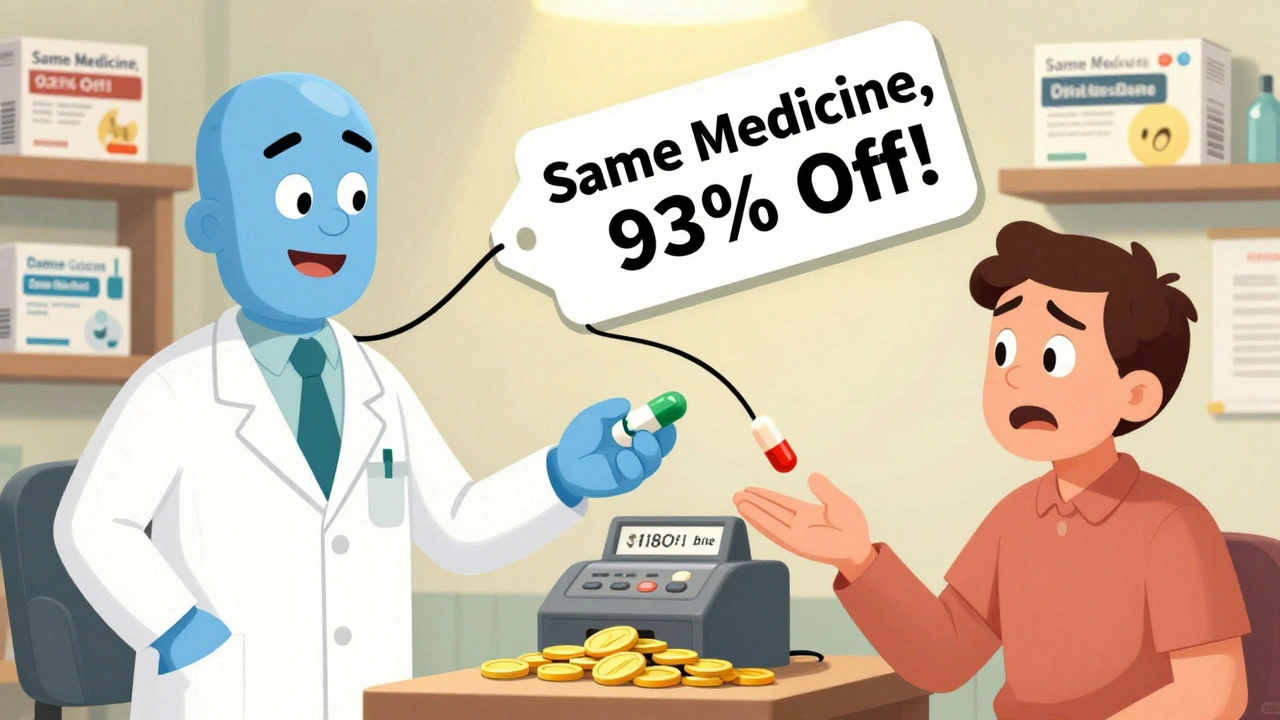
Why Aren’t More People Using Generics?
If generics are so cheap and effective, why do some people still pay more? One reason is fear. Some patients worry generics won’t work as well. Especially for drugs like thyroid medication (levothyroxine) or seizure drugs, where small changes in dosage can matter. While the FDA says generics are safe, a small number of people report feeling different after switching. That doesn’t mean the drug is bad-it might mean their body is sensitive to tiny variations in inactive ingredients. Another issue? Copay structures. Even though the pharmacy pays $2 for a generic, your insurance might still charge you $15 or $20 because of how their formulary is set up. That’s not the drug’s fault-it’s the system’s. And then there’s the problem of drug shortages. In September 2023, over 300 drugs were in short supply in the U.S.-and 78% of them were generics. When supply drops, prices spike. That’s when you see people paying $50 for a $5 pill.What You Can Do Right Now
You don’t need a degree in pharmacology to save money on prescriptions. Here’s what actually works:- Always ask: “Is there a generic version?” Even if your doctor didn’t write it, they can usually change it.
- Ask your pharmacist: “Is there a cheaper generic alternative?” They know which ones are priced lowest in your area.
- Use pharmacy discount apps like GoodRx or SingleCare. They often show prices lower than your insurance copay.
- If you’re on Medicare, check your Part D plan’s formulary. Some plans have tiered pricing-generics are often in Tier 1, the cheapest.
- Don’t be afraid to switch pharmacies. Prices vary wildly. A generic that costs $12 at CVS might be $4 at Walmart.
What’s Changing in 2025?
The Inflation Reduction Act, passed in 2022, is starting to have real effects. Starting in 2025, Medicare Part D beneficiaries will pay no more than $2,000 a year out of pocket for prescriptions. That’s huge. And it’s going to push even more people toward generics. The FDA is also approving more generics than ever. In 2022, they approved 831 new generics-the second-highest number in history. More competition means more savings. Biosimilars-generic versions of complex biologic drugs-are also starting to enter the market. These used to cost $10,000 a year. Now, some cost under $3,000. That’s a game-changer for patients with cancer, arthritis, or autoimmune diseases.What Doesn’t Work
Some people think brand-name drugs are “better.” They’re not. The FDA doesn’t allow a generic to be sold unless it’s proven to be just as safe and effective. Others think they should only use generics if they’re poor. That’s wrong. Even people with good insurance save thousands a year by choosing generics. It’s not about income-it’s about smart choices. And don’t fall for the myth that “American-made” drugs are better. Most generics, even the cheapest ones, are made in FDA-inspected facilities in the U.S., India, or Europe. The country of origin doesn’t affect quality.Final Thought: Generics Are the Quiet Hero of Healthcare
Over the past decade, generic medications have saved the U.S. healthcare system nearly $3 trillion. That’s more than the GDP of most countries. Yet, you rarely hear about it. No one throws parades for pills that cost $5. But every time you choose a generic, you’re not just saving money-you’re helping the whole system work better. Less spending on drugs means more funding for hospitals, clinics, and research. It means fewer people skip their meds because they can’t afford them. You don’t need to be a policy expert to make a difference. Just ask. Just check. Just choose the generic. It’s the same medicine. Just cheaper. And that’s not just smart-it’s powerful.Are generic medications as effective as brand-name drugs?
Yes. The FDA requires generic medications to have the same active ingredients, strength, dosage form, and bioequivalence as their brand-name counterparts. That means they work the same way in your body. Studies show no meaningful difference in effectiveness for the vast majority of drugs. Over 98% of FDA-approved generics are rated AB-meaning they’re therapeutically equivalent.
Why are generic drugs so much cheaper?
Brand-name companies spend millions on research, marketing, and patent protection. Generics don’t. Once a patent expires, other manufacturers can produce the same drug without repeating expensive clinical trials. They only need to prove bioequivalence. That cuts costs dramatically. Plus, competition among multiple generic makers drives prices even lower.
Can I switch from a brand-name drug to a generic without my doctor’s permission?
In most cases, yes. Pharmacists in 49 states can automatically substitute a generic for a brand-name drug unless the prescription says “dispense as written” or “no substitution.” In New York, the prescriber must indicate if substitution is allowed. For drugs with narrow therapeutic windows-like thyroid meds or seizure drugs-your doctor may prefer you stay on the same version. Always check with your pharmacist or provider if you’re unsure.
Do generics have more side effects than brand-name drugs?
No. The FDA requires generics to have the same safety profile as the brand-name version. Side effects come from the active ingredient, which is identical. Some people report feeling different after switching, but that’s usually due to inactive ingredients-like fillers or dyes-that vary between brands. These don’t affect how the drug works, but they can cause minor reactions in sensitive individuals. If you notice a change, talk to your doctor or pharmacist.
Why do some generics cost more than others?
Not all generics are priced the same. Different manufacturers set different prices, and pharmacies negotiate their own deals. One company’s generic might cost $4, while another’s costs $15-even though they’re the same drug. That’s why it pays to compare prices at different pharmacies or use discount apps like GoodRx. Sometimes, switching to a different generic version (not just the brand) can cut your cost in half.
Are there any drugs where I should avoid generics?
For most drugs, generics are perfectly safe. But for medications with a narrow therapeutic index-like warfarin, levothyroxine, or certain seizure drugs-small changes in blood levels can matter. While generics are still approved as equivalent, some patients and doctors prefer to stick with one version to avoid any potential fluctuations. If you’re on one of these drugs and feel fine on your current version, there’s no need to switch. But if you’re paying too much, ask your doctor if a different generic version is available at a lower price.
How do I know if a generic is FDA-approved?
All legally sold generics in the U.S. must be FDA-approved. You can verify this by checking the FDA’s online Orange Book, which lists all approved drugs and their therapeutic equivalence ratings. If a generic is sold in a U.S. pharmacy and doesn’t appear in the Orange Book, it’s likely counterfeit or illegally imported. Stick to licensed pharmacies and avoid online sellers that don’t require a prescription.
 Health and Wellness
Donna Hammond
December 13, 2025 AT 05:11I used to pay $400 for Zoloft until I switched to sertraline. My therapist didn’t even notice. I save $390 a month. That’s a vacation. That’s groceries. That’s not being scared to fill my prescription when rent’s due.
Generics saved my mental health. Not just my wallet.
Richard Ayres
December 13, 2025 AT 14:55The data presented here is both compelling and well-sourced. It is statistically significant that generics account for 90% of prescriptions yet only 1.5% of total spending. This speaks to a systemic efficiency that is rarely acknowledged in public discourse.
The FDA’s bioequivalence standards are among the most rigorous in the world, and the notion that generics are inferior is not supported by empirical evidence. I encourage all patients to engage with their pharmacists about therapeutic alternatives.
Jennifer Taylor
December 13, 2025 AT 17:15WAIT. So you’re telling me the government LETS companies make the SAME DRUG but calls it ‘generic’ so they can charge $5 instead of $500???
Who’s making the profit? Who’s hiding the truth? Why aren’t we rioting in the streets? I swear, Big Pharma is running a cult and we’re all brainwashed into thinking brand names = better.
My cousin’s kid got switched from ‘brand’ Adderall to generic and now he’s ‘different.’ I KNOW THEY’RE DOING SOMETHING. They’re putting something in the cheap ones to make us docile. I’ve seen the documents. They’re in a folder. I’ll send it. I’ll send it all.
Shelby Ume
December 14, 2025 AT 19:29As someone who’s worked in community pharmacy for 18 years, I see this every single day. A patient comes in crying because their insulin copay jumped to $120. I check the formulary. There’s a $12 generic alternative they’ve never heard of.
I don’t charge extra. I don’t get a bonus. I just say, ‘Let me show you how to save your life without going broke.’
People think pharmacists are just pill dispensers. We’re financial counselors. We’re patient advocates. We’re the quiet heroes you never thank.
And yes, I’ve seen the 15x price gaps between generics. It’s not a mistake. It’s a loophole. And we’re fixing it-one patient at a time.
Jade Hovet
December 15, 2025 AT 22:57OMG YES!! 😭 I switched my blood pressure med to the cheap generic and saved $180/month!! I bought myself a new pair of sneakers and cried happy tears 🥹
PS: GoodRx is MAGIC. I used it yesterday and got my thyroid med for $3. Like, THREE DOLLARS. I thought I misread the screen 😂
Y’all need to stop overpaying. Your future self will hug you.
nina nakamura
December 17, 2025 AT 15:50You’re all naive. The FDA approves generics but doesn’t test for long-term effects. The inactive ingredients? They’re designed to break down differently to make you dependent on refills. The real savings? They’re not saving you money-they’re saving the system from collapse while you stay sick.
And don’t get me started on India-made pills. You think they’re safe? They’re not regulated like we are. You’re just trusting your life to a factory with no oversight.
Ask yourself: why do the same pills cost 10x more in Canada? Because they know what’s real.
Rawlson King
December 19, 2025 AT 01:28It’s disappointing to see Americans celebrate cost-cutting as if it’s a moral victory. In Canada, we don’t need to shop around for the cheapest version of levothyroxine because we have universal coverage. Your system is broken because you treat medicine like a commodity, not a right.
Stop patting yourselves on the back for not being robbed by Big Pharma. Fix the system.
Tom Zerkoff
December 20, 2025 AT 05:14While the economic argument for generics is robust, the clinical nuance must not be overlooked. Patients on anticoagulants, antiepileptics, or thyroid replacement therapy may experience subtle pharmacokinetic variations between manufacturers, even when bioequivalence is met.
It is not a matter of efficacy, but of consistency. For these patients, therapeutic stability often outweighs cost savings. Clinicians should document the manufacturer and avoid unnecessary switches.
That said, for the vast majority of medications, generics remain an excellent, evidence-based choice.
kevin moranga
December 21, 2025 AT 21:06Let me tell you something-I used to be the guy who refused generics because I thought they were ‘cheap junk.’ I was wrong. So wrong.
My dad had diabetes and high blood pressure. He was on three brand-name meds. Every month, he’d sit at the kitchen table, counting out cash like it was a game of poker. He’d skip doses just to make it last.
I switched him to generics. We used GoodRx. We called five pharmacies. We found the cheapest versions. His copay dropped from $210 to $22. He started taking his meds every day. He started walking again. He started laughing.
It wasn’t magic. It was math. And it saved his life.
If you’re hesitating? Just try it. Talk to your pharmacist. Ask the question. You won’t regret it. I promise.
And if you’re reading this and you’re healthy? Be grateful. And then help someone who isn’t. Because this isn’t just about pills. It’s about dignity.
Scott Butler
December 23, 2025 AT 14:53Generics are fine for Americans who can’t afford real medicine. But if you’re proud of your country, you should demand American-made drugs. Why are we letting China and India control our medicine supply? This isn’t saving money-it’s surrendering national security.
My grandfather fought in Korea. He didn’t die so we could take pills made in a factory with no inspectors. If you want cheap, go to Mexico. But don’t call it patriotism.
Donna Hammond
December 24, 2025 AT 04:31Scott, your grandfather fought for freedom. Not for expensive pills. He fought so people could live without being bankrupted by healthcare. That’s what generics are-freedom.
And the FDA inspects every single facility that ships drugs to the U.S., whether it’s in Ohio or Mumbai. You don’t get to sell here unless you pass. Same rules. Same standards.
Stop fearmongering. Start saving lives.