
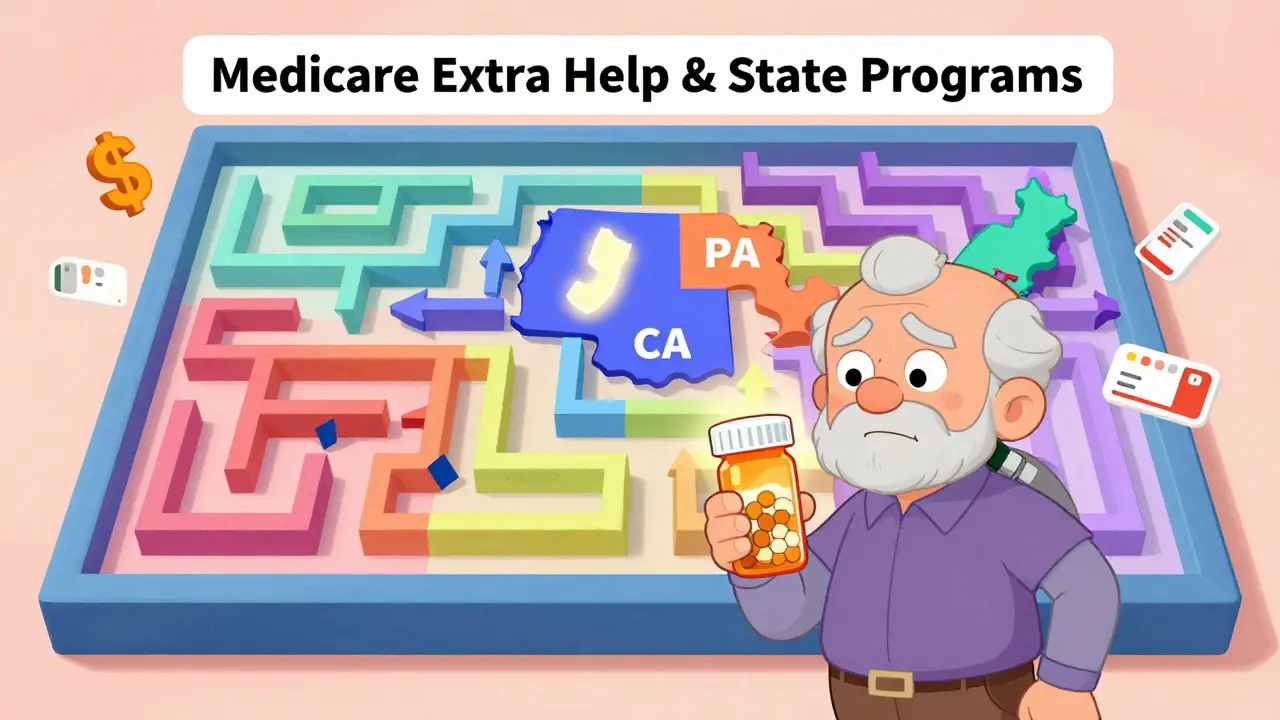
When you’re on a fixed income and need insulin, heart medication, or a monthly prescription for arthritis, the cost can feel impossible. In 2025, nearly 1 in 4 Medicare beneficiaries still skipped doses or cut pills in half because they couldn’t afford their meds. But help exists - and it’s not just federal. Every state runs its own program to fill the gaps, and knowing which one you qualify for can save you thousands a year.
How These Programs Actually Work
Government medication assistance isn’t one big system. It’s a patchwork of federal and state programs that overlap, sometimes in confusing ways. The biggest federal player is Medicare Extra Help, which cuts Part D drug costs for people with low income. But in 32 states, there’s also a State Pharmaceutical Assistance Program - or SPAP - that layers on top of it.Think of it like this: Extra Help pays part of your premium and lowers your co-pays. Your state program might pay the rest, cover drugs Medicare doesn’t, or even pay your premium if you’re not enrolled in a plan yet. But here’s the catch - each state sets its own rules. What works in New Jersey doesn’t work in Texas.
Medicare Extra Help: The Federal Safety Net
If your income is below $23,475 as a single person or $31,725 as a couple in 2025, you likely qualify for Extra Help. Your resources - savings, investments, property (not your home) - must be under $17,600 or $35,130 respectively. You don’t have to apply if you’re already on Medicaid, SSI, or a Medicare Savings Program. You’re automatically enrolled.For those who apply, the benefits are clear: $0 premiums, $0 deductibles, and co-pays capped at $4.90 for generics and $12.15 for brand-name drugs. That’s a huge drop from the $15-$30 many pay without help. And starting in 2025, your total out-of-pocket drug costs are capped at $2,000 a year. That means no more surprise bills after hitting the catastrophic threshold.
But there’s a delay. The Social Security Administration takes an average of 90 days to process applications. During that time, you pay full price. One woman in Ohio paid $872 for her heart medication while waiting - money she didn’t have. If you’re eligible, apply early. You can even backdate your benefits up to 12 months if you qualify.
State Programs: The Real Game-Changers
Extra Help is powerful, but state programs often do more. Take New Jersey’s PAAD. Established in 1967, it’s one of the oldest and most generous. If you’re 65+ or disabled, and your income is under $37,100 (individual) or $45,600 (couple), you pay just $5 for generics and $7 for brand-name drugs. PAAD even pays your Part D premium - as long as it’s under $34.70/month.Compare that to Pennsylvania’s PACE program. It has higher income limits - $27,470 for singles, $36,900 for couples - and covers drugs Medicare doesn’t. But here’s the twist: you must apply for Extra Help first. Then PACE covers what’s left. That process can take four months. If you’re on insulin or a specialty drug for MS, PACE pays for it. If you’re not, you’re stuck paying out of pocket.
California’s Medi-Cal Rx goes even further. It covers 127 specialty drugs that Medicare Part D formularies leave out - including some for rare autoimmune diseases. That’s life-changing for people who need those meds. But eligibility? You have to be on Medicaid. So if you’re on Medicare but not Medicaid, you’re out of luck.
What’s Covered - And What’s Not
Not every drug is covered. Each program has a formulary - a list of approved medications. If your doctor prescribes something off-formulary, you’ll pay full price unless you appeal. And appeals take time. One PAAD user in New Jersey went without her MS medication for seven weeks after her drug was dropped from the list. She had to beg her doctor to switch to a covered alternative.Most programs cover insulin, but not always the newest brands. Some only cover older, cheaper versions. Others cover needles and syringes - PAAD does. Some don’t. And if you’re on a drug that costs $1,200 a month, your state program might cap how much it pays per prescription. You could still owe hundreds.
Also, not all states cover over-the-counter meds - even if your doctor recommends them. Things like blood pressure monitors, diabetic test strips, or even certain pain relievers are often excluded. You’ll need to check your state’s list.
Who Gets Left Behind
The biggest problem? Complexity. The Medicare Rights Center found that 42% of eligible people don’t enroll - not because they don’t qualify, but because they’re overwhelmed. The forms are long. The rules change yearly. And if you move from one state to another? You might lose coverage for weeks or months.And then there’s the resource limit. $17,600 in savings? That’s less than most people think. In California or New York, that’s not even enough for a security deposit on an apartment. Yet if you have $18,000 in a checking account, you’re disqualified - even if you’re living on Social Security and can’t afford your pills.
There’s also a gap for people just above the income limit. If you make $25,000 as a single person, you’re too rich for Extra Help. But you’re still struggling. Some states, like Florida and Illinois, have stepped in with sliding-scale programs for this group. Others haven’t.
How to Apply - And What to Bring
For Extra Help: Fill out the SSA-1020 form online at SSA.gov or at your local Social Security office. You’ll need your most recent tax return, bank statements, proof of residence, and a list of your medications. Don’t wait until you’re out of pills. Apply as soon as you think you qualify.For state programs: Visit your state’s health department website. Most have a direct link to their SPAP application. New Jersey’s PAAD requires a separate form. Pennsylvania’s PACE requires proof of Medicare enrollment. California’s Medi-Cal Rx requires Medicaid enrollment first.
Don’t do this alone. Every state has a SHIP - State Health Insurance Assistance Program. These are free, local counselors trained to walk you through the process. They’ve helped over 4 million people in 2024. Call 1-800-MEDICARE and ask for your local SHIP office. They’ll help you fill out forms, check eligibility, and even call pharmacies to confirm drug coverage.
What’s Changing in 2026
Starting in January 2026, the federal government will roll out a standardized Extra Help application. It’s shorter. It’s digital-first. And it’s meant to cut processing time by 30%. That’s huge. Right now, 63% of people who move between states lose coverage temporarily. A simpler system could fix that.Also, 12 more states are expected to launch or expand SPAPs by 2027. California, Texas, and Florida are leading the way. They’re adding more specialty drugs and lowering income limits. But budget pressures are real. Seven states could run out of money by 2026. If your state cuts coverage, you’ll get a letter - but not always in time.
What You Can Do Right Now
1. Check your income and resources. If you’re single and make less than $23,475, or married under $31,725, you likely qualify for Extra Help. 2. Call 1-800-MEDICARE. Ask for your SHIP counselor. They’ll tell you what your state offers. 3. Apply for Extra Help now. Even if you think you don’t qualify, apply. You can appeal if denied. 4. Ask your pharmacist. They know which drugs are covered by which programs. Bring your list of meds and ask: “Which of these are covered by PAAD, PACE, or Medi-Cal Rx?” 5. Don’t wait until you’re out of pills. The process takes time. Start now.These programs aren’t perfect. But they’re the only thing standing between you and skipping doses. If you’re struggling to pay for meds, you’re not alone - and you’re not without options.
Do I qualify for Medicare Extra Help if I have savings?
Yes, if your total resources (savings, stocks, property other than your home) are under $17,600 for a single person or $35,130 for a couple in 2025. Your income must also be under $23,475 (single) or $31,725 (couple). If you have more than that, you won’t qualify for Extra Help - but you might still qualify for your state’s program.
Can I get help if I’m not on Medicare yet?
Most state programs require you to be on Medicare. But if you’re under 65 and disabled, you may qualify for Medicaid, which often includes prescription coverage. Some states also have programs for low-income adults under 65 who aren’t on Medicare. Check your state’s health department website for options.
What if my state doesn’t have a pharmaceutical assistance program?
Even if your state doesn’t run a SPAP, you can still get Extra Help. And many drug manufacturers offer patient assistance programs that give free or discounted meds to people with low income. Ask your pharmacist or check NeedyMeds.org for free, nonprofit listings of these programs.
Can I use Extra Help and my state program together?
Yes - that’s how most people get the best coverage. Extra Help lowers your Part D costs, and your state program fills in the gaps: paying premiums, covering non-formulary drugs, or reducing co-pays further. Pennsylvania’s PACE requires you to get Extra Help first. New Jersey’s PAAD works alongside it automatically.
How long does it take to get approved for a state program?
Processing times vary. New Jersey’s PAAD takes about 30 days on average. Pennsylvania’s PACE can take up to 120 days because it depends on Extra Help approval first. Always apply early. If you’re waiting and run out of meds, ask your doctor for a 30-day emergency supply - many pharmacies will give you one while you wait.
What happens if I move to another state?
You’ll lose your current state program coverage. You’ll need to reapply in your new state. This can take weeks or months. During that time, you’ll pay full price. That’s why it’s critical to apply for Extra Help first - it’s federal and stays with you. Then apply for your new state’s program as soon as you move.
 Health and Wellness
Jesse Naidoo
February 4, 2026 AT 07:32So I applied for Extra Help last year and got denied because I had $18k in savings. $18k! That’s not wealth, that’s just enough to not qualify for help while still being broke. My insulin costs $1,200/month. I’m not asking for a yacht, I’m asking to not die. The system is designed to fail people like me.
Lorena Druetta
February 4, 2026 AT 10:57Thank you for sharing this. I’ve been helping my elderly neighbor navigate these programs, and I can’t tell you how many times she cried because she didn’t understand the forms. The SHIP counselors are angels. Please, if you’re reading this and you’re struggling - call 1-800-MEDICARE. They don’t judge. They just help. You deserve to breathe without worrying about your next pill.
rahulkumar maurya
February 5, 2026 AT 00:18How is it possible that in 2026, a developed nation still requires citizens to beg for life-saving medication through bureaucratic mazes? The fact that you need a degree in public policy just to access insulin is not a flaw - it’s a moral indictment. The U.S. healthcare system is a carnival of exploitation, and these SPAPs are just the glitter on the coffin.
Alec Stewart Stewart
February 5, 2026 AT 04:56Big love to everyone reading this who’s been through this. 💙 I’m not a doctor or a lawyer, but I’ve been on PACE for two years now. It saved my life. If you’re scared to apply? I was too. Just start with Extra Help - it’s the first domino. And if you need help filling out the form, DM me. I’ll walk you through it. You’re not alone.
Jamillah Rodriguez
February 5, 2026 AT 16:08Wait… so I have to apply for Extra Help before PACE? And then wait 4 months? And if I miss a dose during that time, I’m just supposed to… suffer? 😭 I can’t even get a 30-day emergency supply without jumping through 7 hoops. This is insane. I’m just trying to live.
Susheel Sharma
February 6, 2026 AT 00:48Let’s be brutally honest: these programs are band-aids on a hemorrhaging artery. The real issue is pharmaceutical monopolies and the FDA’s failure to accelerate generic approvals. Why are we praising state-level charity when the federal government could cap drug prices overnight? This isn’t ‘help’ - it’s a distraction from systemic failure. 🤷♂️
Janice Williams
February 6, 2026 AT 18:52I find it deeply irresponsible to encourage people to apply for these programs without first disclosing that 42% of applicants are denied due to obscure asset rules. You’re giving false hope. If you have $17,601 in savings, you are not ‘deserving’ of help. You are simply not eligible. The system is fair - it’s just not designed for the middle class.
Alex LaVey
February 8, 2026 AT 10:50Hey, I’m from Texas - and yeah, we don’t have a great SPAP. But I found a free clinic that works with NeedyMeds. My husband got his MS meds for $5 a month. It’s not perfect, but it’s something. Don’t give up. Talk to your pharmacist. Ask your church. Call SHIP. There are people out there who want to help. You just have to reach out. We’ve got your back.
caroline hernandez
February 8, 2026 AT 15:41From a clinical standpoint, the most critical intervention point is pre-application triage. Utilizing the SHIP network reduces administrative attrition by 68% and increases formulary alignment accuracy. Pro tip: Always submit your medication list in RxNorm format to avoid formulary mismatch errors. Also, ensure your SSA-1020 includes a signed attestation of resource liquidation - this triggers expedited review under 42 CFR § 423.804.