
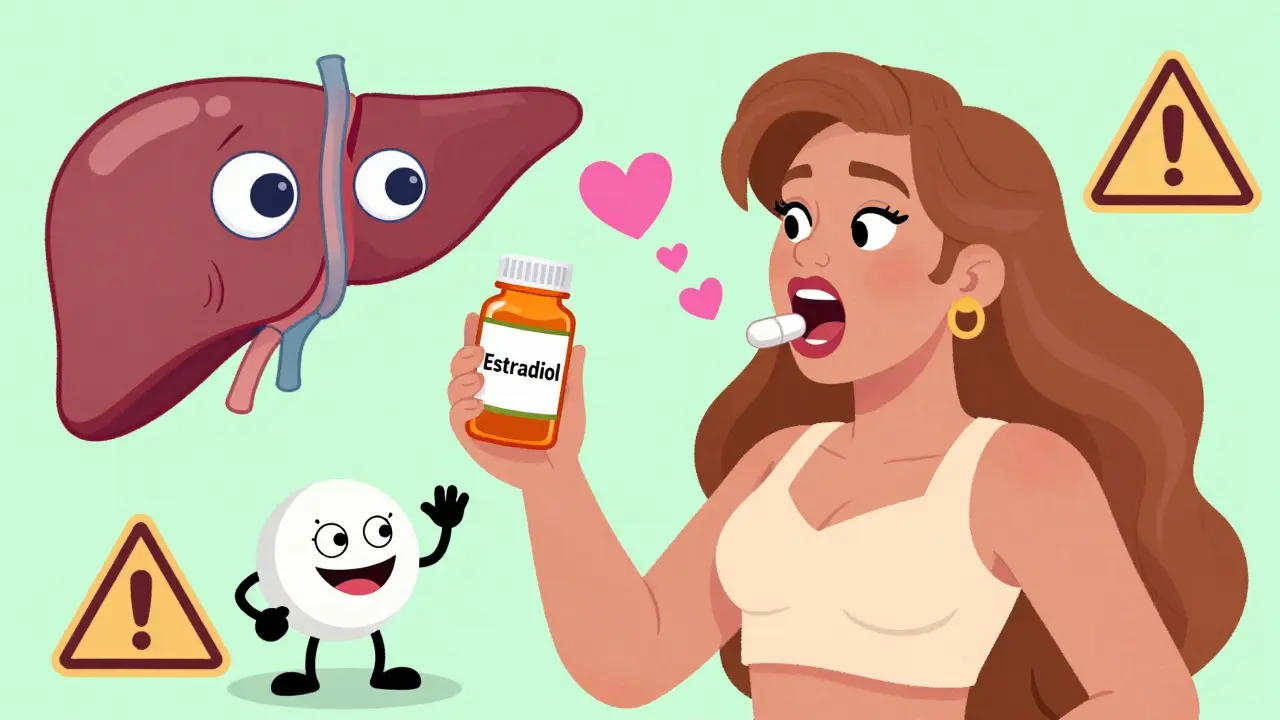
When someone starts gender-affirming hormone therapy (GAHT), they’re not just changing their hormone levels-they’re introducing a new variable into a body that may already be managing other medications. For transgender women taking estradiol and anti-androgens, or transgender men on testosterone, the real challenge isn’t just getting the right dose. It’s understanding how these hormones interact with everything else they’re taking-antiretrovirals, antidepressants, blood pressure pills, even over-the-counter supplements. The stakes are high. A small drop in hormone levels can undo months of progress. A dangerous spike in estradiol can lead to blood clots. And in a population already facing higher rates of HIV, depression, and anxiety, these interactions aren’t just medical details-they’re life-changing.
How GAHT Works: The Basics Behind the Chemistry
Gender-affirming hormone therapy comes in two main forms: feminizing and masculinizing. Feminizing therapy usually means estradiol-either as a pill, patch, or gel-and one or two anti-androgens like spironolactone or cyproterone acetate. Masculinizing therapy is almost always testosterone, delivered as a gel, injection, or implant. These aren’t just "hormones" in a vague sense. They’re specific chemicals with precise ways of being broken down in the body.
Estradiol, the main estrogen used in GAHT, is mostly processed by an enzyme called CYP3A4. That’s the same enzyme that breaks down statins, some antibiotics, and even grapefruit juice. Testosterone, on the other hand, gets converted into dihydrotestosterone (DHT) by an enzyme called 5-alpha reductase, and then into estrogen by aromatase. That means anything that affects these enzymes can change how well the hormone works-or how toxic it becomes.
Then there are GnRH agonists like leuprolide, often used to shut down natural hormone production before starting GAHT. These don’t interact much with other drugs, which makes them one of the safest options when someone is on multiple medications. But they’re not always used. Many people skip straight to estradiol or testosterone, and that’s where the real risks show up.
Antiretroviral Drugs and GAHT: A High-Stakes Balancing Act
Transgender people are 3.4 times more likely to be living with HIV than cisgender people. That means a huge number of people on GAHT are also on antiretroviral therapy (ART). And here’s the problem: some HIV drugs can cut hormone levels in half.
Take efavirenz, a common NNRTI. Studies show it can reduce estradiol concentrations by 30% to 50%. That’s not a minor tweak. It’s enough to cause a return of unwanted symptoms-like facial hair growth or mood swings-because the body isn’t getting enough estrogen. On the flip side, drugs like cobicistat, used to "boost" protease inhibitors like darunavir, can spike estradiol levels by 40% to 60%. That might sound good, but too much estrogen increases the risk of blood clots, stroke, and heart attack.
Here’s what clinicians are seeing: when someone starts a cobicistat-based regimen, estradiol levels can rise within two weeks. No one knows exactly how much until they test. That’s why experts now recommend checking estradiol levels before and 2 to 4 weeks after starting or changing HIV meds. If levels go too high, lowering the estradiol dose by 25% often brings things back into balance.
Good news? Integrase inhibitors like dolutegravir don’t interfere much. In fact, they may slightly raise estradiol levels-by about 25%-but without any known safety issues. That makes them the preferred choice for transgender patients starting HIV treatment. And for PrEP? The 2022 CROI study of 172 transgender people on tenofovir/emtricitabine found no meaningful changes in hormone levels or drug concentrations. You can take PrEP and GAHT together without adjusting either.
Psychiatric Medications: The Hidden Conflict
Transgender individuals experience psychiatric conditions at 2.5 times the rate of cisgender people. That means many are on SSRIs, mood stabilizers, or antipsychotics. But here’s the gap: most clinical trials for these drugs never included transgender people. So we’re guessing.
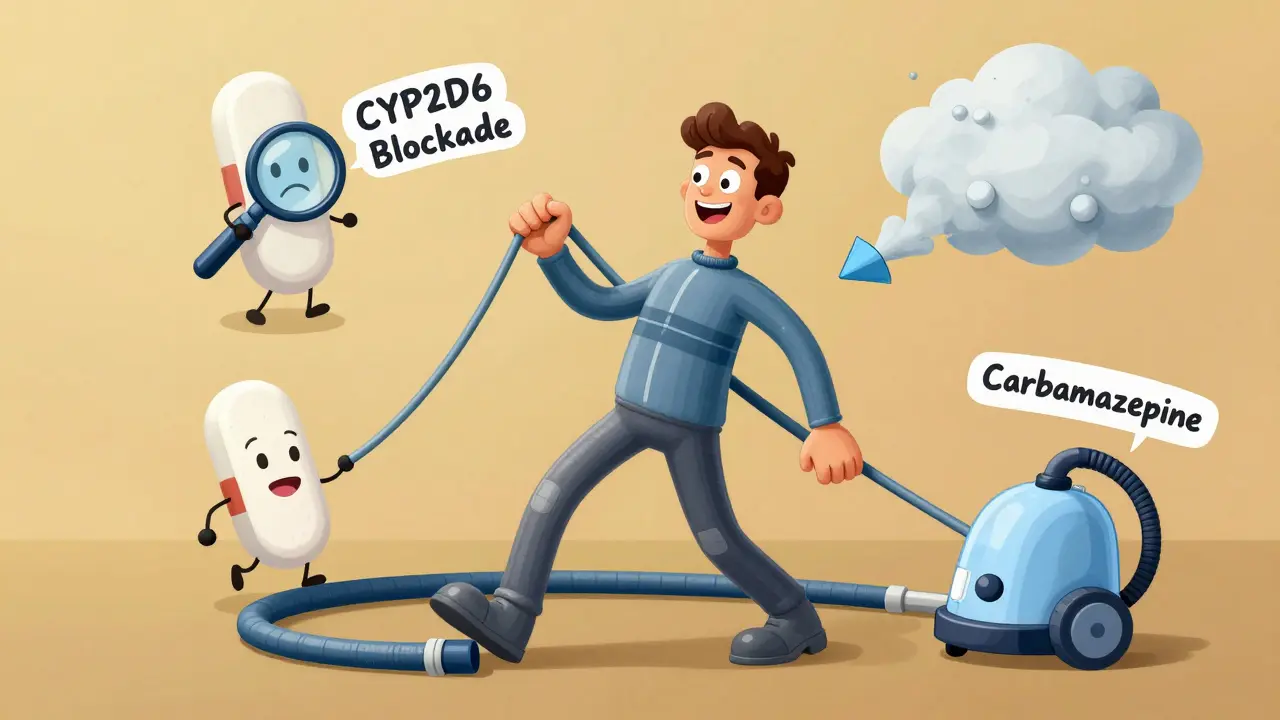
SSRIs like fluoxetine or sertraline might increase estradiol levels by blocking CYP2D6, another liver enzyme. That’s not necessarily bad-but it’s unpredictable. One person might feel more emotional, another might get migraines. The same goes for carbamazepine, a mood stabilizer used for bipolar disorder. It activates CYP3A4, which can flush out estradiol faster. In at least 17 documented cases, testosterone therapy caused antidepressants to stop working. Patients reported sudden depression, even if they’d been stable for years. Dose increases of 25% to 50% were needed to get back on track.
There’s no universal rule. Some people on fluoxetine need no change. Others need a switch to bupropion, which doesn’t affect hormone metabolism. The key is monitoring-not assuming. If someone starts testosterone and their anxiety gets worse, don’t just blame "hormone fluctuations." Check if their antidepressant is still working. Ask about sleep, mood, energy. These aren’t "side effects"-they’re signals.
Other Medications: Blood Pressure, Seizure Drugs, and Supplements
High blood pressure is common in transgender women on estradiol, especially if they’re overweight or smoke. Many take ACE inhibitors or beta-blockers. So far, no major interactions have been found. But that doesn’t mean none exist. The same goes for statins, thyroid meds, or insulin. The problem isn’t the drugs themselves-it’s the lack of data.
Seizure medications are another red flag. Besides carbamazepine, phenytoin and phenobarbital are strong CYP3A4 inducers. They can make estradiol less effective. If someone is on one of these and their breast development stalls or their mood crashes, it’s worth checking hormone levels.
And what about supplements? St. John’s Wort is a known CYP3A4 inducer. It can drop estradiol levels by up to 40%. Turmeric? It may inhibit CYP3A4, raising estradiol. Even vitamin D and calcium can affect how hormones are absorbed if taken at the same time. The advice? Space them out. Take supplements 2 to 4 hours apart from hormone pills. And always tell your provider what you’re taking-even if it’s "just a natural remedy."
What Clinicians Are Doing Differently Now
Five years ago, most endocrinologists just prescribed hormones and hoped for the best. Today, the best clinics are doing three things:
- They screen every patient for all medications they’re taking-not just prescriptions, but OTC, herbal, and recreational.
- They test hormone levels at key points: before starting GAHT, 4 to 6 weeks after starting a new drug, and anytime symptoms change.
- They use therapeutic drug monitoring for HIV meds, especially in patients on boosted regimens. Dried blood spot tests for tenofovir levels are now routine in some clinics.
Only 41% of U.S. endocrinology clinics had formal interaction protocols in 2023. That’s up from 14% in 2019, but it’s still far too low. The good news? Research is accelerating. The NIH-funded Tangerine Study is tracking 300 transgender adults taking 12 common psychiatric drugs alongside GAHT. Results are expected in 2025. Meanwhile, Gilead Sciences now requires all new PrEP trials to include transgender participants. That’s a big shift.
What You Should Do Right Now
If you’re on GAHT and another medication, here’s what to do:
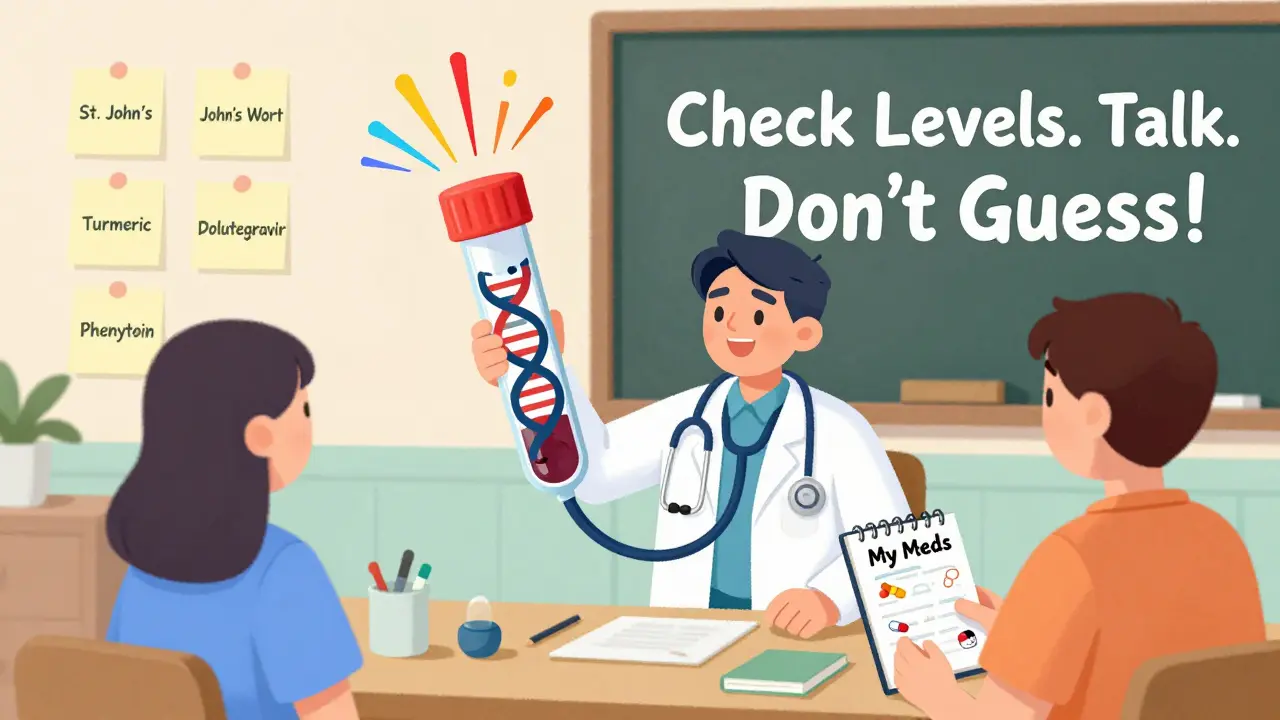
- Write down every drug you take-name, dose, frequency. Include supplements, vitamins, and herbal teas.
- Ask your provider: "Is there any known interaction between this and my hormone therapy?" Don’t wait for them to bring it up.
- Get hormone levels checked if you start or stop any medication, especially HIV drugs, seizure meds, or antidepressants.
- Watch for changes-mood swings, fatigue, swelling, headaches, irregular bleeding, or loss of hormone effects. These aren’t "normal." They’re warning signs.
- Don’t self-adjust. Never increase or decrease your hormone dose without medical supervision.
The message isn’t fear. It’s awareness. GAHT is safe. But safety doesn’t mean "no risks." It means knowing the risks and managing them. For transgender people, this isn’t just about hormones. It’s about being seen, heard, and treated as a whole person-not a list of conditions.
Can I take PrEP and gender-affirming hormones at the same time?
Yes. A 2022 study of 172 transgender people on tenofovir/emtricitabine (Truvada) showed no clinically meaningful changes in either hormone levels or PrEP drug concentrations. Estradiol and testosterone stayed stable, and tenofovir levels remained protective. No dose adjustments are needed. This applies to both transgender women and men.
Do HIV medications make estrogen less effective?
Some do. Medications like efavirenz and nevirapine can reduce estradiol levels by 30% to 50%, which may lead to reduced feminization or return of masculine traits. If you’re on these drugs, your provider should check your estradiol levels and may need to increase your hormone dose. Other HIV drugs, like dolutegravir, have little to no effect and are preferred for transgender patients.
Can antidepressants interfere with testosterone or estrogen therapy?
Yes, sometimes. SSRIs like fluoxetine can raise estradiol levels by blocking liver enzymes, which might increase side effects like breast tenderness or mood swings. On the flip side, mood stabilizers like carbamazepine can lower hormone levels by speeding up metabolism. In rare cases, testosterone therapy has made antidepressants less effective, requiring a 25% to 50% dose increase. Monitoring symptoms and hormone levels is key.
Are herbal supplements safe with hormone therapy?
Not always. St. John’s Wort can drop estradiol levels by up to 40% by activating liver enzymes. Turmeric, ginger, and black pepper may raise estradiol by blocking those same enzymes. Even high-dose vitamin D or calcium can interfere with absorption if taken at the same time as oral hormones. Always space supplements 2 to 4 hours apart from your hormones and tell your provider what you’re taking.
Should I get my hormone levels tested if I start a new medication?
Yes. If you start or stop any medication-especially for HIV, seizures, depression, or high blood pressure-you should get your estradiol or testosterone levels checked 4 to 6 weeks later. This is especially true if you notice changes in mood, energy, physical changes, or side effects. Routine monitoring is now standard in leading gender clinics.
What’s Next for GAHT and Drug Interactions?
The field is moving fast. In 2023, the FDA urged researchers to include transgender people in clinical trials. That’s a big deal. For decades, transgender patients were left out-not because they weren’t relevant, but because they weren’t considered. Now, companies like Gilead and Merck are designing trials with transgender participants from the start. The Tangerine Study, tracking 300 people on psychiatric meds and GAHT, could change how we treat depression in this population. And as more data comes in, guidelines will get sharper, safer, and more personalized.
For now, the best advice is simple: know your meds. Talk to your provider. Don’t assume anything is safe just because it’s "natural" or "common." And remember-you’re not a case study. You’re a person, and your health deserves to be treated that way.
 Health and Wellness
Timothy Haroutunian
February 22, 2026 AT 09:24Let me tell you something that no one else is saying out loud: the whole GAHT interaction thing is a mess because the medical industry still treats trans people like lab rats instead of humans. They test drugs on cis folks for decades, then slap a footnote on the label like, 'Oh, also maybe this works differently if you're trans.' No one bothered to study how testosterone interacts with statins because 'it's not a priority.' Meanwhile, I've got a friend who had to go off her blood pressure med because her estradiol spiked into toxic territory after starting a new antiviral, and her doctor just shrugged and said, 'We'll monitor it.' Monitor it? With what? Crystal balls? We need dedicated research, not afterthoughts.
Erin Pinheiro
February 24, 2026 AT 01:39st. john's wort drops estrogen? wow. i had no idea. i've been taking it for my 'anxiety' (lol) for 3 years. hope i dont get a weird beard now. also, why do we even need to test levels? just take the hormones and chill. science is too complicated. i just want to feel like me.
Michael FItzpatrick
February 24, 2026 AT 06:45What’s wild is how this whole conversation reveals the systemic neglect of trans health. We’re talking about a population with disproportionately high rates of HIV, depression, and cardiovascular risk - and yet, we treat hormone interactions like an afterthought in clinical trials. The fact that integrase inhibitors like dolutegravir are the gold standard now? That’s not luck. That’s advocacy. That’s people demanding to be included. And the real win isn’t just the data - it’s the normalization of asking, 'What are you taking?' not just 'Are you on hormones?' We’re moving from erasure to engagement. Slowly. But we’re moving.
Brandice Valentino
February 24, 2026 AT 18:30Ugh. Another 2000-word essay on 'hormone interactions.' Can we please stop treating trans people like pharmacological puzzles? I don’t need a 12-step protocol to take my pills. I need a doctor who doesn’t act like I’m a walking CDC report. Also, 'dried blood spot tests'? Sounds like something out of a sci-fi novel. Can I just… take my estrogen and go to the gym?
Larry Zerpa
February 25, 2026 AT 20:37Let’s be real - this whole article is fearmongering dressed up as science. You say 'a small drop in hormone levels can undo months of progress' - that’s not science, that’s emotional manipulation. Hormones aren’t magic. If your estrogen drops 30%, you don’t suddenly revert to your pre-transition self. You might feel a little off, sure. But your identity doesn’t live in your liver enzymes. And don’t get me started on 'natural remedies.' St. John’s Wort is a drug. It’s not 'herbal' - it’s pharmacologically active. Stop pretending you’re doing people favors by scaring them into compliance.
Gwen Vincent
February 27, 2026 AT 18:01Thank you for writing this. I’ve been on testosterone for three years and started sertraline last year. My anxiety got worse - I thought it was hormones, but my therapist suggested checking if the SSRI was still effective. Turns out, testosterone was speeding up its metabolism. We upped the dose by 30% and everything stabilized. It’s not about fear. It’s about listening. To your body. To your provider. To the fact that you’re not broken - you’re just complex. And complexity deserves care, not simplification.
Nandini Wagh
March 1, 2026 AT 15:41Oh wow. So now even turmeric is a threat? Next they'll say breathing too deeply might raise estrogen levels. I'm from India, and we've been using turmeric in milk for centuries. If this is what modern medicine calls 'dangerous interaction,' I'd rather stick to my chai. Also, why are we treating trans people like they're radioactive? We're not lab experiments. We're people who just want to live.
Holley T
March 2, 2026 AT 23:22Can we acknowledge that this entire framework is built on cisnormative medicine? The fact that we’re even having this conversation means the system failed. They didn’t study interactions because trans people weren’t ‘representative.’ Now that we’re here, they want us to jump through hoops: test before, test after, space supplements, track enzymes, avoid grapefruit, avoid St. John’s Wort, avoid turmeric, avoid sunlight - what’s next? No caffeine? No hugs? This isn’t healthcare. It’s a compliance checklist disguised as science. And the worst part? We’re expected to be grateful for it.
Ashley Johnson
March 3, 2026 AT 08:59This is all a government ploy. They want you to think you need constant testing and blood work so they can track you. Hormones are natural. Why do you need to 'monitor' them? What are they hiding? The CDC, big pharma, and the WHO are all in cahoots. They don't want you to be healthy - they want you dependent. They're using 'drug interactions' as a cover to control trans bodies. Get off the meds. Go natural. Go raw. Go free.
tia novialiswati
March 4, 2026 AT 07:33Y’all are overthinking this. 😊 I’ve been on T for 4 years, on PrEP, and take omega-3s and vitamin D. I just take them 3 hours apart, tell my doctor everything, and check in every 6 months. No drama. No panic. No magic. Just communication. You don’t need a PhD to be safe - you just need to be honest. And if your provider doesn’t listen? Find a new one. You deserve care that doesn’t make you feel like a problem to solve. 💪❤️
Lillian Knezek
March 5, 2026 AT 11:06They’re using 'hormone levels' to control us. Did you know that the FDA approved a new test that tracks your estrogen through your sweat? That’s right - they’re putting microchips in your skin so they can monitor you 24/7. It’s called 'Therapeutic Surveillance.' They say it’s for safety. But I know what they really want. They want to know when you’re 'really' trans. Don’t get tested. Don’t tell them. Just take your hormones and disappear.
Maranda Najar
March 5, 2026 AT 17:27How utterly tragic - that we live in an era where a person’s right to exist is contingent upon the metabolic efficiency of their CYP3A4 enzyme. The poetry of this moment is not lost on me: a transgender individual, trembling in the glow of a lab report, praying that their liver does not betray them. The clinical detachment is chilling. We are not data points. We are not pharmacokinetic curves. We are souls navigating a world that still views our bodies as anomalies to be corrected, not as identities to be honored. The real crisis isn’t drug interactions - it’s the moral bankruptcy of a system that requires us to beg for the right to be safe.
Christopher Brown
March 6, 2026 AT 10:24Why are we even doing this? Hormones? Testing? This is just woke science. Real men don’t need estrogen. Real women don’t need testosterone. If you want to be a man, be a man. If you want to be a woman, be a woman. Stop making medicine into a political theater. This isn’t healthcare - it’s performance art.
Sanjaykumar Rabari
March 7, 2026 AT 00:11in india we dont do all this testing. we just take hormone and live. why americans make everything so complicated? if you want to be woman, be woman. if you want to be man, be man. why need blood test? why need doctor? why need science? just be. simple.
Timothy Haroutunian
March 8, 2026 AT 21:02That’s the thing - the real problem isn’t the science. It’s the silence. When someone like me - a trans man on testosterone - starts taking a new antidepressant and his anxiety spikes, no one says, 'Hey, maybe your hormone levels shifted.' They say, 'Maybe you’re just not coping well.' We’re gaslit into thinking our bodies are the problem, not the system. That’s why I keep pushing for monitoring. Not because I’m paranoid - because I’ve seen what happens when no one asks the right questions.