
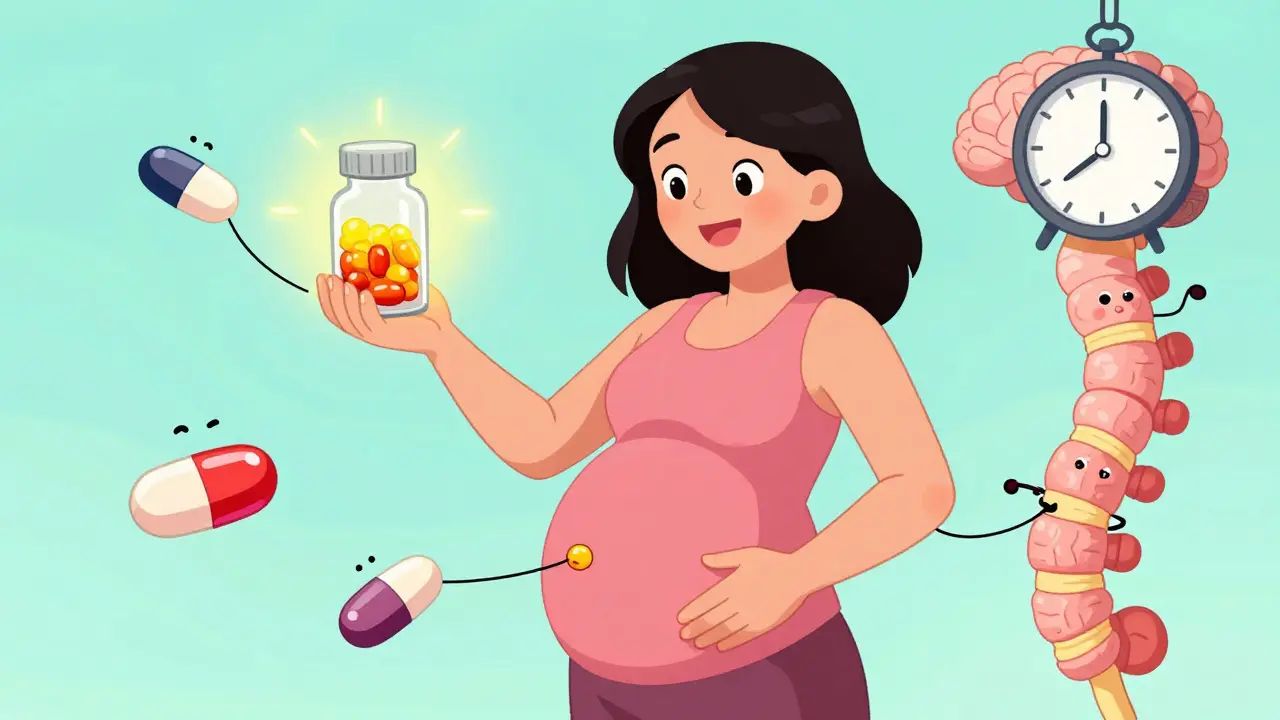
When you're pregnant, taking folic acid isn't just a suggestion-it's one of the most important things you can do to protect your baby. But here’s the part no one talks about enough: folic acid doesn’t play nice with every medication. Taking it at the wrong time, with the wrong drug, or in the wrong dose can reduce its effectiveness-or even put you at risk.
Most prenatal vitamins contain 600 to 1,000 micrograms (mcg) of folic acid. That’s the amount doctors recommend to prevent neural tube defects like spina bifida and anencephaly. These defects happen in the first 28 days after conception-often before a woman even knows she’s pregnant. That’s why experts say you should start taking folic acid at least one month before trying to conceive. But if you’re already on other meds, especially for epilepsy, autoimmune conditions, or mental health, things get complicated fast.
How Folic Acid Works-and Why It Can Conflict With Other Drugs
Folic acid is the synthetic form of folate, a B vitamin your body uses to make DNA and repair cells. It’s critical during early pregnancy because your baby’s spine and brain are forming in those first few weeks. But folic acid doesn’t just help your baby-it also affects how your body processes certain medications.
Take anticonvulsants like phenytoin (Dilantin), carbamazepine (Tegretol), or valproic acid. These drugs are used to control seizures, but they can lower your folate levels. So doctors often tell women on these meds to take higher doses of folic acid-up to 4,000-5,000 mcg daily. But here’s the catch: too much folic acid can reduce how well these drugs work. There are documented cases where women on phenytoin had breakthrough seizures after starting high-dose folic acid without medical oversight. That’s not a coincidence. Folic acid interferes with the way these drugs bind to brain receptors.
Same goes for methotrexate, a drug used for rheumatoid arthritis, psoriasis, and sometimes ectopic pregnancies. Methotrexate works by blocking folate metabolism. Giving folic acid alongside it might seem risky-but under strict medical supervision, low-dose folic acid (1-5 mg daily) can actually reduce methotrexate’s side effects like nausea and mouth sores without lowering its effectiveness. This isn’t something to try on your own. It requires careful timing and monitoring.
Then there’s pyrimethamine, used to treat toxoplasmosis during pregnancy. This drug also blocks folate. If you take folic acid at the same time, it can make pyrimethamine less effective. Pharmacists report that 32% of pregnant women on this combo need their pyrimethamine dose adjusted. That’s not rare. It’s predictable.
Iron, Calcium, and Antacids: The Silent Folic Acid Killers
You might think your prenatal vitamin is doing all the work. But if you’re taking it with food-or with other supplements-it might not be absorbing properly.
Iron and folic acid compete for absorption in your gut. When taken together, iron can reduce folic acid uptake by 20-30%. That’s why many women feel nauseated on prenatal vitamins-they’re getting a heavy dose of iron at the same time as folic acid. The fix? Take your prenatal at night, or separate the iron and folic acid by a few hours. Many women report feeling better after switching to a prenatal with 800 mcg folic acid and taking an iron-only supplement in the afternoon.
Calcium is another silent saboteur. If you take your prenatal with milk, yogurt, or a calcium supplement, absorption drops by about 25%. Antacids? Even worse. If you’re popping Tums or Rolaids for heartburn, they can cut folic acid absorption by up to 50%. That’s because antacids raise stomach pH, and folic acid needs an acidic environment to be absorbed properly. The FDA updated its labeling in 2021 to warn about this. So if you’re on acid reflux meds, talk to your doctor about timing.
Who Needs More Than the Standard 600 mcg?
Not everyone needs the same dose. The CDC recommends 400 mcg daily for most women trying to conceive. But some groups need way more:
- Women with a history of neural tube defects in previous pregnancies: 4,000 mcg daily, starting at least one month before conception.
- Women with epilepsy on certain seizure meds: 4,000-5,000 mcg daily under neurologist supervision.
- Women with MTHFR gene mutations (about 1 in 5 Hispanics, 1 in 10 Caucasians): These people have trouble converting folic acid into its active form. They may benefit from L-methylfolate (Quatrefolic®), a newer form of folate that bypasses this step. The FDA approved the first prenatal with Quatrefolic® in 2023.
- Women taking sulfasalazine (for Crohn’s or ulcerative colitis): This drug blocks folate absorption. NICE guidelines in the UK specifically warn against taking folic acid without medical guidance if you’re on this med.
And here’s something surprising: the standard 400-800 mcg dose might not be enough for some. A 2022 JAMA Pediatrics study of over 45,000 children found a 40% lower risk of autism spectrum disorder (ASD) when mothers took folic acid before and during early pregnancy. But a 2021 Danish study found no link. The science isn’t settled yet. But if you’re at higher risk for ASD-family history, advanced maternal age, or autoimmune conditions-many OB-GYNs now recommend 800-1,000 mcg as a precaution.

What’s in Your Prenatal? Not All Are Created Equal
Not every prenatal vitamin is the same. A 2020 ConsumerLab test of 15 brands found only 12 met safety standards for heavy metals like lead and arsenic. Price doesn’t always mean quality. CVS Health Prenatal costs $8.99 a month. Thorne Basic Prenatal runs $38.99. But both can have the same folic acid dose.
What you want to look for:
- 600-1,000 mcg of folic acid (or L-methylfolate if you have MTHFR)
- No unnecessary additives like artificial colors or soy
- Iron separate from folic acid if you have nausea
- Third-party testing (USP, NSF, or ConsumerLab verified)
Prescription prenatal vitamins like Prenate Pixie contain 1,000 mcg folic acid and are often used for high-risk pregnancies. Over-the-counter options like Nature Made Prenatal Multi + DHA also hit 800 mcg. The key isn’t the brand-it’s whether the dose matches your needs.
What Happens If You Take Too Much?
There’s a myth that more is better. But there’s an upper limit: 1,000 mcg per day for adults over 18. Why? Because excess folic acid can hide a vitamin B12 deficiency. Back in the day, doctors worried high folic acid would mask the anemia caused by B12 deficiency, letting nerve damage go untreated. That’s less of a concern now because we test for B12 routinely. But the CDC still says: don’t exceed 1,000 mcg unless your doctor tells you to.
There’s also a newer concern: unmetabolized folic acid. Some people, especially those with MTHFR variants, can’t convert all the folic acid they take into its active form. That leftover folic acid circulates in the blood. A 2021 review by Dr. Joseph Selhub at Tufts University warned this might have unknown long-term effects. The CDC says there’s no confirmed harm-but they also say more research is needed.
Bottom line: stick to the dose your provider recommends. Don’t stack supplements. Don’t double up on prenatal vitamins. And if you’re unsure, ask your pharmacist. They’re trained to catch these interactions.
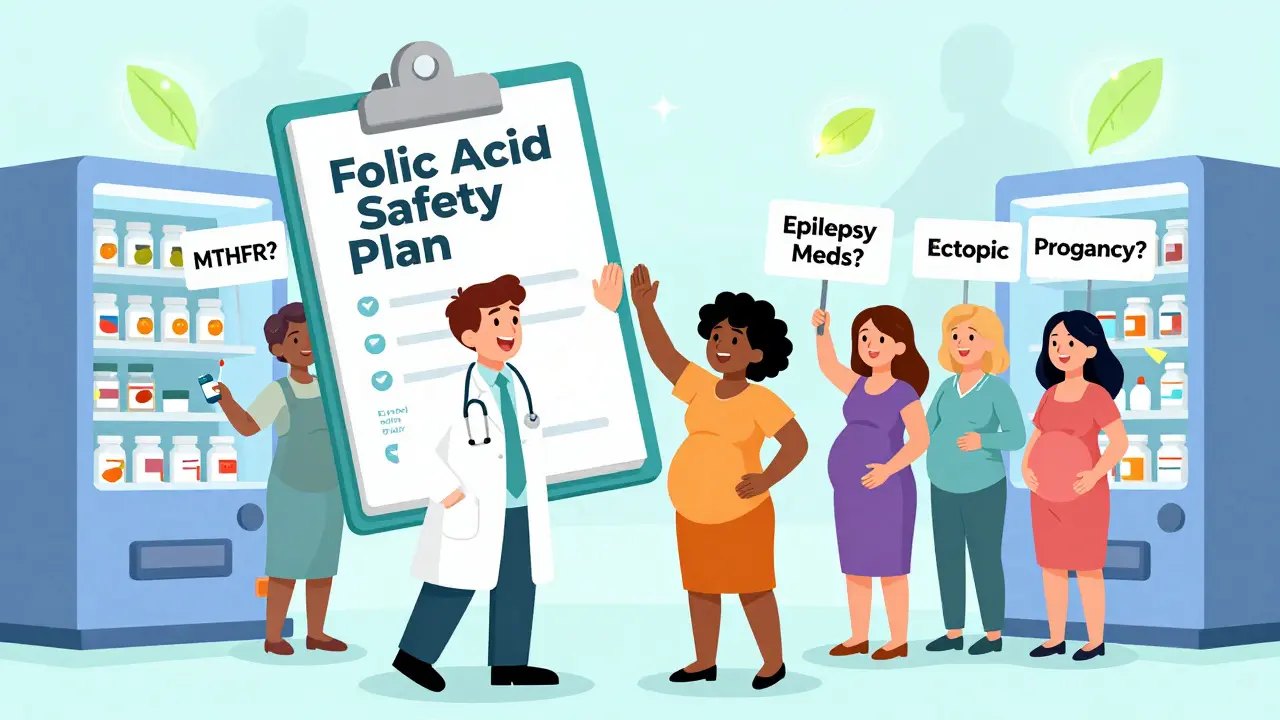
Real Stories, Real Risks
On Reddit, thousands of pregnant women share their experiences. One user, u/AnxiousMom2022, started taking 800 mcg folic acid while on phenytoin. Within weeks, she had a seizure. Her neurologist later told her the folic acid had reduced her drug’s effectiveness. She now takes 5,000 mcg folic acid under strict supervision.
Another woman, on BabyCenter, was treated for an ectopic pregnancy with methotrexate. Her doctor gave her 5 mg folic acid daily, timed 12 hours apart from the methotrexate. She avoided the severe nausea and mouth sores that often come with the drug. She credits the timing for her recovery.
A 2023 survey by What to Expect found 43% of pregnant women didn’t know folic acid could interact with medications. Eighteen percent were taking anticonvulsants without telling their OB-GYN. That’s not negligence-it’s a lack of clear communication. Most doctors assume you know. Most women assume their prenatal is safe.
What to Do Right Now
If you’re pregnant or planning to be:
- Check your current meds. List every prescription, OTC pill, and supplement you take.
- Look at your prenatal vitamin. Does it have 600-1,000 mcg folic acid? Is it L-methylfolate if you have MTHFR?
- Ask your doctor or pharmacist: "Could any of my meds interact with folic acid?" Don’t assume they’ll bring it up.
- If you’re on seizure meds, methotrexate, sulfasalazine, or pyrimethamine, ask about dose adjustments.
- Take your prenatal on an empty stomach with water. Avoid antacids and calcium-rich foods within two hours.
- If nausea hits, switch to separate folic acid and iron pills, taken at different times.
Folic acid saves lives. But it’s not a magic bullet. It’s a tool-and like any tool, it works best when you know how to use it.
Can I take folic acid with my prenatal vitamin and iron supplement at the same time?
It’s not ideal. Iron can reduce folic acid absorption by 20-30%. For best results, take your prenatal vitamin with folic acid in the morning on an empty stomach, and take your iron supplement at lunch or dinner, at least 2-3 hours apart. If you’re nauseated, try taking the prenatal at night and iron in the afternoon.
Is 800 mcg of folic acid too much during pregnancy?
No, 800 mcg is within the safe upper limit of 1,000 mcg per day for adults. Most prenatal vitamins contain this amount. It’s the standard dose recommended by the CDC for women with average risk. Higher doses (4,000-5,000 mcg) are only for women with specific medical conditions and must be supervised by a doctor.
Do I need L-methylfolate instead of folic acid?
You might, if you have the MTHFR C677T gene variant, which affects about 10-25% of people. This mutation makes it harder for your body to convert folic acid into its active form. If you’ve had a previous pregnancy with a neural tube defect, unexplained miscarriages, or if you’ve been told you have this variant, L-methylfolate (like Quatrefolic®) may be more effective. Talk to your doctor about genetic testing or switching formulas.
Can folic acid cause autism?
No. Multiple large studies show the opposite. A 2022 JAMA Pediatrics study found a 40% lower risk of autism in children whose mothers took folic acid before and during early pregnancy. Some studies, like a 2021 Danish cohort, found no link-but none have shown folic acid increases autism risk. The idea that it causes autism is a myth fueled by misinformation.
What if I forgot to take folic acid before getting pregnant?
Start immediately. Neural tube closure happens by day 28, but starting folic acid as soon as you know you’re pregnant still reduces risk. The CDC says it’s never too late. While the best protection comes from pre-conception use, taking it now still helps with red blood cell formation, placental growth, and reducing other birth defect risks.
Are there natural sources of folate that are better than folic acid?
Foods like spinach, lentils, avocado, and fortified cereals contain natural folate. But your body absorbs synthetic folic acid from supplements and fortified foods much better-up to 100% from supplements versus 50% from food. That’s why supplements are recommended: they guarantee you get enough. You still need to eat folate-rich foods, but you can’t rely on diet alone to meet pregnancy needs.
What’s Next?
The CDC is pushing to fortify corn masa flour with folic acid by 2025. Why? Hispanic women have 20-30% higher rates of neural tube defects. This change could prevent hundreds of cases a year. Meanwhile, research is exploring whether folic acid can reduce the risk of preterm birth and preeclampsia. The science keeps evolving.
But right now, your job is simple: know your meds, know your dose, and talk to your provider. Don’t guess. Don’t assume. And don’t stop taking folic acid because you’re worried about interactions-just make sure you’re taking it right.
 Health and Wellness
Aaron Mercado
January 6, 2026 AT 09:38Wait-so you’re telling me I’ve been taking my prenatal WITH my Tums?? And now I’m a monster?? I’ve been doing this for 6 months!! My baby’s gonna be a lab experiment!! I just Googled ‘folic acid + calcium = fetal sabotage’ and now I’m crying in the shower!!
John Ross
January 7, 2026 AT 06:59From a clinical pharmacology standpoint, the competitive inhibition of folate absorption by divalent cations like Ca²⁺ and Fe²⁺ is well-documented in vitro and in vivo. The pH-dependent bioavailability of pteroylmonoglutamate is a classic example of first-pass metabolic interference. The FDA’s 2021 labeling update was long overdue-this isn’t anecdotal, it’s mechanistic.
Clint Moser
January 7, 2026 AT 11:27They don’t want you to know this-but folic acid is a BIG PHARMA tool to control the birth rate. They pump it into flour, then hide the fact that it masks B12 deficiency so they can keep selling expensive neurological drugs. And now they’re pushing ‘Quatrefolic’? That’s just the same poison with a new label. The CDC? Complicit. The WHO? In bed with Pfizer. You’re being manipulated.
Ashley Viñas
January 9, 2026 AT 04:18Oh honey. I’ve been there. I had MTHFR, took regular folic acid, and had two miscarriages before switching to L-methylfolate. It’s not ‘alternative medicine’-it’s biochemistry. If your prenatal doesn’t say ‘Quatrefolic’ or ‘L-methylfolate’ on the label, you’re basically giving your baby synthetic junk food. I’m not mad-I’m just disappointed. You deserve better.
Brendan F. Cochran
January 10, 2026 AT 10:45So let me get this straight-some dumb woman in Texas took folic acid with her seizure meds and had a seizure? That’s not a drug interaction, that’s a dumb person interaction. You don’t just pop pills like candy. If you’re on phenytoin, you better know what you’re doing. This is why America’s so sick-people think a vitamin is a free pass.
Ethan Purser
January 11, 2026 AT 16:44I’ve been thinking… if folic acid prevents neural tube defects, but also potentially hides B12 deficiency-which causes neurological damage-then aren’t we just trading one tragedy for another? Are we playing God with our DNA? Is this what enlightenment looks like? A baby born healthy… but a mother slowly losing her mind because no one tested her B12? I don’t know anymore.
Doreen Pachificus
January 12, 2026 AT 20:41Interesting. I take my prenatal at night with a glass of water, and my iron supplement at lunch. Never thought about the calcium thing though-I drink almond milk every morning. Should I switch to water? Or is that overkill?
Roshan Aryal
January 13, 2026 AT 01:36Western medicine always oversimplifies. You think folic acid is the solution? In India, we’ve had healthy pregnancies for centuries without synthetic folate. We eat methi, palak, and lentils. Your body evolved to get folate from food-not a pill made in a lab by men who don’t know what a real meal is. This is colonization of the womb.
Jack Wernet
January 14, 2026 AT 22:54Thank you for this comprehensive and clinically grounded overview. I’m a nurse practitioner and see patients daily who are unaware of these interactions. The most common mistake? Assuming their OTC prenatal is sufficient without disclosing their antiepileptic or immunosuppressant regimen. This post could save lives.
Catherine HARDY
January 15, 2026 AT 18:46What if the real danger isn’t too much folic acid… but too much surveillance? What if the reason they push folic acid so hard is because they’re tracking fetal development through blood markers? What if ‘neural tube defect prevention’ is just the cover story? I’ve seen the patents. They’re not just preventing defects-they’re mapping epigenetic changes. I’m not paranoid. I’ve read the documents.
bob bob
January 16, 2026 AT 00:56Okay but real talk-my wife took her prenatal with orange juice and a banana and still had a healthy baby. She’s now a mom of two. Maybe the science is good, but real life is messier? I’m not scared-I’m just grateful she didn’t stress about it.
Vicki Yuan
January 16, 2026 AT 09:36One of the most important things I’ve learned as a new mom: never assume your doctor knows your full med list. Write it down. Bring it in. Ask, ‘Could this interact with folic acid?’ Even if they say no, ask again. I asked three times before my OB finally checked my methotrexate dose. That’s how I avoided the mouth sores. Knowledge is power.
Oluwapelumi Yakubu
January 16, 2026 AT 14:35Let me tell you something-back home in Lagos, women take palm oil, bitter leaf, and groundnuts during pregnancy. No pills. No labs. No ‘Quatrefolic’. They birth healthy babies. Why? Because nature knew before Big Pharma did. You don’t need a synthetic B9 when your grandmother’s kitchen had all the answers. This isn’t science-it’s cultural erasure dressed in white coats.
melissa cucic
January 16, 2026 AT 22:10There is a profound ethical tension here: the imperative to prevent catastrophic congenital anomalies versus the potential for iatrogenic harm through pharmacological overcorrection. The bioavailability paradox-where supplementation intended to protect may, in certain genetic contexts, introduce novel metabolic burdens-demands not just clinical vigilance, but epistemological humility. We must recognize that ‘standard’ dosing is, in fact, a statistical approximation, not a biological truth.
Akshaya Gandra _ Student - EastCaryMS
January 17, 2026 AT 10:01Wait so if I take my prenatal at night and iron in the afternoon, I’m good? I’ve been taking them together for 3 months… is my baby gonna be okay??