
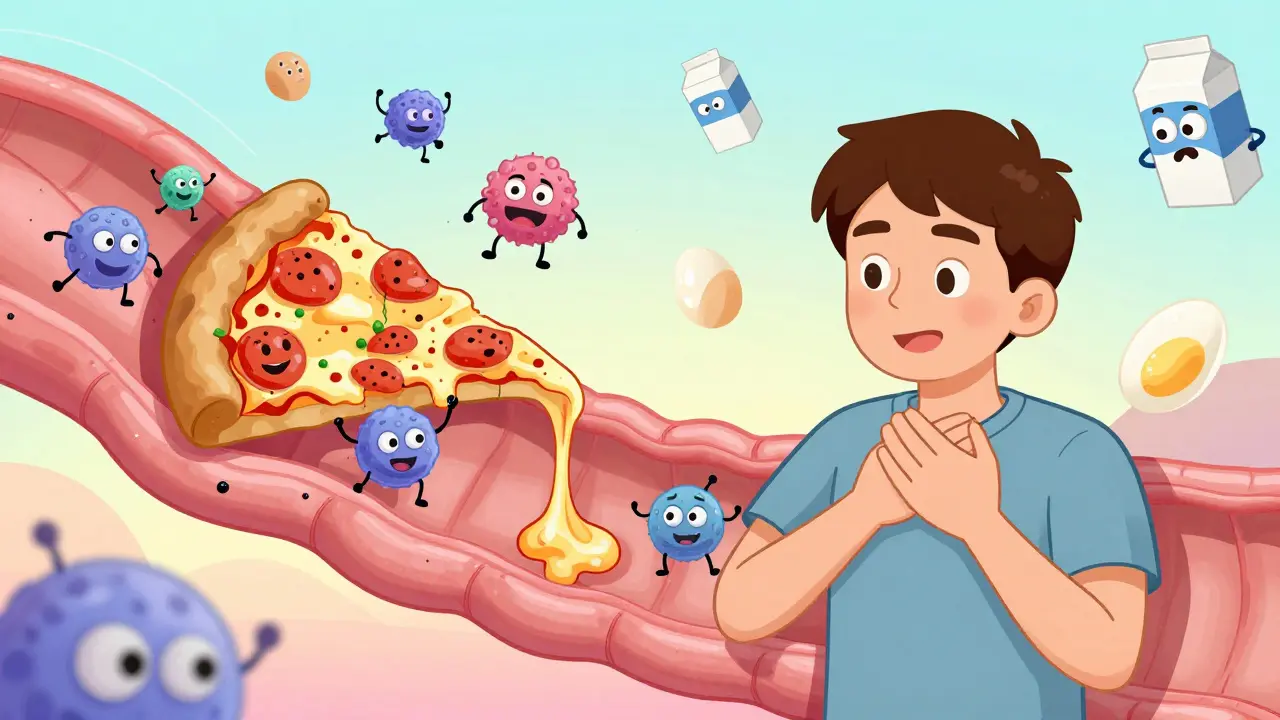
Imagine swallowing a bite of pizza and feeling like your throat is closing up. Not because you’re choking - but because your body is fighting what it thinks is a threat. That’s what happens in eosinophilic esophagitis (EoE). It’s not heartburn. It’s not a food allergy you’d see on a skin test. It’s a silent, stubborn inflammation in your esophagus, triggered by everyday foods, and it’s getting worse for more people every year.
In the U.S., about 1 in 1,700 adults now have EoE. In Australia, numbers are rising fast, too. The condition used to be rare. Now, doctors see it regularly - especially in young men and children. And the worst part? Many patients go years without a diagnosis because the symptoms look like reflux or anxiety. But the fix isn’t just pills. It’s about what you eat… and how you swallow medicine.
What Exactly Is Eosinophilic Esophagitis?
EoE isn’t just "allergies in the throat." It’s an immune system mistake. Your body sees harmless proteins in food as invaders. So it sends eosinophils - a type of white blood cell - to attack. Instead of fighting germs, they pile up in your esophagus, swelling the lining, causing scarring, and making it hard to swallow. Over time, this can narrow the tube, leading to food getting stuck. Some people need procedures to stretch their esophagus. Others can’t eat solid food at all.
It’s not caused by acid. Antacids don’t help. It’s not triggered by stress. It’s an allergic reaction - but not the kind you’d expect. You won’t break out in hives or gasp for air. Instead, you feel pain when swallowing, chest tightness, or a sensation that food is stuck. In kids, it shows up as refusal to eat, vomiting, or poor weight gain. In adults, it’s often choking on bread, meat, or even pills.
The key clue? A biopsy. If you have more than 15 eosinophils per high-power field in your esophagus - and no other cause like acid reflux - you have EoE. It’s the only way to confirm it.
The Six Foods That Trigger EoE - And the New One-Food Rule
For years, doctors told patients to cut out six foods: milk, eggs, wheat, soy, fish, and nuts. That’s the six-food elimination diet (6FED). And it works - about 80% of kids and 65% of adults go into remission after 6-8 weeks. But imagine giving up all those foods. No pizza. No sandwiches. No yogurt. No peanut butter. It’s exhausting. Social life? Gone. Grocery shopping? A full-time job.
Then came the 2022 NIH study that changed everything. Researchers compared the six-food diet to just cutting out milk. The results? Both worked almost equally well. Milk alone triggered EoE in 7 out of 10 adults. That’s huge. It means you don’t have to give up everything. Just dairy.
Why milk? It’s not just about lactose. It’s the proteins - casein and whey - that fool your immune system. And here’s the twist: allergy tests like skin prick or blood tests? They’re useless for EoE. Only 20-30% of people with EoE test positive for milk allergy. That’s why elimination, not testing, is the gold standard.
But it’s not the same everywhere. In Spain, soy and legumes are bigger triggers. In Australia, wheat and eggs still show up often. So while milk is the biggest trigger in North America, your triggers might be different. That’s why doctors now recommend starting with the one-food elimination diet (1FED) - remove milk first. If symptoms don’t improve after 6 weeks, then move to the six-food diet.
Steroid Slurries: How Swallowing Medicine Can Heal Your Esophagus
If diet feels too hard - or if you’re still struggling after elimination - there’s another option: steroid slurries.
You might know fluticasone (Flovent) or budesonide (Pulmicort) as asthma inhalers. But for EoE, you don’t inhale them. You swallow them.
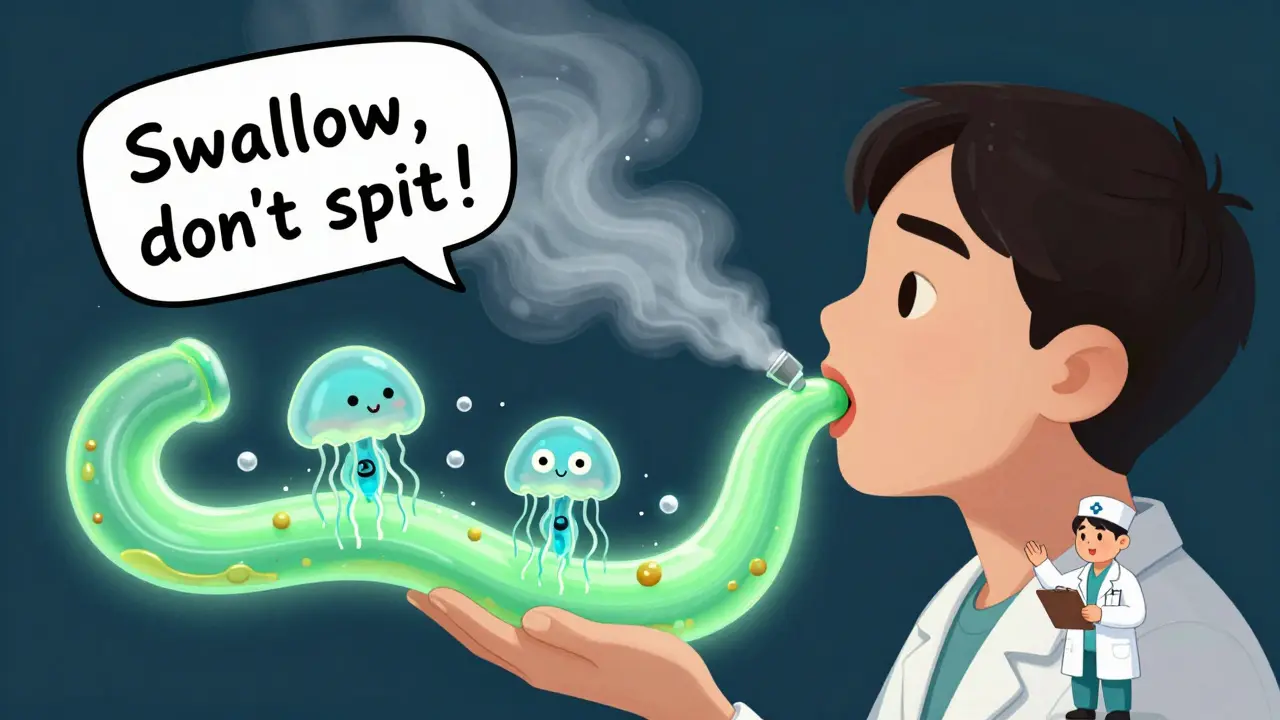
Here’s how it works: You take the inhaler, spray it into a small cup, mix it with water or honey, and slowly swallow it. The goal? Let the steroid coat your esophagus. It doesn’t go to your lungs. It stays where the inflammation is. That’s why it’s called a slurry - a thick, goopy liquid you sip and hold in your mouth before swallowing.
Studies show budesonide slurry works faster. Most people feel better in 2-4 weeks. At 12 weeks, 64% of patients see histological remission - meaning the eosinophils drop below 15 per field. Fluticasone is slightly less effective (50-60%) but cheaper and easier to prepare. The new FDA-approved drug, Jorveza (budesonide oral suspension), is specifically made for EoE. It’s a ready-to-swallow slurry, no mixing needed. But it costs over $10,000 a year.
There’s a catch. About 15% of people get oral thrush - a yeast infection in the mouth. That’s why you must rinse your mouth with water after each dose. And don’t spit it out. Swallow it. The medicine only works if it touches your esophagus.
Many patients hate the taste. Honey helps. Applesauce works. Some even freeze the slurry into popsicles. But if you can’t stick with it, the treatment fails. And if you stop too soon, the inflammation comes back.
Diet vs. Drugs: Which One Should You Choose?
There’s no one-size-fits-all answer. It depends on your life, your symptoms, and your goals.
Choose dietary elimination if:
- You’re young and motivated
- You want to avoid long-term medication
- You’re willing to work with a dietitian
- You’ve tried reflux meds and they didn’t work
Choose steroid slurries if:
- You need fast relief (within weeks)
- Your job or social life makes elimination too hard
- You’re allergic to multiple foods and don’t want to give up everything
- You’re not ready for biologics like dupilumab (which costs over $30,000/year)
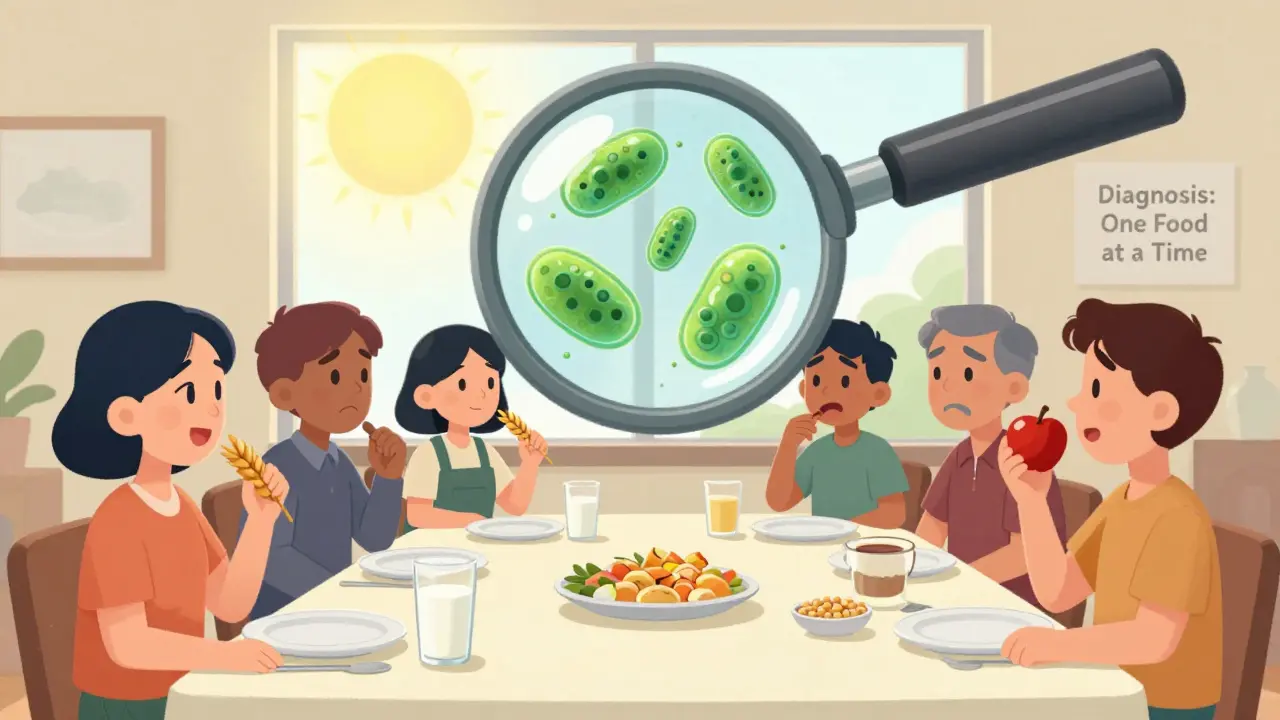
But here’s the reality: Most people do both. Start with diet. If you don’t improve in 8 weeks, add the slurry. Then, once you’re better, slowly reintroduce foods - one at a time - to find your trigger. That’s the only way to know what you can eat again.
And don’t forget: Even if you feel fine, you still need an endoscopy. Symptoms lie. Eosinophils don’t. You can feel okay but still have active inflammation. That’s why follow-up biopsies every 3-6 months are non-negotiable.
What No One Tells You About Living With EoE
There are hidden battles no one talks about.
First, nutrition. Cutting out dairy means missing calcium and vitamin D. Cutting out eggs? You lose choline and protein. Cutting out wheat? You lose fiber. Many patients develop deficiencies. That’s why seeing a registered dietitian isn’t optional - it’s essential. Programs like the Eosinophilic Esophagitis Food Pantry in Cincinnati now give free hypoallergenic meals to patients who can’t afford them.
Second, mental health. The isolation is brutal. Birthdays. Weddings. Lunch with friends. Every meal becomes a minefield. One Reddit user wrote: "I cried in a grocery store because I couldn’t find a bread that didn’t have soy." Another said: "I stopped dating because I couldn’t explain why I couldn’t eat pizza."
Third, recurrence. Even if you find your trigger and eliminate it, 40% of patients relapse within 6 months. Why? Because reintroducing foods too fast. Because stress. Because you missed a hidden ingredient. That’s why long-term management isn’t a fix - it’s a lifestyle.
What’s Next? Biologics, Biomarkers, and Hope
The future is changing fast. In May 2023, the FDA approved dupilumab (Dupixent) for EoE. It’s a biologic - an injection that blocks the immune signals causing inflammation. In trials, 60% of adults went into remission. It’s not a cure. But for people who failed diet and steroids? It’s life-changing.
And researchers are working on something even bigger: a blood test to predict your trigger foods without elimination. The CEGIR study is testing biomarkers - tiny signals in your blood that point to specific food reactions. If it works, you won’t have to give up your favorite foods for months just to find out what’s hurting you.
Right now, you have options. You can start with milk. You can try the slurry. You can do both. But you don’t have to do it alone. Support groups like APFED and Reddit’s r/EoE have thousands of people who’ve been there. They know how to make the slurry taste better. They know which brands of pasta are safe. They know how to explain EoE to your boss.
It’s not easy. But it’s manageable. And for the first time in history, we have real tools to take back control - one swallow at a time.
 Health and Wellness
Sumit Mohan Saxena
February 27, 2026 AT 14:44The clinical data presented here is methodologically sound and aligns with recent meta-analyses from the Journal of Allergy and Clinical Immunology (2023). The 1FED approach, particularly dairy elimination, demonstrates a statistically significant reduction in eosinophilic infiltration, with remission rates comparable to 6FED in North American cohorts. The emphasis on biopsy confirmation remains paramount, as symptom correlation with histology is poor in up to 40% of cases. Dietary management must be supervised by a registered dietitian to mitigate risks of micronutrient deficiency, particularly in calcium, vitamin D, and choline. Longitudinal follow-up is non-negotiable.
Pharmacologic intervention via topical steroids remains a valid second-line option, though adherence is suboptimal due to palatability and regimen complexity. The emergence of Jorveza represents a significant therapeutic advancement, despite cost barriers. Future biomarker development may obviate prolonged elimination diets, but for now, empirical elimination remains the gold standard.
Systemic biologics like dupilumab are transformative for refractory cases, yet their use should be reserved for patients who have failed both dietary and topical steroid protocols. The integration of behavioral health support is critically under-addressed in current clinical guidelines.
Katherine Farmer
March 1, 2026 AT 08:26How quaint. A 1-in-1,700 prevalence rate and suddenly we’re treating this like a pandemic? The entire narrative here is built on cherry-picked NIH data from a single-center trial with a sample size of 127. And now we’re telling patients to swallow steroid slurries like some kind of medieval tonic? The real tragedy isn’t EoE-it’s the medical-industrial complex turning a niche condition into a $10,000/year revenue stream.
Meanwhile, the real triggers-glyphosate residues in dairy, emulsifiers in processed foods, and gut dysbiosis from antibiotics-are never mentioned. No, let’s just keep feeding people $150/month slurry and calling it science. Brilliant.
Angel Wolfe
March 2, 2026 AT 02:27THIS IS A GLOBALIST SCAM TO MAKE YOU DEPEND ON BIG PHARMA AND LOSE YOUR FOOD FREEDOM
They don’t want you to know that milk is fine if it’s raw and from grass-fed cows in the USA
They banned raw milk in 48 states so you’d have to buy their slurry or their $30k drug
They’re replacing your immune system with steroids and calling it treatment
Wake up sheeple
My cousin had EoE and he just drank apple cider vinegar and now he eats pizza every day
THEY DON’T WANT YOU TO KNOW THIS
TRUST NO ONE
THEY’RE LYING ABOUT THE BIOPSY
THEY’RE LYING ABOUT THE EOSINOPHILS
THEY’RE LYING ABOUT EVERYTHING
Sophia Rafiq
March 3, 2026 AT 16:05so i just cut out dairy and my symptoms vanished in like 10 days
no slurry no biopsy no drama
turns out my esophagus just hates cheese
also i found out i’m allergic to oat milk? who knew
now i eat rice milk and chill
life is good
Martin Halpin
March 4, 2026 AT 11:10Let me tell you something about this whole EoE thing that nobody dares to say out loud-because it’s too inconvenient, too politically incorrect, too deeply uncomfortable for the medical establishment to acknowledge. We’ve been conditioned to believe that the esophagus is some kind of passive pipe, a mere conduit, when in fact it’s a highly sensitive immunological interface, one that responds not just to food proteins but to environmental toxins, emotional stress, and yes-microplastics in our water supply. I’ve been studying this for over a decade, and I’ve seen patients whose EoE symptoms completely resolved after removing their plastic water bottles and switching to glass. I’ve seen patients who developed EoE after moving from rural Ireland to urban Chicago, where the air quality and glyphosate-laced food supply are catastrophically different. And yet, we’re told to eliminate milk? That’s like treating lung cancer by telling the patient to stop smoking one cigarette a day. The real trigger isn’t casein-it’s the cumulative burden of modern life. The real solution isn’t a slurry-it’s a complete overhaul of our toxic environment. But no, let’s just keep prescribing more drugs and calling it progress. We’ve lost the forest for the trees, and the trees are dying.
Justin Ransburg
March 5, 2026 AT 13:03This is one of the most well-researched and compassionate summaries of EoE I’ve ever read. Thank you for breaking down the science without overwhelming the reader. The shift from 6FED to 1FED is a game-changer for families who are already stretched thin. I’ve worked with dozens of patients who thought they had to give up everything, only to find that removing dairy was enough. And the steroid slurry advice? Spot on. I always tell patients: don’t spit it out. Swallow it. That’s the key.
If you’re struggling, reach out. There are support groups. There are dietitians. There are people who get it. You’re not alone.
Brandie Bradshaw
March 6, 2026 AT 11:09It’s not just about the eosinophils. It’s about the silence. The loneliness. The way you sit at a restaurant and smile while everyone else eats, because you’re too afraid to explain why you’re eating plain rice and steamed broccoli. It’s about the guilt you feel when your child cries because they can’t have birthday cake. It’s about the way your partner looks at you like you’re being dramatic when you say, "I can’t eat that." It’s about the years you spent being told it was "just anxiety"-and then the moment you finally got the biopsy that proved you weren’t crazy. This isn’t a medical condition. It’s a social crisis. And we’re treating it like a diet problem.
Lisa Fremder
March 7, 2026 AT 22:48Why are we letting Big Pharma get away with this? They invented EoE so they could sell slurries and $30k drugs
They made it worse by banning raw milk and pushing pasteurized dairy
They’re poisoning us with soy and wheat and calling it food
And now they want us to swallow steroids like some kind of magic potion
THIS IS A COVER-UP
THEY KNOW THE TRUTH
THEY KNOW IT’S THE WATER
THEY KNOW IT’S THE FLUORIDE
THEY KNOW IT’S THE VACCINES
AND THEY’RE SILENT
Full Scale Webmaster
March 8, 2026 AT 06:21Oh my god I’ve been waiting for someone to say this
They’re lying about the slurry
It doesn’t work
I did it for 6 months
Spent $1,200 on budesonide
Swallowed it every night
Swished it like a wine tasting
And guess what?
My eosinophils went up
My esophagus got worse
And the doctor just said "try harder"
That’s not medicine
That’s emotional abuse
And now they’re pushing Jorveza
At $10,000 a year
For what?
For a placebo wrapped in a prescription
I’m done
I’m going raw
I’m going paleo
I’m going to find a functional doc who doesn’t work for Big Pharma
And if you’re still swallowing that slurry
You’re being scammed
I’m not mad
I’m just disappointed
They promised healing
They gave us debt