
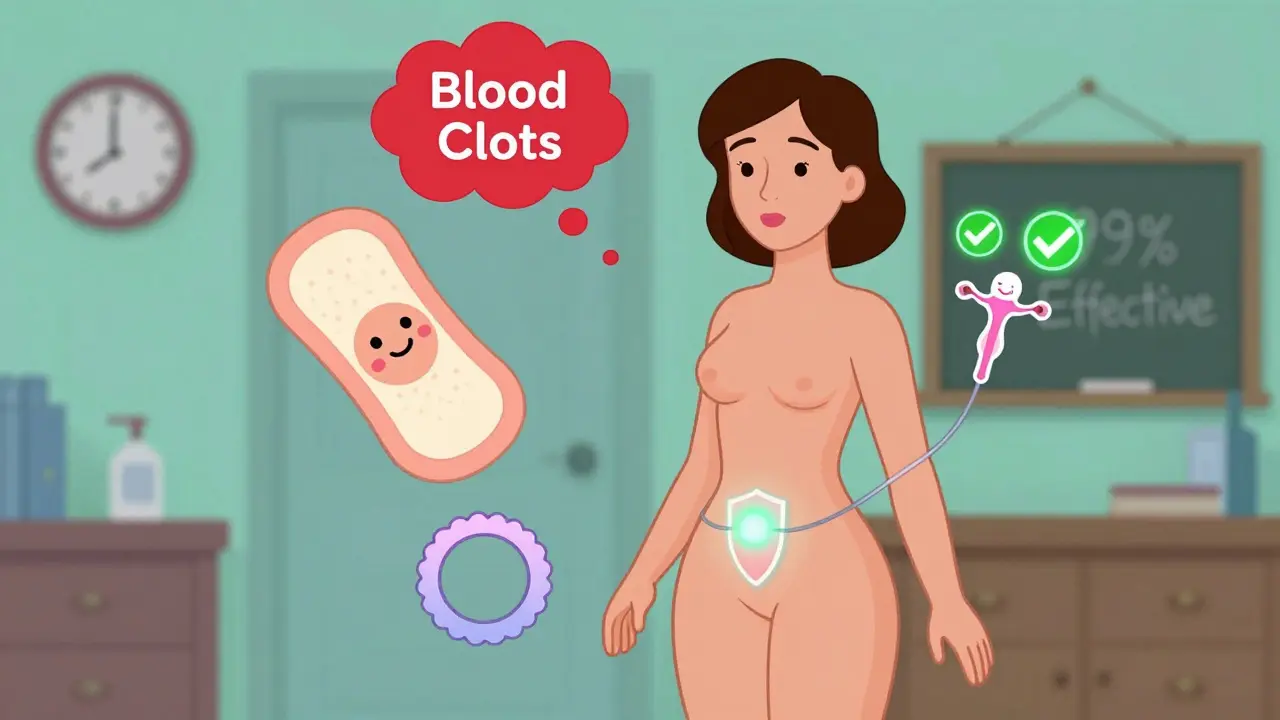
When it comes to birth control, you’re not just choosing between options-you’re choosing between different ways your body will react. The contraceptive patch, the vaginal ring, and the IUD are all effective, but they work in very different ways. And those differences matter when it comes to your safety. If you’ve ever wondered which method is safest for your body, especially if you have a history of migraines, blood clots, or heavy periods, this isn’t just another overview. This is a real comparison based on current data, user experiences, and medical guidelines.
How Each Method Works
The contraceptive patch (like Xulane®) sticks to your skin and releases hormones daily: 150 mcg of norelgestromin and 35 mcg of ethinyl estradiol. You change it once a week for three weeks, then skip a week to get your period. It’s simple, but it delivers more estrogen than the average birth control pill. That’s not just a technical detail-it’s a risk factor.
The vaginal ring (NuvaRing®) sits inside your vagina and releases 0.12 mg of etonogestrel and 0.015 mg of ethinyl estradiol every day. You leave it in for three weeks, then take it out for a week. It’s convenient, but because it’s internal, some women report discomfort during sex or expulsion-about 3 to 5% of users say it falls out at least once.
The IUD is a small T-shaped device inserted into your uterus. There are two types: copper (Paragard®) and hormonal (Mirena®, Liletta®, Kyleena®, Skyla®). The copper IUD works by releasing ions that are toxic to sperm. Hormonal IUDs release levonorgestrel, which thickens cervical mucus and thins the uterine lining. They last 3 to 12 years depending on the brand. No weekly or monthly maintenance. No pills to forget. Just one procedure.
Effectiveness: The Numbers Don’t Lie
Let’s cut through the noise. How likely are you to get pregnant using each method? The difference is huge.
- Contraceptive patch: 91% effective with typical use (9 pregnancies per 100 women per year)
- Vaginal ring: 91% effective (same as the patch)
- Hormonal IUD: Over 99% effective (less than 1 pregnancy per 100 women per year)
- Copper IUD: Over 99% effective (0.2% failure rate)
A 2022 review in JAMA Network Open found that short-acting methods like the patch and ring had a pregnancy rate of 4.55 per 100 women-years. IUDs? Just 0.27. That’s more than 16 times safer in real-world use. And if you’re under 21, your risk with short-acting methods jumps even higher-1.9 times more likely to get pregnant than women over 21. With an IUD? Age doesn’t matter.
Safety: Blood Clots, Hormones, and Your Body
The patch and ring both contain estrogen. That’s the problem.
Estrogen increases your risk of venous thromboembolism-blood clots in the legs or lungs. For women not using hormonal birth control, the baseline risk is 2 to 10 events per 10,000 women per year. With estrogen-containing methods, that jumps to 7 to 10. The patch? A 2022 JAMA review and FDA warnings suggest it may carry an even higher risk than the pill. Why? Because the patch delivers more estrogen into your bloodstream than oral pills. Medical News Today (2023) reported women on the patch are more likely to develop dangerous clots than those on pills. No one’s saying it’s common-but if you smoke, have high blood pressure, or get migraines with aura, this isn’t worth the gamble.
IUDs don’t have that risk. The copper IUD has no hormones. Hormonal IUDs release progestin directly into the uterus. Very little enters your bloodstream. That’s why the American College of Obstetricians and Gynecologists (ACOG) recommends IUDs as first-line contraception for most women. Dr. Jen Gunter says it plainly: “IUDs have the lowest failure rate of any reversible method and don’t carry the blood clot risks associated with estrogen-containing methods.”
Side Effects: What You’ll Actually Feel
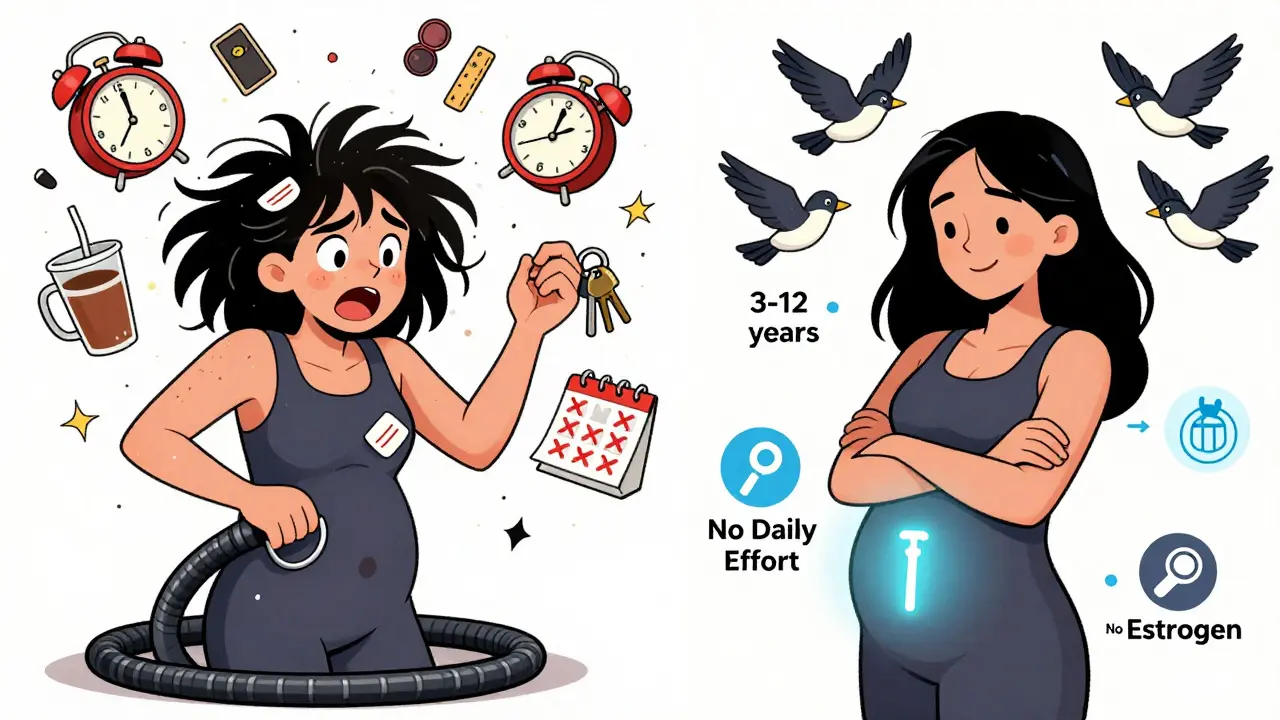
Side effects aren’t just listed in brochures-they’re your daily life.
With the patch, 42% of users on Healthgrades reported skin irritation where the patch stuck. 37% had breakthrough bleeding. And 20% quit within six months, according to a 2022 Contraception study. That’s more than one in five.
The vaginal ring? 38% of users on Drugs.com said they felt discomfort or had the ring expelled during sex. Some love the convenience. Others feel it constantly. The ring has lower breakthrough bleeding than some pills, but it still causes regular withdrawal bleeding every month.
IUDs? It’s a trade-off.
The copper IUD makes periods heavier and cramps worse. One user on Reddit said, “Paragard made my periods unbearable-8 days of heavy flow with debilitating cramps.” That’s common. About 57% of Paragard users report this as a major downside.
Hormonal IUDs? The opposite. Many users get lighter periods. Some stop having periods altogether. But in the first 6 to 12 months, 32% of Mirena® users report irregular bleeding. It’s messy. It’s confusing. But it usually settles down. And when it does? Many say they wish they’d switched sooner.
Insertion, Expulsion, and Infection Risk
IUDs aren’t risk-free. The insertion process takes 5 to 10 minutes and feels like strong menstrual cramps. Some women pass out. Others cry. It’s real.
Expulsion happens in 2 to 10% of cases, especially in women who’ve never given birth or have heavy periods. Uterine perforation is rare-0.1 to 0.6%-but it can happen. Infection risk? Only 1 to 2% in the first 20 days after insertion. That’s why doctors check for STIs before inserting.
Still, these risks are low. And they’re one-time. Once it’s in and you’re past the first month, most women don’t think about it again.
Compare that to the patch and ring. You have to remember them. Every week. Every month. Miss one day? You’re at risk. The patch can fall off. The ring can slip out. Neither gives you the same peace of mind as an IUD.
Cost: Upfront vs. Long-Term
The patch costs $15 to $80 a month without insurance. The ring? $0 to $200. Both add up fast.
An IUD? Upfront cost is $0 to $1,300. But it lasts 3 to 12 years. That’s less than $10 a year. And under the Affordable Care Act, most insurance plans cover it with no copay. If you’re planning to use birth control for more than a year, the IUD saves you money. A lot of it.
Who Should Avoid What?
Not everyone can use every method. Here’s what you need to know:
- Avoid estrogen methods (patch, ring) if you: smoke over age 35, have migraines with aura, high blood pressure, a history of blood clots, or breast cancer.
- Consider copper IUD if: you want hormone-free contraception, have heavy periods (though it may make them worse), or need emergency contraception (it’s the most effective option if inserted within 120 hours).
- Consider hormonal IUD if: you want lighter periods, fewer cramps, and long-term protection without daily maintenance.
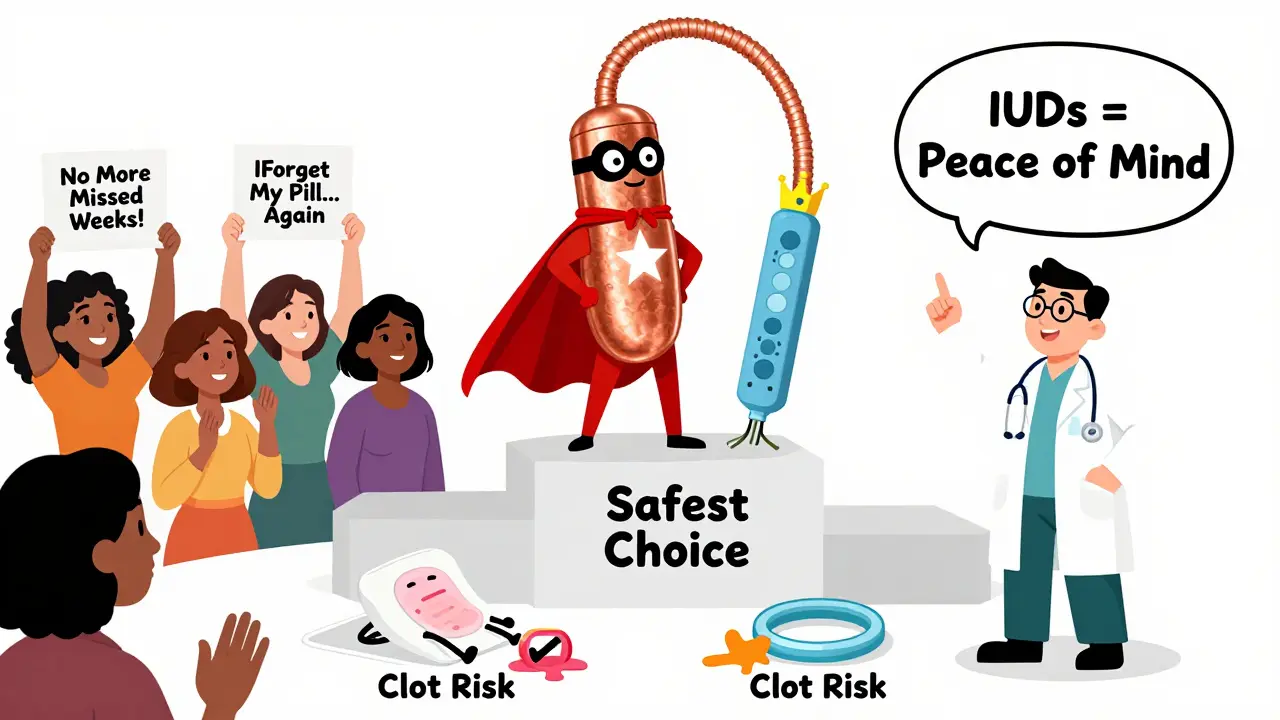
Dr. Sarah Prager from the University of Washington says it best: “The best birth control is the one that works for the individual’s body, lifestyle, and risk factors.” There’s no universal winner. But there is a universal truth: IUDs are safer, more effective, and more reliable for most women.
What Experts Are Saying Now
The Guttmacher Institute found IUD use jumped from 6% of contraceptive users in 2006 to 14% in 2019. The patch and ring? They’ve stayed around 5-6%. Why? Because women are learning. They’re seeing the data. They’re talking to each other. And they’re choosing methods that don’t just work-they work without constant effort or hidden risks.
The Contraceptive CHOICE Project showed that when cost and access barriers are removed, 75% of women choose IUDs or implants. Unintended pregnancy rates dropped by 75%. That’s not magic. That’s science.
And while research continues-new non-hormonal IUD materials are being tested, and lower-dose hormonal options are gaining traction-the message is clear: if you’re looking for safety, effectiveness, and peace of mind, the IUD is the most reliable option available today.
What Should You Do Next?
If you’re thinking about switching or starting birth control:
- Ask your provider: “What are my risks with estrogen?”
- Ask: “What’s my chance of expulsion or infection with an IUD?”
- Ask: “Which method has the lowest failure rate for someone like me?”
- Don’t assume the patch or ring is safer just because it’s easier to start. The real safety comes from long-term reliability.
And if you’re on the patch or ring and you’ve had migraines, mood swings, or clots in your family? Talk to your doctor. There’s a better option out there.
Is the contraceptive patch safer than the birth control pill?
No, the patch is not safer. It delivers more estrogen than the average pill, which increases the risk of blood clots. The FDA and multiple studies, including a 2022 JAMA review, suggest the patch carries a higher thrombotic risk than oral contraceptives. If you’re concerned about blood clots, avoid estrogen-based methods altogether.
Can the IUD cause infertility?
No, IUDs do not cause infertility. Once removed, fertility returns quickly-usually within a month. The idea that IUDs cause infertility is an old myth. In fact, studies show women who use IUDs have the same pregnancy rates after removal as women who’ve never used them. Infection risk is very low and only occurs in the first few weeks after insertion, not long-term.
Which method is best for someone with heavy periods?
A hormonal IUD (like Mirena® or Liletta®) is the best choice. It thins the uterine lining and reduces bleeding for most users. About 68% of users report lighter periods, and 20% stop having periods altogether. The copper IUD does the opposite-it often makes periods heavier. The patch and ring may help a little, but not as consistently or effectively as the hormonal IUD.
How long does it take for an IUD to start working?
A copper IUD works immediately and can even be used as emergency contraception if inserted within 120 hours after unprotected sex. Hormonal IUDs are effective right away if inserted during your period. If inserted at any other time, you need to use backup contraception (like condoms) for 7 days.
Can I use the patch or ring if I’m over 35?
Only if you don’t smoke and have no other risk factors like high blood pressure, migraines with aura, or a history of blood clots. For women over 35 who smoke, estrogen-containing methods are strongly discouraged. IUDs are a much safer alternative. Many women in this group switch to IUDs for safety reasons.
 Health and Wellness
Aisling Maguire
March 1, 2026 AT 14:05Just switched to a hormonal IUD last year and I can’t believe I waited so long. No more weekly patch changes, no more worrying if I forgot to put it on. My periods went from a nightmare to a memory. Seriously, if you’re on the patch or ring and you’re over 25, just talk to your doc. It’s not even close.
Sophia Rafiq
March 2, 2026 AT 14:16Estrogen is the silent killer in birth control. Patch and ring are basically slow drip IVs of clot risk. IUD? Progestin local delivery. Minimal systemic exposure. That’s why ACOG pushes it. The data’s not even close. Stop treating convenience like safety.
Martin Halpin
March 3, 2026 AT 07:58Look I get the IUD love but let’s be real here. The copper one turned my period into a horror movie. I bled for 12 days straight. My partner couldn’t even touch me. And the cramps? I had to call in sick three times. Yeah it’s ‘effective’ but at what cost? The patch? Yeah I got a rash but I didn’t feel like I was being gutted every month. This whole post feels like an ad for Big IUD.
Eimear Gilroy
March 4, 2026 AT 01:30Does anyone know if the hormonal IUD affects libido? I’ve heard it can go either way. My friend’s libido tanked, another one said she felt like a new woman. Wonder if it’s tied to the type of progestin or just individual biochemistry.
Ajay Krishna
March 5, 2026 AT 18:53For anyone considering an IUD, don’t be scared of the insertion. It’s intense but quick. I cried, my mom held my hand, and 7 minutes later I was fine. The first month was messy but now? I forget I even have it. Life-changing. Also, if you’re on a budget, the upfront cost is worth it. I saved over $2k in 5 years.
Charity Hanson
March 7, 2026 AT 07:56Y’all need to stop romanticizing IUDs. My sister had a perforation. Took two surgeries. She’s fine now but the trauma? Real. And yes, expulsion happens. I know a girl who lost her ring in the shower and got pregnant. Every method has trade-offs. Don’t let anyone shame you for choosing what works for YOU.
Noah Cline
March 9, 2026 AT 00:37Anyone who says the patch is safer than the pill is either misinformed or paid by the manufacturer. JAMA 2022 showed 40% higher VTE risk than oral contraceptives. The FDA issued a black box warning. This isn’t opinion. It’s biophysics. Stop pretending convenience equals safety.
Lisa Fremder
March 9, 2026 AT 17:14Why are we even talking about this? The IUD is clearly the superior option. Americans are too lazy to stick to a schedule. Patch and ring are for people who think birth control is a chore. IUDs are for adults who want to live their lives without thinking about it. End of story.
Justin Ransburg
March 9, 2026 AT 17:58Thank you for this comprehensive breakdown. The data is clear and the tone is balanced. I’ve shared this with my sister who’s been on the patch for three years. She’s scheduled her consultation for a hormonal IUD next week. Knowledge is power - and this post gave her the clarity she needed.
Sumit Mohan Saxena
March 10, 2026 AT 01:17According to the 2022 JAMA Network Open meta-analysis, the typical-use failure rate for the contraceptive patch and vaginal ring is 4.55 per 100 woman-years, whereas for hormonal IUDs it is 0.27 per 100 woman-years. This represents a 16.85-fold reduction in failure risk. Additionally, the absolute risk of venous thromboembolism for estrogen-containing methods is approximately 7–10 per 10,000 woman-years, compared to 2–10 for non-hormonal methods. The differential is statistically significant (p < 0.001). Therefore, clinical guidelines are unequivocal.
Brandon Vasquez
March 10, 2026 AT 08:44I had the copper IUD for 6 years. Heavy periods, yes. But I didn’t have to think about it. No pills. No patches. No rings. No anxiety. I got pregnant right after removal. Fertility was fine. The insertion sucked but the peace of mind? Priceless. If you’re on the fence, just talk to someone who’s had it for a few years.
Vikas Meshram
March 10, 2026 AT 19:08You all are ignoring the fact that the copper IUD has a 0.2% failure rate, not 0.27. The source is incorrect. Also, the patch doesn’t deliver ‘more estrogen’ than the pill - it delivers the same total dose, just transdermally. Absorption rates differ. This article is full of misinformation. Also, ‘migraines with aura’ is not an absolute contraindication - it’s a relative one. You’re all overreacting.
Aisling Maguire
March 12, 2026 AT 14:26^ I had the copper too. And yeah, the bleeding sucked. But I’m 30 now and my periods are lighter than they were before IUD. My body adjusted. Also, the ‘0.2%’ stat is for the copper IUD overall - the 0.27 is from the JAMA study on typical use across all hormonal IUDs. You’re comparing apples to oranges. And no, the patch doesn’t just ‘deliver the same dose’ - it delivers more systemic estrogen because of constant absorption. The FDA’s own data shows higher Cmax than oral pills. This isn’t Reddit myth. It’s pharmacokinetics.