
Carpal tunnel syndrome isn’t just a minor wrist ache-it’s a nerve compression disorder that can slowly steal your ability to grip, type, or even hold a coffee cup. If you’ve woken up with numb fingers, or find yourself shaking your hand like you’re trying to get water off your palm, you’re not alone. Around 10% of people in the U.S. deal with this condition, and it hits women three times more often than men, especially between ages 45 and 60. It’s not caused by typing too much on a keyboard, as many think. It’s about pressure. Too much pressure inside a tight space in your wrist, squeezing the median nerve that runs from your forearm into your hand.
What’s Really Happening in Your Wrist?
Your wrist isn’t just skin and bone. Inside it lies a narrow tunnel made of eight small carpal bones on the bottom and a tough ligament on top. Nine tendons that bend your fingers and thumb squeeze through this tunnel, along with the median nerve. This nerve gives feeling to your thumb, index, middle, and half of your ring finger. When the tunnel gets crowded-because of swelling, inflammation, or repetitive motion-the nerve gets pinched. That’s when symptoms start.The process isn’t sudden. It builds. First, you feel tingling at night. You wake up, shake your hand, and it’s fine. Then the tingling moves into the day. You drop things. Buttoning a shirt becomes a chore. Eventually, your thumb muscles weaken. That’s when the damage becomes harder to reverse. Studies show that if the nerve stays compressed for over a year, the risk of permanent nerve damage jumps significantly.
How Do You Know It’s Carpal Tunnel?
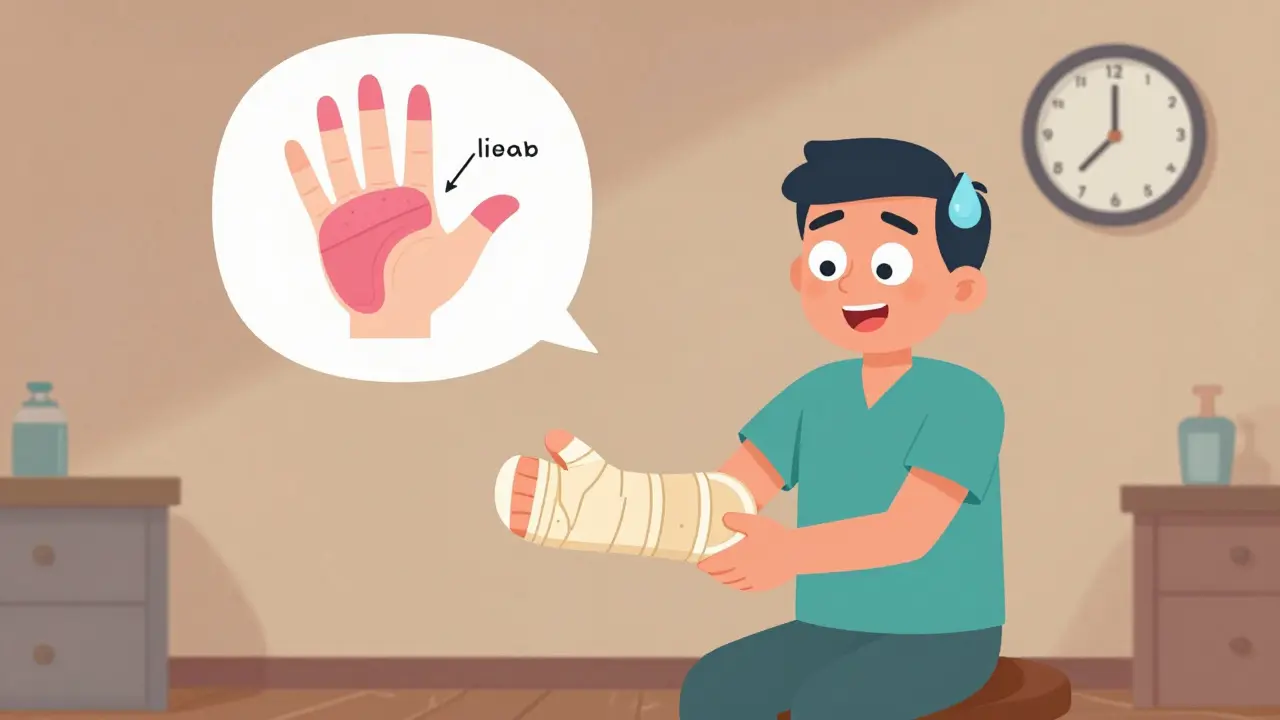
There’s no single test that confirms carpal tunnel syndrome. Doctors use a mix of physical exams and symptom patterns. One of the most telling signs is the Katz hand diagram-a drawing of a hand where patients mark where they feel numbness. If it’s only the thumb, index, middle, and part of the ring finger, that’s a strong clue. Other signs include:- Positive Phalen’s test: Holding your wrists bent forward for 60 seconds triggers numbness.
- Tinel’s sign: Tapping over the wrist makes a tingling shock run into your fingers.
- Carpal compression test: Pressing directly on the tunnel for 30 seconds reproduces symptoms.
Doctors also check for muscle loss at the base of the thumb-the thenar eminence. If it’s sunken or smaller than the other hand, the nerve has been under pressure for a long time. For unclear cases, nerve conduction studies measure how fast electrical signals move through the median nerve. A delay over 3.7 milliseconds confirms compression. But here’s the catch: about 15-20% of people over 60 show abnormal nerve tests even when they have no symptoms. That’s why doctors always match test results with how you feel.
First Steps: Conservative Treatments That Actually Work
If your symptoms are mild or moderate, and you’ve had them less than 10 months, conservative treatment has a 75% success rate. The most effective first step? Wearing a wrist splint at night.It sounds simple, but it’s backed by solid data. Wearing a splint that keeps your wrist straight-not bent-while you sleep reduces pressure on the nerve. Studies show 60-70% of people see major improvement after 4-6 weeks. The key is consistency. You need to wear it every night for at least 8 weeks. No skipping. No “I’ll wear it tomorrow.”
Activity changes matter too. Avoid bending your wrist past 30 degrees. If you’re typing, raise your keyboard so your wrists stay flat. If you’re a nurse holding a patient’s arm, or a cook chopping veggies, find ways to reduce repetitive wrist motion. Take breaks every 20 minutes. Stretch your fingers and wrists. Nerve gliding exercises-gentle movements that help the nerve slide through the tunnel-are also proven to help. A physical therapist can show you how to do them safely.
Corticosteroid injections are another option. They reduce swelling around the nerve and give relief for 3-6 months in about 70% of cases. But they’re not a cure. They buy time. If symptoms come back quickly, it’s a sign the pressure is still there.
When Surgery Becomes Necessary
If you’ve tried splinting, exercises, and injections for 6-8 weeks with no improvement-or if you’re losing muscle strength-surgery is the next step. Carpal tunnel release cuts the ligament that’s squeezing the nerve, giving it room to breathe. Two main types exist:- Open release: A 2-inch incision on the palm. The ligament is cut directly. Recovery takes 6-8 weeks for full strength.
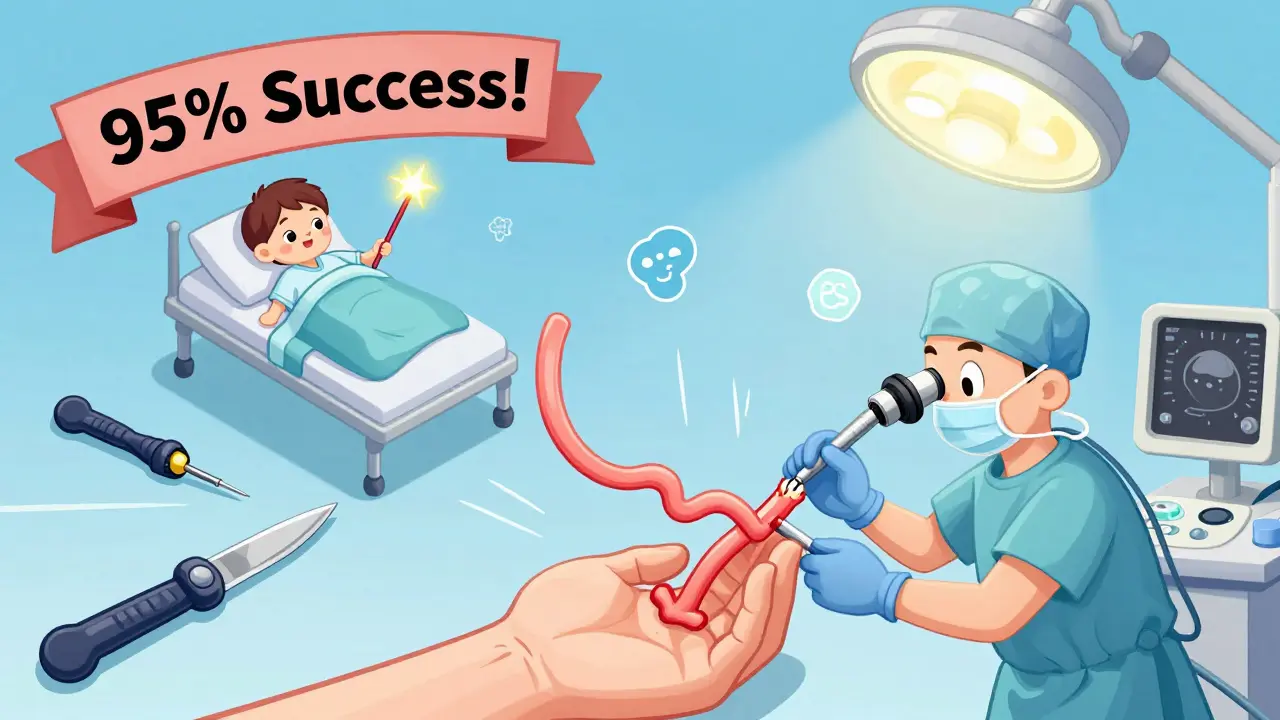
- Endoscopic release: A tiny camera and tool are inserted through one or two small cuts. Less scarring, faster recovery-often 2-3 weeks quicker than open surgery.
Both have a 90-95% success rate in relieving symptoms. But surgery isn’t risk-free. About 15-30% of people get pillar pain-tenderness on the sides of the palm. Scar tissue can stay sensitive for months. Nerve injury is rare-under 1%-but it happens.
There’s a newer option: ultrasound-guided percutaneous release. The FDA approved it in 2021. A tiny knife, guided by real-time ultrasound, cuts the ligament through a needle-sized puncture. Patients report 40% less pain after and return to work 50% faster. It’s not available everywhere yet, but it’s gaining ground.
Cost, Recovery, and What to Expect
Conservative care-splint, therapy, injections-costs about $450-$750 in the U.S. A custom splint runs $150-$250. Physical therapy sessions are $100-$200 each, usually 4-6 visits. Steroid injections are $300-$500.Surgery is more expensive. With insurance, out-of-pocket costs range from $1,200 to $2,500. Endoscopic is 15-20% pricier than open. But recovery is faster. Most people return to light work in 2-3 weeks. For desk jobs, you might be back in a week. For manual labor-construction, cooking, nursing-you’ll need 6-12 weeks.
Post-op rehab is crucial. You’ll need 6-8 physical therapy sessions to rebuild strength and reduce scar stiffness. Skipping this step leads to lingering pain and weakness.
Who’s Most at Risk?
It’s not just about age or gender. Your job matters. The Bureau of Labor Statistics found 27,300 work-related carpal tunnel cases in 2022. The top three:- Manufacturing (23%)
- Healthcare (19%)
- Food service (14%)
People who do the same hand motion over and over-like packing boxes, holding surgical tools, or scrubbing dishes-are at highest risk. Even hobbies like knitting, gardening, or playing guitar can contribute if done intensely for years.
Other risk factors include pregnancy, diabetes, thyroid disorders, and obesity. Fluid retention during pregnancy can swell the carpal tunnel. Diabetes damages nerves, making them more vulnerable. And extra body weight increases pressure on the wrist.
What Doesn’t Work
Don’t waste time on unproven fixes. Magnets, copper bracelets, acupuncture, and “nerve flossing” apps with no clinical backing won’t stop the compression. Over-the-counter anti-inflammatories like ibuprofen might help with pain, but they don’t reduce the pressure on the nerve.Also, don’t wait. The longer you ignore symptoms, the harder it is to fix. Patients with symptoms under 10 months have a 75% chance of avoiding surgery. After 12 months? That drops to 35%. Early action saves your hand.
What’s Changing in 2026?
New research is shifting how CTS is diagnosed. High-resolution ultrasound can now measure the median nerve’s size in the wrist. If it’s larger than 12mm² at the pisiform bone, it’s likely compressed. This test is 92% accurate-almost as good as nerve conduction studies-and faster, cheaper, and non-invasive. The American Academy of Neurology now recommends ultrasound as a first-line tool where trained providers are available.And prevention? More workplaces are starting to adopt ergonomic assessments, though the U.S. still lacks mandatory rules. In the EU, employers must evaluate repetitive motion risks. Here, it’s up to you. If your job hurts, talk to your manager. Ask for wrist supports, adjustable workstations, or task rotation.
One big takeaway: carpal tunnel isn’t inevitable. It’s treatable. And the earlier you act, the better your outcome. Don’t wait until your thumb feels weak. Don’t brush off nighttime numbness as ‘just aging.’ Your hand is telling you something. Listen.
 Health and Wellness
Bryan Fracchia
January 28, 2026 AT 03:01Been dealing with this for years-wrist splints at night changed everything. I used to wake up like my hand was asleep after a bad dream. Now? Just a faint tingle sometimes. Consistency is everything. Don’t skip nights. Even if you think it’s ‘fine’-it’s not.
Also, nerve glides? Total game-changer. Not some woo-woo stretch, but actual physical therapy stuff. Do them before you type, after you cook, right before bed. Five minutes a day keeps the surgeon away.
And yeah, typing doesn’t cause it. It’s the gripping. Holding tools. Holding babies. Holding your phone like your life depends on it. Your wrist isn’t built for that.
fiona vaz
January 30, 2026 AT 01:57My mom had carpal tunnel after 30 years of nursing. She tried everything-copper bracelets, acupuncture, even ‘nerve flossing’ apps. None worked. The splint? Took her 6 weeks to commit. Then boom-no more night awakenings. She still wears it every night. Says it’s like a security blanket for her hands.
Don’t let pride delay treatment. If you’re shaking your hand like you’re trying to甩掉水,you’re already late.
Rose Palmer
January 30, 2026 AT 07:08As a board-certified occupational therapist with over 18 years of clinical experience, I must emphasize that the 75% success rate for conservative management applies only to patients with mild-to-moderate symptoms and documented electrophysiological confirmation. Many patients self-diagnose based on online symptom checkers, which leads to inappropriate treatment trajectories. The Katz diagram, while useful, has a 22% false positive rate in patients with cervical radiculopathy. Always rule out proximal pathology before attributing symptoms solely to carpal tunnel syndrome.
Timothy Davis
January 30, 2026 AT 23:02Wow. So let me get this straight. You’re telling me that people who work in manufacturing, healthcare, and food service are the real victims here? Not the 25-year-old who types 10 hours a day? That’s rich. I’ve been typing since I was 12. My wrists are fine. Meanwhile, the guy who lifts 50-pound boxes all day complains about ‘repetitive motion’? Please. This is just another corporate wellness narrative to shift blame away from poor ergonomics in the tech industry.
And ultrasound-guided release? Cute. But the FDA approved it in 2021? That’s not innovation-that’s regulatory capture. Ask any surgeon who’s done 200 open releases: they’ll tell you the endoscopic method has higher recurrence rates. The industry just wants to sell you a flashier procedure.
Lexi Karuzis
February 1, 2026 AT 07:31Wait… so you’re telling me this is ALL about pressure? Not EMFs? Not 5G? Not fluoride in the water? I’ve been reading forums-people are linking carpal tunnel to smartwatch vibrations, phone radiation, and even the aluminum in deodorant! And now you’re saying it’s just… a ligament? That’s what they want you to believe. The real cause? Corporate America’s push for productivity at the cost of human bodies. They don’t want you to know that your wrist pain is a symptom of capitalism. They want you to buy a splint and go back to work. Think about it.
Also, why do they always say ‘women 3x more often’? Because women are more likely to report symptoms. Men are taught to ‘tough it out.’ The real ratio? Probably 1:1. And the stats are rigged.
Also, corticosteroids? They’re just a band-aid. The real solution? Detox your liver. Your body’s inflammation is caused by toxins. I’ve cured my own CTS with lemon water and infrared sauna. No surgery. No splint. Just truth.
Sue Latham
February 1, 2026 AT 21:17Ugh. I just had to Google ‘carpal tunnel’ because my mom’s been nagging me about my phone use. I’m 24. I don’t even have a job yet. How am I supposed to have this? I don’t lift boxes or scrub dishes. I just scroll. And now I’m scared I’m going to need surgery by 30? I mean… I guess I should stop typing with my thumbs like a caveman? But I like my phone. 😔
Also, why do all the doctors sound like they’re reading from a textbook? Can’t someone just say, ‘Hey, put your phone down’?
James Dwyer
February 2, 2026 AT 06:23I had surgery in 2020. Open release. Took me 3 months to feel normal again. The pain after was worse than before. But now? I can grip a wrench, hold a coffee mug, and type without thinking. Worth it. Don’t wait until your thumb muscle looks like a raisin. Go earlier than you think you should.
Lance Long
February 3, 2026 AT 04:21Let me tell you something. I used to be a line cook. Eight hours a day, 7 days a week, chopping onions, flipping burgers, gripping knives like they were lifelines. My hands would burn at night. I’d wake up screaming. I thought it was just ‘being tired.’
Then one day, I couldn’t hold a spatula. Not because I was weak. Because my nerve was screaming. I didn’t believe in splints. I thought they were for old people. I tried ibuprofen. I tried ice. I tried yoga. Nothing.
So I went to a physical therapist. She taught me nerve glides. I did them every morning. I wore the splint every night. I stopped gripping so hard. I started using my whole arm to lift, not just my wrist.
Four months later? I could cook again. Not just survive. Actually enjoy it.
Don’t wait for your hand to betray you. Listen to it now. It’s not ‘just pain.’ It’s a warning.
Howard Esakov
February 4, 2026 AT 16:16Oh wow. A 92% accurate ultrasound? How revolutionary. I suppose the next thing you’ll tell me is that water is wet and gravity exists. I mean, come on. We’ve known about median nerve compression since the 1800s. It’s not some new-age breakthrough-it’s basic anatomy. And now we’re treating it like it’s a TED Talk? 🙄
Also, ‘carpal tunnel isn’t caused by typing’? Really? Then why do every single tech bro I know have it? Oh right-because they sit like statues with their wrists bent on a mechanical keyboard for 12 hours a day. But sure, blame the nurses and the cooks. That’s much more convenient for Silicon Valley.
John Rose
February 6, 2026 AT 12:12Interesting that the article mentions the EU mandates ergonomic assessments but the U.S. doesn’t. I wonder if this is a regulatory gap-or a cultural one. In the U.S., we often equate endurance with virtue. ‘Push through the pain’ is a badge of honor. In Germany, they install adjustable workstations before anyone complains. Which approach actually saves money long-term? The one that prevents injury-or the one that pays for surgery and lost productivity?
Also, I’d love to see longitudinal data on whether ultrasound-guided release reduces long-term recurrence rates. The 50% faster return to work is compelling, but is it durable?
jonathan soba
February 7, 2026 AT 18:55Let’s be honest: the entire narrative around carpal tunnel is manufactured. The ‘10% of Americans’ statistic? That’s based on self-reported surveys. No objective diagnostic standard. And the ‘3x more common in women’? That’s because women are more likely to seek medical attention. Men? They ignore it until they can’t hold a beer. So the data is skewed by reporting bias, not biological reality.
Also, the ‘75% success rate’ with splints? That’s from studies funded by orthopedic device manufacturers. No independent replication. And the steroid injections? They’re just masking inflammation while the nerve continues to degenerate. You’re not treating the cause-you’re buying time until you need surgery. It’s a pyramid scheme disguised as medicine.
Brittany Fiddes
February 9, 2026 AT 06:48Oh, so now we’re telling Americans that their wrists are weak? How quaint. In Britain, we don’t have this problem because we don’t sit hunched over keyboards like robots. We stand. We walk. We use proper cutlery. And we don’t let corporations turn our bodies into disposable machines. This whole ‘carpal tunnel epidemic’ is an American invention-like obesity and credit card debt. You created it. Now you’re selling splints to fix it. Pathetic.
Rose Palmer
February 10, 2026 AT 10:53Thank you for your thoughtful comments. I appreciate the lived experiences shared here. To clarify: while the Katz diagram has limitations, it remains one of the most reliable clinical tools when used in conjunction with history and physical exam. The key is not to rely on any single tool, but to integrate multiple data points. As for ultrasound-yes, it’s becoming more accessible, and yes, it reduces cost and wait times. But it requires training. Not every clinic has a sonographer who can accurately measure nerve cross-sectional area. That’s the real barrier-not the science.
And to those who say ‘it’s just typing’-I’ve seen nurses with CTS who’ve never touched a keyboard. It’s the gripping, the sustained postures, the vibration from tools. The hand is a precision instrument. It deserves respect. Not blame.