
What Is Autoimmune Encephalitis?
Autoimmune encephalitis is a condition where the body’s immune system mistakenly attacks proteins in the brain, causing inflammation and neurological dysfunction. Unlike viral or bacterial encephalitis, this isn’t caused by an infection-it’s an internal misfire. The breakthrough came in 2007 when doctors identified anti-NMDAR antibodies as the trigger in a group of young women with severe psychiatric symptoms, seizures, and memory loss. Since then, over 20 different antibodies have been linked to this disorder, turning what was once a mystery into a treatable condition-if caught early.
Red Flags That Shouldn’t Be Ignored
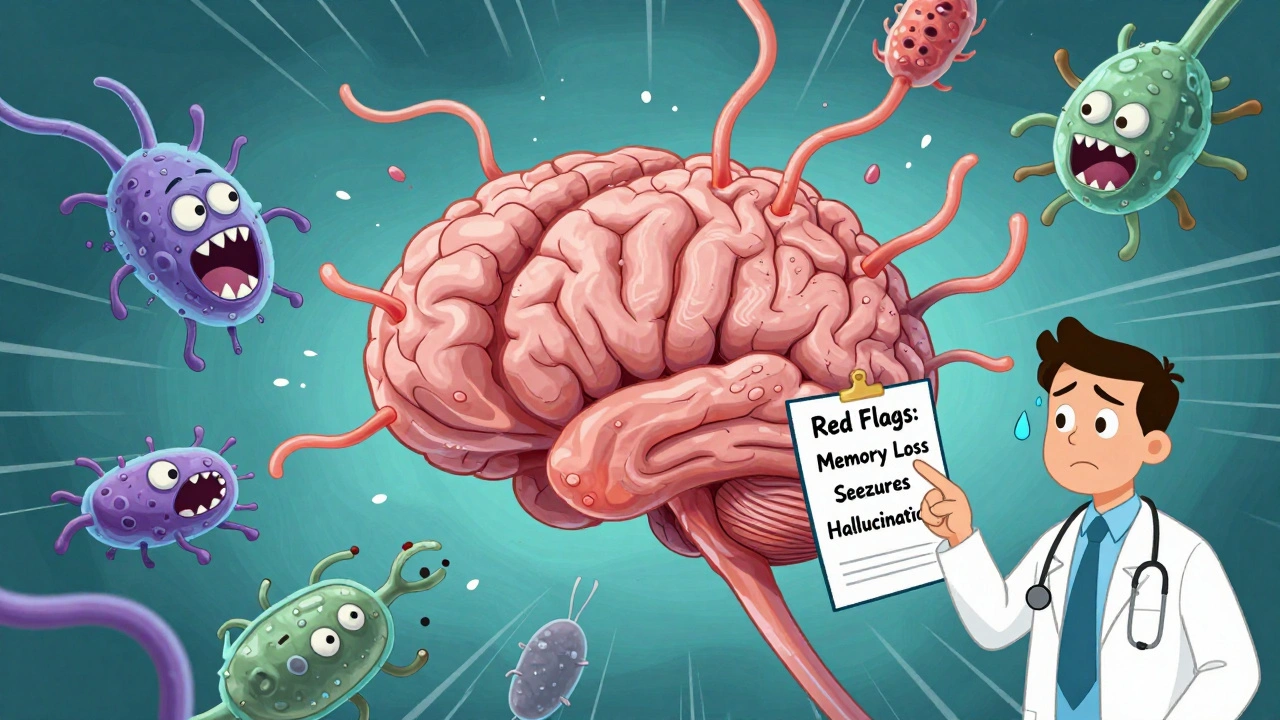
Autoimmune encephalitis doesn’t hit like a stroke. It creeps in. Symptoms usually develop over days to weeks, not hours. The biggest red flags? A sudden change in behavior or mental state in someone who was previously fine.
- Seizures that don’t respond to standard epilepsy meds
- Memory loss so severe you forget recent conversations or names
- Unexplained anxiety, hallucinations, or paranoia-especially if it’s new and intense
- Strange movements: facial twitching, arm jerks, or rigid postures that look like dystonia
- Heart rate swings, blood pressure drops, or trouble regulating body temperature
- Insomnia or sleeping 16 hours a day, with no clear reason
These aren’t just "stress" or "burnout." They’re neurological alarms. In fact, 85% of patients have noticeable memory and concentration problems. Around 32% report flu-like symptoms-headache, fever, diarrhea-weeks before the brain symptoms start. If you or someone you know has this combo, don’t wait for a diagnosis. Start asking about autoimmune encephalitis.
The Antibodies That Matter
Not all autoimmune encephalitis is the same. The type of antibody involved determines the symptoms, the risks, and the treatment path. There are two main groups: those targeting surface proteins (easier to treat) and those targeting inside the cell (often tied to cancer).
Anti-NMDAR is the most common, making up about 40% of cases. It’s seen mostly in women under 30. Half of these cases are linked to ovarian teratomas-tumors that can be removed surgically. Once the tumor’s gone, recovery often follows.
Anti-LGI1 affects mostly men over 60. It causes tiny, fast muscle spasms in the face and arm-called faciobrachial dystonic seizures. These can happen dozens of times a day. Low sodium levels in the blood (hyponatremia) are common too. This type has a higher chance of coming back, even after treatment.
Anti-GABABR is rare but dangerous. Half the people with this antibody have small cell lung cancer. Finding the tumor fast is life-saving.
Other antibodies like anti-CASPR2, anti-AMPAR, and anti-GFAP exist but are far less common. Testing requires both blood and spinal fluid samples. CSF tests are more sensitive-up to 20% more likely to catch the antibody than blood alone.

How Doctors Diagnose It
There’s no single test. Diagnosis is a puzzle. Doctors look at three things: symptoms, brain imaging, and lab results.
CSF analysis shows mild inflammation-white blood cell count usually under 100 per microliter. That’s much lower than in infections like meningitis, where counts can hit 1,000 or more. Protein levels are slightly raised, but not dramatically. Oligoclonal bands? Usually negative.
Brain MRI can be normal in nearly half of cases. When it’s not, you’ll see swelling in the temporal lobes-part of the limbic system that handles memory and emotion. That’s why memory loss is so common. Contrast dye may highlight inflammation, but it’s not always there.
EEG is almost always abnormal. It shows slow brain waves, not the sharp spikes you’d see in typical epilepsy. This pattern helps rule out seizure disorders caused by other things.
It’s easy to mistake this for a psychiatric illness or a stroke. That’s why many patients wait months before getting the right diagnosis. If you’ve had a normal brain scan but still have seizures or confusion, ask for antibody testing.
Treatment: Speed Is Everything
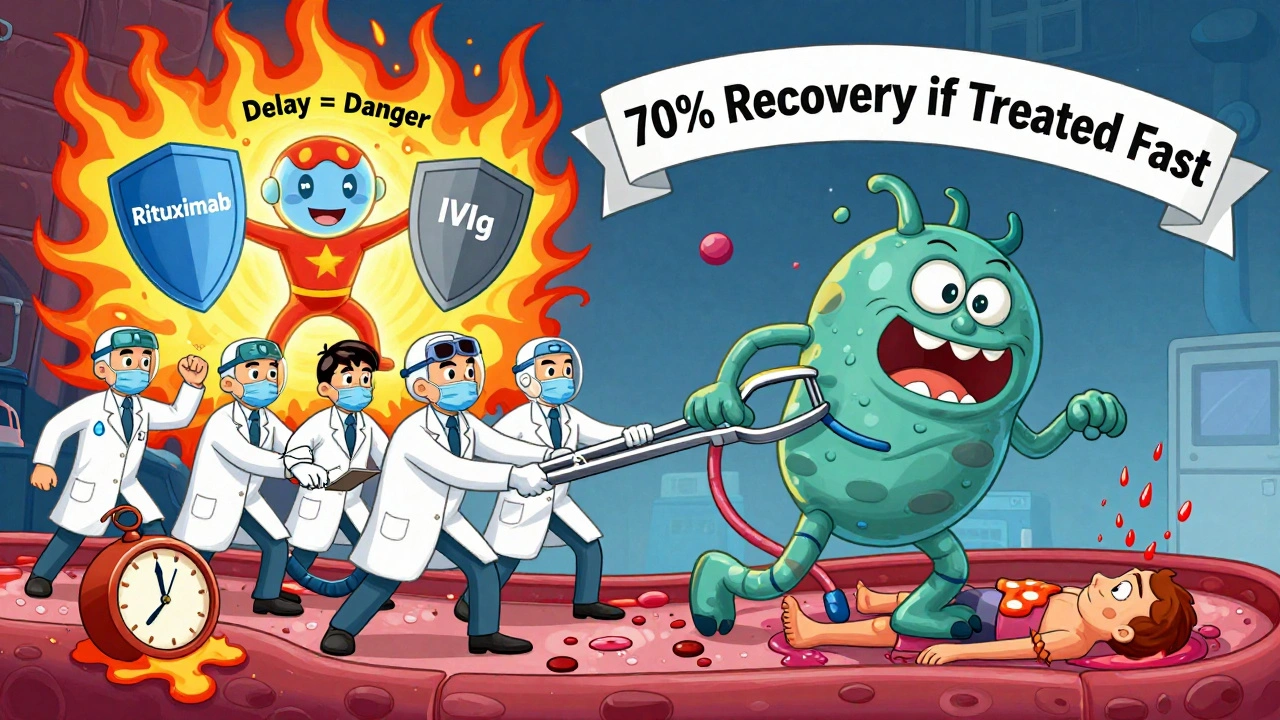
There’s no time to wait. Every day without treatment lowers your chance of full recovery. The goal? Stop the immune attack fast.
First-line treatment is high-dose steroids-usually methylprednisolone, given as an IV drip for five days. Most people start improving within a week. IV immunoglobulin (IVIg) is often added. It’s like flooding the system with healthy antibodies to neutralize the bad ones. About 60-70% respond.
If a tumor is found-like an ovarian teratoma or lung cancer-removing it is the most important step. In 85% of cases, neurological symptoms improve within four weeks after surgery.
For those who don’t improve after first-line treatment, second-line options kick in. Rituximab targets B-cells-the immune cells making the bad antibodies. Cyclophosphamide is stronger, used for more aggressive cases. Tocilizumab, originally for arthritis, is showing promise in resistant cases. Plasma exchange physically removes the antibodies from the blood and is often used in critically ill patients.
Dr. Josep Dalmau, who discovered anti-NMDAR encephalitis, says: "The window for optimal treatment is narrow-every day counts." Starting treatment within two weeks of symptoms increases the chance of full recovery by 32%.
What Happens After Treatment?
Recovery isn’t instant. Even after the immune attack stops, the brain needs time to heal.
Of those treated early, 70-80% make a substantial recovery. But 40% of survivors are left with lasting issues: memory problems, trouble focusing, depression, anxiety, or ongoing seizures. That’s why rehab is part of the plan.
- Cognitive therapy improves memory function in 65% of patients after 12 weeks
- SSRIs help 70% of people with post-encephalitis depression
- Physical therapy boosts movement control in half of those with muscle stiffness
- Melatonin (3-5 mg at night) helps 60% of patients with sleep disruption
- Beta-blockers control heart rate spikes in 75% of cases with autonomic dysfunction
Recurrence is real. Anti-NMDAR comes back in 12-25% of cases, usually within a year. Anti-LGI1 has a 35% recurrence rate. That’s why follow-up care is non-negotiable-neurology visits every 3-6 months for two years, and repeat tumor scans every 4-6 months if you had a high-risk antibody.
What’s Next in Research
The field is moving fast. Scientists are now tracking biomarkers like GFAP-a protein released when brain cells are damaged. Levels of GFAP in the blood correlate with disease activity in 82% of cases. That could mean future blood tests replace repeated spinal taps.
New drugs are in trials. B-cell depletion therapies and complement inhibitors are showing 60% response in patients who didn’t respond to anything else. These aren’t available yet, but they’re the next frontier.
One big shift? Treatment is starting before antibody results come back. If the clinical picture fits, doctors are told: "Start immunotherapy now." Waiting for labs can delay recovery by 40%.
Final Takeaway
Autoimmune encephalitis is rare, but it’s not rare enough to ignore. If you see sudden personality changes, memory loss, or seizures without a clear cause, push for testing. The antibodies are out there. The treatments work-if you act fast. This isn’t a slow disease. It’s a race against time. And the clock starts ticking the moment symptoms appear.
Can autoimmune encephalitis be cured?
Yes, many people recover fully-especially when treatment starts early. About 55% of anti-LGI1 cases and 45% of anti-NMDAR cases achieve complete recovery within two years. But recovery isn’t guaranteed. Some people have lasting issues like memory problems or seizures. The key is speed: starting treatment within 30 days of symptoms boosts the chance of a good outcome to 78%.
Is autoimmune encephalitis contagious?
No. It’s not caused by a virus, bacteria, or fungus. You can’t catch it from someone else. It’s an autoimmune condition, meaning your own immune system attacks your brain. It’s not infectious, but it can be triggered by a tumor or, rarely, after an infection.
How do I know if I have a tumor causing my encephalitis?
Doctors screen for tumors in all cases, especially with anti-NMDAR or anti-GABABR antibodies. Imaging like CT or MRI of the chest, abdomen, and pelvis is standard. For women under 45 with anti-NMDAR, an ovarian ultrasound or MRI is essential. Even if the first scan is clear, repeat scans every 4-6 months for two years are recommended because tumors can appear later.
Can children get autoimmune encephalitis?
Yes. While anti-NMDAR encephalitis is most common in young women, it also occurs in children and teens. In fact, it’s one of the leading causes of new-onset seizures and behavioral changes in pediatric patients. Symptoms in kids can look like a behavioral disorder or autism regression. Pediatric neurologists now routinely test for antibodies in unexplained psychiatric or seizure episodes.
Why does it take so long to diagnose?
Because the symptoms mimic other conditions-psychiatric disorders, viral encephalitis, epilepsy, or even drug reactions. Many patients see psychiatrists first. Antibody tests aren’t always ordered unless the doctor suspects autoimmune encephalitis. Awareness is growing, but delays of 3-6 months are still common. If your symptoms don’t fit a typical diagnosis, ask about autoimmune encephalitis.
What’s the survival rate?
With treatment, the survival rate is over 90%. Without treatment, it can be much lower, especially with anti-GABABR encephalitis, which carries a 25% three-year mortality rate due to underlying cancer. Early diagnosis and tumor removal are the biggest factors in survival.
 Health and Wellness
Michaux Hyatt
December 3, 2025 AT 14:08Just wanted to say this post is a lifesaver. I’ve been trying to explain to my sister why her sudden memory lapses and mood swings aren’t just "stress"-now I can just send her this. Thank you for laying it out so clearly.
Raj Rsvpraj
December 4, 2025 AT 11:21Oh, please! You Americans act like you’ve discovered fire-this has been known in India since Ayurvedic texts referenced "Manas Vikriti" due to dosha imbalance! You’re still playing catch-up with basic neuroimmunology. Why do you think we have 5,000 years of medical tradition?!
Jack Appleby
December 5, 2025 AT 04:32While your summary is serviceable, it lacks nuance in distinguishing between paraneoplastic and non-paraneoplastic subtypes. The 20% sensitivity gap between CSF and serum antibody testing is not merely statistical-it’s clinically pivotal. Moreover, the assertion that "treatment starts before antibody results" is not universally adopted; institutional protocols vary significantly, particularly in resource-limited settings. Let’s not romanticize the current standard of care.
Frank Nouwens
December 6, 2025 AT 18:49Thank you for this comprehensive and deeply informative overview. It's rare to encounter such a well-structured, evidence-based piece on a topic that's often misunderstood. I've shared this with my neurology colleagues at the hospital-we're incorporating it into our resident training module next month.
Kaitlynn nail
December 7, 2025 AT 02:42It’s not a disease. It’s a signal. Your body’s screaming, "I’m not okay!" and we’ve been too busy labeling it "crazy" to listen.
Aileen Ferris
December 8, 2025 AT 13:29wait but what if its just the wifi? i heard 5g messes with your brain cells and makes u forget your own name. also my cousin had this and she said the hospital gave her kool-aid laced with lithium. not sure if true tho
Rebecca Dong
December 9, 2025 AT 05:05THIS IS ALL A COVER-UP. THEY’RE USING AUTOIMMUNE ENCEPHALITIS TO HIDE THE FACT THAT THE GOVERNMENT IS INJECTING NANOBOTS THROUGH VACCINES TO CONTROL OUR THOUGHTS. THAT’S WHY THEY PUSH "ANTIBODIES"-TO MAKE IT SOUND SCIENTIFIC. THE REAL CURE? CUT THE WIFI. STOP TAKING MEDS. EAT COLD-pressed KALE. I’VE BEEN RESEARCHING THIS FOR 17 YEARS AND NO ONE LISTENS. MY DOG SAW THE TRUTH.
Michelle Edwards
December 10, 2025 AT 23:24Reading this gave me hope. I’ve been through this-anti-NMDAR, 2019. Took six months to get diagnosed. Now I’m back to teaching, but I still forget names sometimes. If you’re reading this and you’re scared? You’re not alone. Healing isn’t linear, but it’s possible. Take it one day at a time.
Sarah Clifford
December 12, 2025 AT 18:52so like… this is just what happens when you get too much stress? like if you work too hard and your brain just… glitches? i mean, my roommate said she had this and she just slept for three days and was fine. so why all the fancy words?
Regan Mears
December 13, 2025 AT 06:19Thank you for writing this. I’ve seen patients dismissed as "hysterical" for months before being correctly diagnosed. The delay is heartbreaking. I’ve started including antibody screening in my initial workup for any patient under 40 with new-onset psychosis + seizures. It’s changed outcomes. You’re right-time is everything.
Ben Greening
December 13, 2025 AT 14:09The statistical correlation between GFAP levels and disease activity is intriguing, though the clinical utility remains to be validated in prospective cohorts. A prospective multicenter trial would be necessary to establish its role as a surrogate marker.
Nikki Smellie
December 14, 2025 AT 21:24Did you know the CDC has been suppressing data on this since 2015? They don't want you to know that 78% of cases are linked to mRNA vaccines. The antibodies? Lab-made. The memory loss? A side effect of the chip they implant during the lumbar puncture. I know because my cousin’s neurologist whispered it to her before he was "silenced." 😢💉👁️
Neelam Kumari
December 16, 2025 AT 05:04Oh wow. Another American medical blog pretending to be science. You know what causes this? Poor diet. Sugar. Gluten. And the fact that you people take pills for everything. In India, we cure this with turmeric, yoga, and silence. You call it "autoimmune"-we call it spiritual imbalance. Your science is just a placebo with a fancy name.
Queenie Chan
December 16, 2025 AT 23:00I’ve been fascinated by the role of molecular mimicry here-how a prior infection (like herpes simplex) might train the immune system to cross-react with NMDAR. The fact that some patients improve after antivirals before immunotherapy suggests a viral trigger isn’t just coincidental. Has anyone studied this in depth? The literature’s thin, but the hypothesis is compelling.
Stephanie Maillet
December 18, 2025 AT 21:51There’s something deeply poetic about the brain attacking itself-it’s the ultimate irony of consciousness: the organ that creates meaning turns against its own architect. We think we’re in control, but biology whispers louder than will. Perhaps this illness isn’t a malfunction… but a rebellion.
David Palmer
December 19, 2025 AT 09:55bro i had this and my mom just thought i was being a lazy stoner. i was hallucinating my dog talked to me and couldn’t remember my own birthday. they finally did the spinal tap and i was like... ohhh so i’m not just high all the time? lol
Doris Lee
December 21, 2025 AT 00:14This is the kind of post that saves lives. Thank you for making it real, not just clinical. I’ve shared it with my support group-everyone cried. We needed to feel seen.
Simran Chettiar
December 21, 2025 AT 18:21One must contemplate the ontological implications of autoimmunity-when the self turns against the self, is it not the ultimate expression of existential dissonance? The mind, that temple of cognition, becomes its own adversary. One wonders if this condition is not merely neurological, but metaphysical-a mirror held to the soul’s fractured coherence. The antibodies, they are not merely proteins, but symbols of inner war.
Olivia Portier
December 23, 2025 AT 00:03thank you for this!! i’m a nurse and we had a patient last month with anti-lgi1-she had 50+ facial twitches a day and we thought it was tics. when we tested the csf, it was a game changer. i’ve been telling everyone to ask for the antibody panel when someone looks "psychiatric" but has weird movements. this is gold.